

التداول
اكتشف مجموعة متنوعة من الأسواق العالمية مع تسعير تنافسي، سيولة عالية، وأدوات تداول متقدمة تدعم قراراتك الاستثمارية.
اكتشف المزيد 
منصات التداول
تداول بسلاسة مع منصة TMGM القوية، المصممة للسرعة والدقة وتجربة تداول فائقة.
اكتشف المزيد منصات التداول
الأكاديمية
تعلّم أساسيات التداول من خلال محتوى تعليمي مُبسط ومصمم للمبتدئين، يشمل أدلة تعليمية،ندوات مباشرة عبر الإنترنت، وتحليلات لأهم تحركات السوق.
اكتشف المزيد أكاديمية TMGM
الأخبار والتحليلات
تابع أحدث تطورات الأسواق لحظة بلحظة، مع تحليلات احترافية تساعدك على اتخاذ قرارات مدروسة والاستفادة من فرص التداول.
اكتشف المزيد الأخبار والتحليلات
معلومات عنا
تعرّف على ما يميز TMGM، من حضور عالمي قوي وإشراف تنظيمي موثوق، إلى التزامنا المستمر بالابتكار وتطوير بيئة تداول متقدمة.
اكتشف المزيد لماذا TMGM؟
Silver Price Forecast: XAG/USD rebounds over 3%, but bears retain control
- Silver gains as bargain hunters step in following last week's sell-off.
- The US Dollar climbs to a fresh 19-month high as traders anticipate further Fed tightening.
- Technical indicators remain bearish, with the ADX pointing to a strong downtrend.
Silver (XAG/USD) opens the week on a bullish note, gaining over 3% as buyers return following last week’s 16% slump that pushed the metal to its lowest level since September 2025. However, the metal is struggling to extend its gains as a hawkish Federal Reserve (Fed) outlook and the resulting strength in the US Dollar (USD) cap upside. At the time of writing, XAG/USD trades around $42.48.

The US Dollar Index (DXY), which tracks the Greenback against a basket of six major currencies, climbs above 104.00 to a fresh 19-month high after dipping to 103.59 earlier in the day.
Traders widely expect the Fed to raise rates by a quarter point in December and see scope for further hikes in January and March, according to the CME FedWatch Tool. Bets on a half-point move in December have faded following last week’s equity rout. Over the weekend, US Treasury Secretary Scott Bessent also warned that the Fed risks overtightening, citing a substantial tightening in financial conditions in recent months.
A stronger US Dollar makes Silver more expensive for buyers using other currencies, while higher interest rates raise the opportunity cost of holding the non-yielding metal. Traders now turn to Wednesday’s US Personal Consumption Expenditures (PCE) Price Index, the Fed’s preferred inflation gauge. A surprise in either direction could shift rate hike bets and trigger a sharp move in Silver.
Technical analysis
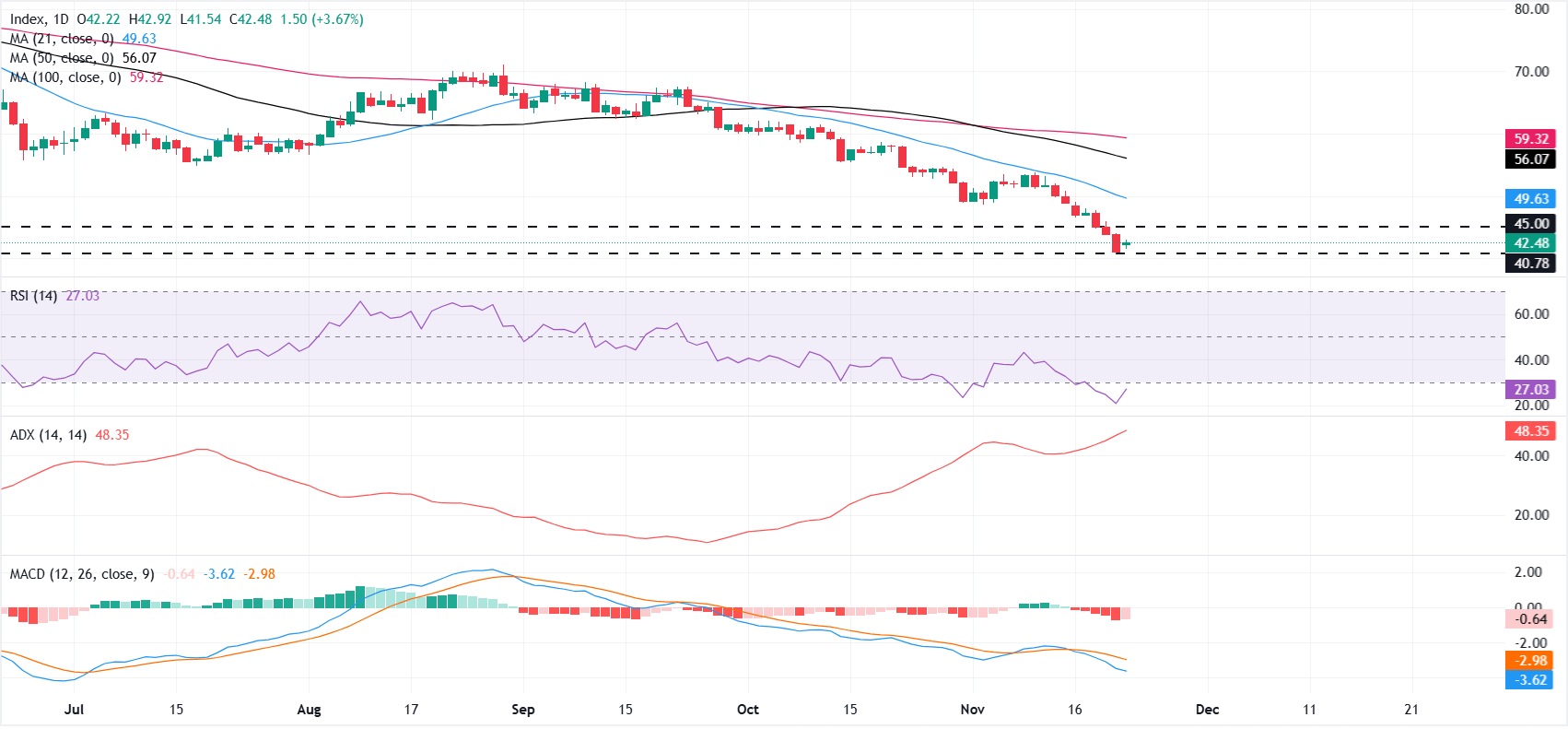
On the daily chart, XAG/USD trades with a clear bearish bias, holding well below the 21-day, 50-day, and 100-day Simple Moving Averages (SMAs) clustered between roughly $49.50 and $59.30, which collectively cap the upside.
The Relative Strength Index (RSI) sits in oversold territory near 27, while the Average Directional Index (ADX) near 48 signals a strong downtrend, and the negative Moving Average Convergence Divergence (MACD) reading reinforces persistent bearish momentum despite the extended decline.
On the topside, initial resistance is seen at the horizontal barrier around $45, ahead of the 21-day SMA near $49.63, with the 50-day SMA at $56 and the 100-day SMA at $59.32 marking deeper recovery hurdles. On the downside, immediate support emerges at Friday's low at $40.78, and a clear break beneath this level would expose the metal to further downside in line with the prevailing downtrend.
(The technical analysis of this story was written with the help of an AI tool. Know more.)
Silver FAQs
Silver is a precious metal highly traded among investors. It has been historically used as a store of value and a medium of exchange. Although less popular than Gold, traders may turn to Silver to diversify their investment portfolio, for its intrinsic value or as a potential hedge during high-inflation periods. Investors can buy physical Silver, in coins or in bars, or trade it through vehicles such as Exchange Traded Funds, which track its price on international markets.
Silver prices can move due to a wide range of factors. Geopolitical instability or fears of a deep recession can make Silver price escalate due to its safe-haven status, although to a lesser extent than Gold's. As a yieldless asset, Silver tends to rise with lower interest rates. Its moves also depend on how the US Dollar (USD) behaves as the asset is priced in dollars (XAG/USD). A strong Dollar tends to keep the price of Silver at bay, whereas a weaker Dollar is likely to propel prices up. Other factors such as investment demand, mining supply – Silver is much more abundant than Gold – and recycling rates can also affect prices.
Silver is widely used in industry, particularly in sectors such as electronics or solar energy, as it has one of the highest electric conductivity of all metals – more than Copper and Gold. A surge in demand can increase prices, while a decline tends to lower them. Dynamics in the US, Chinese and Indian economies can also contribute to price swings: for the US and particularly China, their big industrial sectors use Silver in various processes; in India, consumers’ demand for the precious metal for jewellery also plays a key role in setting prices.
Silver prices tend to follow Gold's moves. When Gold prices rise, Silver typically follows suit, as their status as safe-haven assets is similar. The Gold/Silver ratio, which shows the number of ounces of Silver needed to equal the value of one ounce of Gold, may help to determine the relative valuation between both metals. Some investors may consider a high ratio as an indicator that Silver is undervalued, or Gold is overvalued. On the contrary, a low ratio might suggest that Gold is undervalued relative to Silver.
المقالات الشائعة
1الفرنك السويسري: توقعات بالتداول ضمن نطاق مقابل الدولار الأمريكي – UOB2الدولار الكندي يقبع عند أدنى مستوياته في 19 شهرًا مع محو الدولار الأمريكي خسائره3الزلوتي البولندي: مخاطر الانتخابات تحدّ من مكاسبه – كومرتس بنك4توقعات سعر Ripple: يتحرك XRP في نطاق عرضي وسط تدفقات رأسمالية خارجة من المستثمرين الأفراد والمؤسسات5الجنيه الإسترليني: مسار بنك إنجلترا يحدّ من مخاطر الهبوط – BBH6الفرنك السويسري يرتفع مع استمرار حذر المستثمرين بعد موجة هبوط حاد في الأسهم7اليورو: ضغوط بفعل المخاطر السياسية وإعادة تسعير توقعات سياسة البنك المركزي الأوروبي – رابوبنك8الدولار الأمريكي: آفاق قوية حتى عام 2027 – HSBC9مؤشر الدولار الأمريكي (DXY) يرتد صعودًا مع صدور بيانات مخيبة للآمال لنشاط الأعمال في منطقة اليورو والمملكة المتحدة

ابدأ الآن!
سجّل وابدأ التداول في الأسواق العالمية خلال أقل من 3 دقائق

تواصل معنا









جهات الاتصال
الهاتف +61 2 8036 8388
الفاكس +61 2 8036 8388
البريد الإلكتروني support@tmgm.com
الموقع الإلكتروني https://www.tmgmasia.com



المعلومات المقدمة على هذا الموقع الإلكتروني ذات طبيعة عامة فقط ولا تشكل نصيحة مالية شخصية. قبل اتخاذ أي إجراء بناءً على أي معلومات واردة في هذا الموقع الإلكتروني، ينبغي عليك النظر في مدى ملاءمة هذه المعلومات لأهدافك ووضعك المالي واحتياجاتك. ينطوي الاستثمار في عقود الفروقات وعقود الهامش على الفوركس على مخاطر كبيرة، وهو غير مناسب لجميع المستثمرين. قد تخسر أكثر من إيداعك الأولي. أنت لا تملك الأصل الأساسي، ولا لديك أي مصلحة فيه. نوصي بأن تطلب مشورة مستقلة وأن تتأكد من أنك تفهم تمامًا المخاطر التي تنطوي عليها قبل التداول. من المهم أن تقرأ وثيقة الإفصاح وتدرسها قبل الحصول على أي منتج مدرج على الموقع الإلكتروني. إن المعلومات والإعلانات المعروضة على هذا الموقع الإلكتروني غير مخصصة للاستخدام من قبل أي شخص في أي بلد أو ولاية قضائية يكون فيها هذا الاستخدام مخالفًا للقوانين واللوائح المحلية. المنتجات والخدمات المعروضة على هذا الموقع الإلكتروني غير مخصصة للمقيمين في الولايات المتحدة وماليزيا وتايلاند.
TMGM مرخصة ومنظمة في ولايات قضائية مختلفة.
شركة Trademax Australia Limited، التي تتداول باسم TMGM، منظمة من قبل لجنة الأوراق المالية والاستثمارات الأسترالية (ASIC)، رقم AFSL 436416 وتقع في المستوى 28، برج دولي واحد، 100 شارع بارانجارو، 2000 سيدني، نيو ساوث ويلز أستراليا.
البريد الإلكتروني: support@tmgm.com.au
شركة Trademax Global Limited، التي تتداول باسم TMGM، مرخصة ومنظمة من قبل لجنة الخدمات المالية في فانواتو (VFSC)، رقم التسجيل 40356 ومسجلة في 1276، طريق كومول السريع، بورت فيلا، فانواتو، جمهورية فانواتو.
البريد الإلكتروني: support@tmgm.com
شركة Trademax Global Markets (SE) Limited، المعروفة باسم TMGM، مرخصة ومنظمة من قبل هيئة الخدمات المالية (FSA) في سيشيل، برقم الترخيص SD224. الشركة مسجلة في المكتب رقم 13، مركز ABIS العقاري، ماهي، سيشيل.
البريد الإلكتروني: support@tmgm.com
شركة Trademax Global Markets (International) Pty Ltd، التي تتداول باسم TMGM، مرخصة ومنظمة من قبل لجنة الخدمات المالية، موريشيوس (FSC) برقم الترخيص GB22201012، ومسجلة في 33، شارع إديث كافيل c/o IQ EQ Fund Services (Mauritius) Ltd بورت لويس، 11324 موريشيوس.
البريد الإلكتروني: support@tmgm.com
حقوق الطبع والنشر © TMGM. جميع الحقوق محفوظة