

ADP Employment Report is expected to show a moderate increase in private payrolls in August
- The US ADP Employment Change report is expected to show that net private employment increased by 47K in August.
- A weak ADP reading might cast doubt about Friday’s NFP report and dampen hopes of a Fed rate hike in September.
- The US Dollar picks up but remains relatively close to three-month lows.
The Automatic Data Processing (ADP) Research Institute will release its monthly report on private-sector job creation for August next Wednesday. The ADP Employment Change report is expected to show that the United States (US) private sector added 47K new positions this month, little changed from the 44K new jobs reported in July.

The ADP report precedes the all-important Nonfarm Payrolls (NFP) report, which will be released by the US Bureau of Labor Statistics on Friday. The ADP is hardly an advanced indicator of NFP trends; however, it holds significant relevance as it tends to set the tone for the official employment report, which is a cornerstone for the Federal Reserve’s (Fed) monetary policy. In that sense, a surprise in ADP data often triggers significant US Dollar (USD) volatility.
ADP jobs report, likely to shed some light on the Fed’s monetary policy
August’s ADP report comes out at a moment when the Federal Reserve’s policy is gathering increasing attention, as Chairman Kevin Warsh strives to deal with US President Donald Trump’s pressure to cut interest rates, persistent inflation concerns pulling in the opposite direction, and a split Federal Open Market Committee (FOMC).
Beyond that, the US Treasury Secretary, Scott Bessent, announced a plan to double buybacks of long-term government Bonds, another sign that the US government wants to avoid a more restrictive monetary policy by all means.
Commerzbank analysts expect political resistance to monetary tightening to increase heading into September’s Fed meeting: “The impression created by these actions (Treasury buyback plans) is that the US fiscal authorities are keen to contain upward pressure on yields, albeit through unconventional measures rather than through greater fiscal discipline that might convince markets to demand lower risk premia.”
The experts caution that “this is a development that the Federal Reserve cannot ignore,” since “Fed rate hikes would make it more difficult for the Treasury's efforts to cap yields,” reinforcing the case for policy restraint even as inflation remains elevated.
Bearing this in mind, a 47K increase in ADP employment is far from the reading needed to assure a Federal Reserve rate hike in September. July’s 44K figure marked the weakest job creation since January and, unless the final reading beats the market consensus by a wide margin, August data will not show any significant improvement in job creation, let alone a miss.
When will the ADP report be released, and how could it affect the USD?
The US ADP Employment Change report will be out on Wednesday at 12:15 GMT, and is expected to show that private-sector employment increased by 47K in August. The reading comes with the US Dollar struggling to extend its recovery from mid-August lows.
Investors' aversion to risk amid growing tensions in the Middle East and higher global yields, together with Fed Chair Warsh’s hawkish comments at the Jackson Hole meeting, are supporting the Greenback, but concerns about the ballooning US government debt and the US Treasury’s buyback plan continue to act as headwinds.
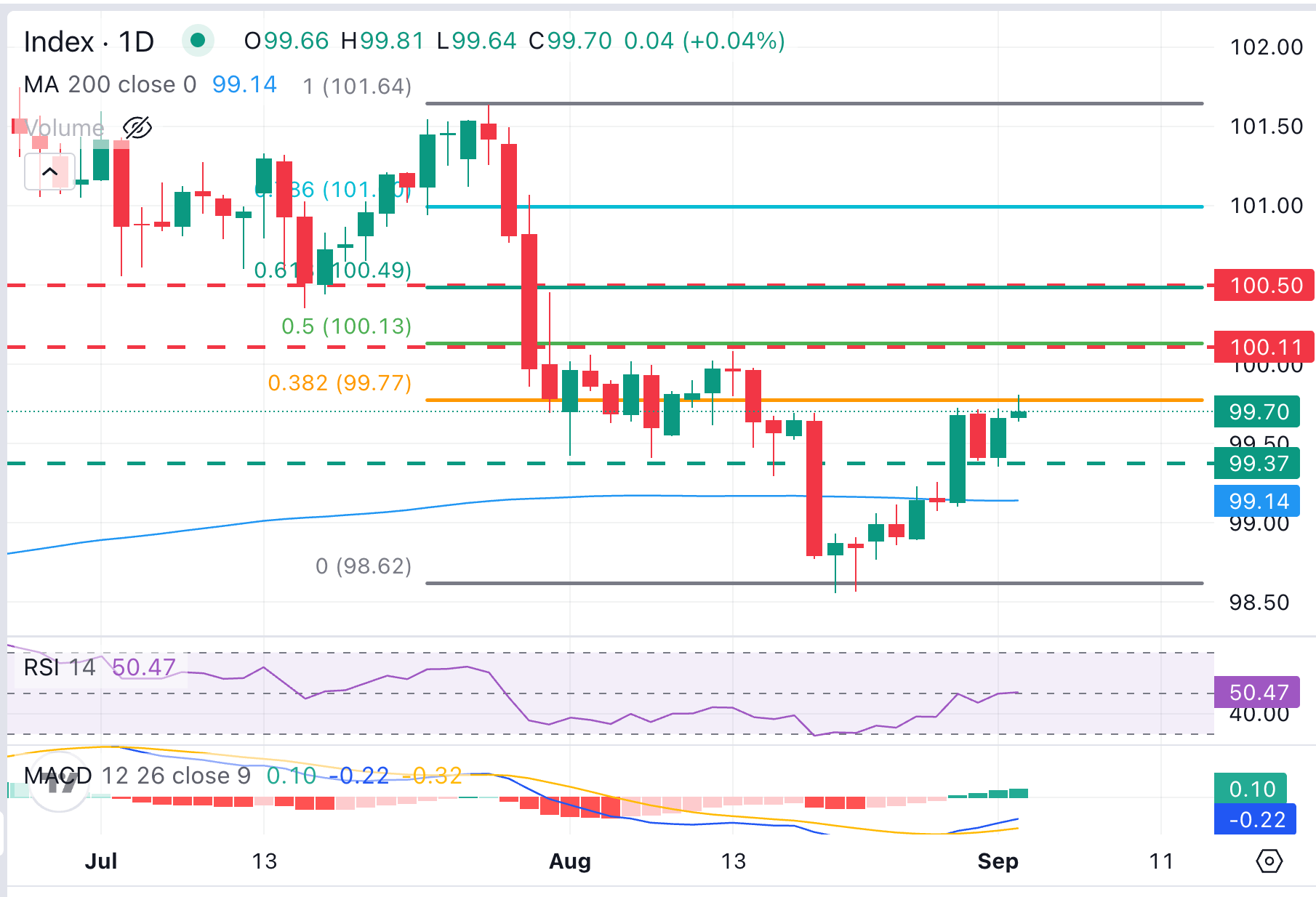
Guillermo Alcalá, Analyst at FXStreet, observes the US Dollar Index (DXY), which tracks the Greenback’s value against a basket of six major currencies, is “picking up from lows near 98.50, but likely to meet relevant resistance at the 100.00 psychological area, which capped rallies several times in August.” “Momentum indicators on the daily chart are turning positive, and price action crossed above the 200-day Simple Moving Average (SMA), at 99.14 last week, which is a bullish sign,” says Alcalá.
“The index, however, is not out of the woods, after dropping nearly 3% in the first two weeks of August. Bulls would need strong employment figures this week, ideally combined with hot CPI data next week to convince Fed policymakers that conditions are set for some monetary policy tightening. This scenario would push the DXY beyond the 38.6% Fibonacci retracement, at 99.76, which is capping rallies this week and probably also above the mentioned 100.00 level,” according to Alcalá
Employment FAQs
Labor market conditions are a key element to assess the health of an economy and thus a key driver for currency valuation. High employment, or low unemployment, has positive implications for consumer spending and thus economic growth, boosting the value of the local currency. Moreover, a very tight labor market – a situation in which there is a shortage of workers to fill open positions – can also have implications on inflation levels and thus monetary policy as low labor supply and high demand leads to higher wages.
The pace at which salaries are growing in an economy is key for policymakers. High wage growth means that households have more money to spend, usually leading to price increases in consumer goods. In contrast to more volatile sources of inflation such as energy prices, wage growth is seen as a key component of underlying and persisting inflation as salary increases are unlikely to be undone. Central banks around the world pay close attention to wage growth data when deciding on monetary policy.
The weight that each central bank assigns to labor market conditions depends on its objectives. Some central banks explicitly have mandates related to the labor market beyond controlling inflation levels. The US Federal Reserve (Fed), for example, has the dual mandate of promoting maximum employment and stable prices. Meanwhile, the European Central Bank’s (ECB) sole mandate is to keep inflation under control. Still, and despite whatever mandates they have, labor market conditions are an important factor for policymakers given its significance as a gauge of the health of the economy and their direct relationship to inflation.
Economic Indicator
Nonfarm Payrolls
The Nonfarm Payrolls release presents the number of new jobs created in the US during the previous month in all non-agricultural businesses; it is released by the US Bureau of Labor Statistics (BLS). The monthly changes in payrolls can be extremely volatile. The number is also subject to strong reviews, which can also trigger volatility in the Forex board. Generally speaking, a high reading is seen as bullish for the US Dollar (USD), while a low reading is seen as bearish, although previous months' reviews and the Unemployment Rate are as relevant as the headline figure. The market's reaction, therefore, depends on how the market assesses all the data contained in the BLS report as a whole.
Read more.Next release: Fri Sep 04, 2026 12:30
Frequency: Monthly
Consensus: 58K
Previous: -23K
Source: US Bureau of Labor Statistics
America’s monthly jobs report is considered the most important economic indicator for forex traders. Released on the first Friday following the reported month, the change in the number of positions is closely correlated with the overall performance of the economy and is monitored by policymakers. Full employment is one of the Federal Reserve’s mandates and it considers developments in the labor market when setting its policies, thus impacting currencies. Despite several leading indicators shaping estimates, Nonfarm Payrolls tend to surprise markets and trigger substantial volatility. Actual figures beating the consensus tend to be USD bullish.










