




Gold price shines above $4,400 as inflation dip fuels Fed relief
- Gold rallies above $4,400 as softer CPI eases Fed pressure.
- Fed hold bets rise for September after cooler inflation print.
- Hormuz closure risk keeps energy-driven inflation concerns alive.
Gold price (XAU/USD) registers gains of over 1% on Wednesday as US inflation data aligns with estimates, easing the Federal Reserve’s (Fed) task of further tightening monetary policy. The Consumer Price Index (CPI) continues its downward trajectory. The XAU/USD trades above $4,400 after bouncing off daily lows of $4,362.
XAU/USD rallies after US inflation cools, easing September hike fears

Bullion extended its gains as investors speculate that the Fed will not raise rates at its September meeting, following July’s report. On Tuesday, money markets priced in a 52% chance of a Fed rate hike at the next meeting. But the dip in inflation shifted the odds to 60% that the US central bank will keep rates steady, according to Prime Terminal data.
The Fed has a 73% chance of raising rates in December, with three inflation reports before the December 9 meeting.
July’s CPI came in at 3.5% YoY, down from 3.6%, while core CPI also edged lower from 2.6% to 2.5% YoY, as revealed by the US Bureau of Labour Statistics (BLS). Even though Oil prices rose nearly 24% in July, gasoline prices declined for the second straight month.
However, geopolitics continued to weigh on the economy, and if negotiations between the US and Iran failed to reach common ground to end the conflict, energy prices could jump again, threatening to halt the disinflation process in the US.
According to Al-Mayadeen, an Iranian political and security source said that the Strait of Hormuz remained closed and that Tehran hasn’t changed its policy.
US President Donald Trump posted on his Truth Social account that “The U.S.A. has total control over the Strait of Hormuz. I THINK WE WILL KEEP IT!” It's a belief that isn't backed up by the facts on the waterway. At the same time, CNN reported that US embassies in the Middle East would continue to work with reduced staff amid the Iran war.
On Thursday, traders' eyes will be on the release of the US Producer Price Index (PPI) for July and Initial Jobless Claims data. If the number of Americans filing for unemployment benefits rises, it could increase downside risks to the labour market, which could push the Unemployment Rate higher.
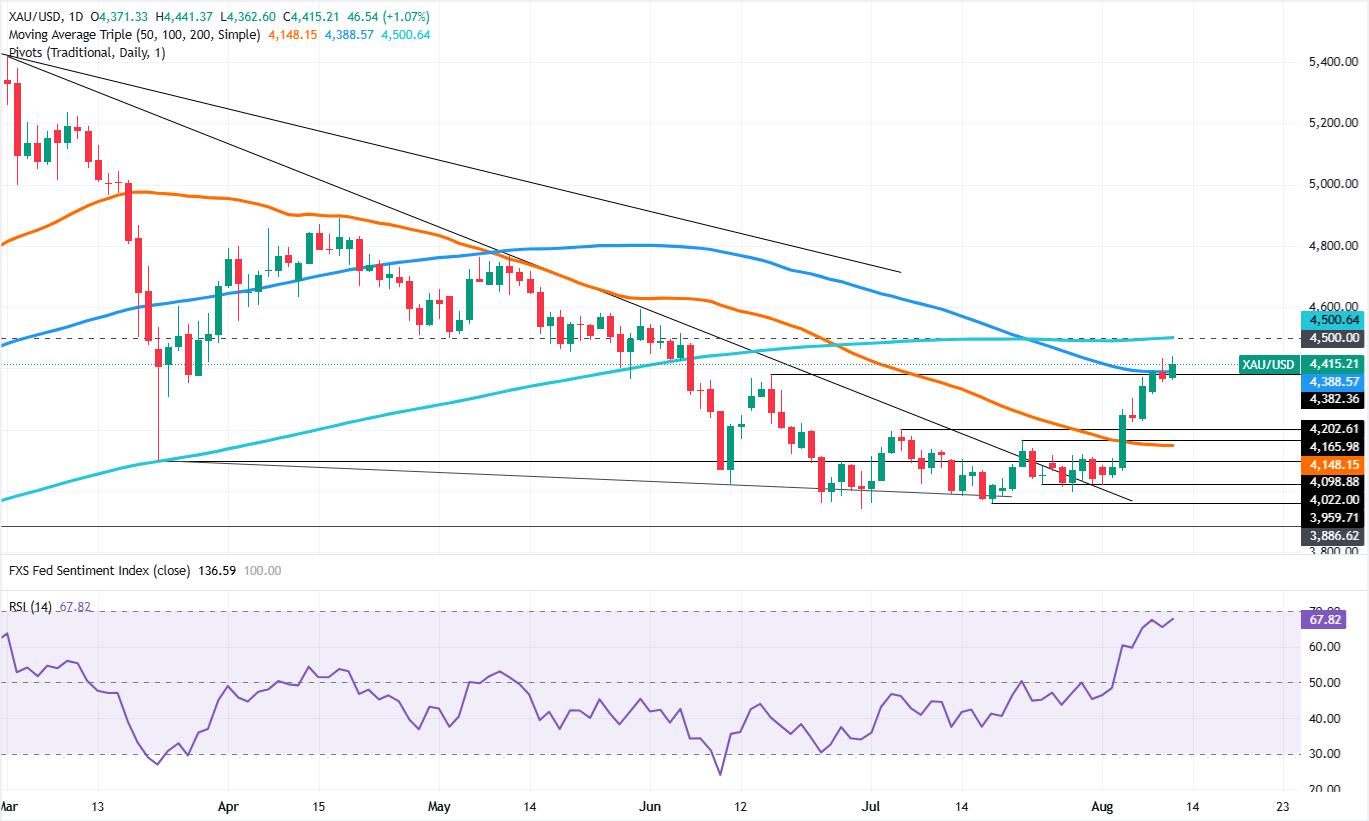
XAU/USD price forecast: Gold climbs back above $4,400, eyes on $4,500
Gold price seems to be gaining traction as it clears the 100-day Simple Moving Average (SMA) at $4,388, potentially opening the door to further upside. Momentum as measured by the Relative Strength Index (RSI) shows that buyers are gaining traction. Hence, the path of least resistance is upward in the short term.
XAU/USD's first resistance would be the $4,450 psychological level. A breach of it will expose the 200-day SMA exactly at the psychological $4,500 mark. A daily close above the latter could pave the way to challenge the $5,000 milestone.
On the flip side, if Gold falls below the low of the day (LOD) at $4,362, it opens the door to a deeper pullback. The next support is $4,300, followed by the July 6 high at $4,202. If this level fails, the next support levels are the 50-day SMA at $4,150 and $4,100.
Gold FAQs
Gold has played a key role in human’s history as it has been widely used as a store of value and medium of exchange. Currently, apart from its shine and usage for jewelry, the precious metal is widely seen as a safe-haven asset, meaning that it is considered a good investment during turbulent times. Gold is also widely seen as a hedge against inflation and against depreciating currencies as it doesn’t rely on any specific issuer or government.
Central banks are the biggest Gold holders. In their aim to support their currencies in turbulent times, central banks tend to diversify their reserves and buy Gold to improve the perceived strength of the economy and the currency. High Gold reserves can be a source of trust for a country’s solvency. Central banks added 1,136 tonnes of Gold worth around $70 billion to their reserves in 2022, according to data from the World Gold Council. This is the highest yearly purchase since records began. Central banks from emerging economies such as China, India and Turkey are quickly increasing their Gold reserves.
Gold has an inverse correlation with the US Dollar and US Treasuries, which are both major reserve and safe-haven assets. When the Dollar depreciates, Gold tends to rise, enabling investors and central banks to diversify their assets in turbulent times. Gold is also inversely correlated with risk assets. A rally in the stock market tends to weaken Gold price, while sell-offs in riskier markets tend to favor the precious metal.
The price can move due to a wide range of factors. Geopolitical instability or fears of a deep recession can quickly make Gold price escalate due to its safe-haven status. As a yield-less asset, Gold tends to rise with lower interest rates, while higher cost of money usually weighs down on the yellow metal. Still, most moves depend on how the US Dollar (USD) behaves as the asset is priced in dollars (XAU/USD). A strong Dollar tends to keep the price of Gold controlled, whereas a weaker Dollar is likely to push Gold prices up.










