
News & AnalysisCareer

Falling oil prices, driven by hopes of a United States (US)-Iran agreement, are weighing broadly on the US Dollar (USD) against its peers.
With WTI Oil touching a fresh 10-week low near $84.20, the US Dollar Index (DXY) remains near 101.67 during Tuesday’s European session, retaining the previous day’s losses. The index tracks the Greenback against six major currencies.

A softer tone from Washington over the weekend has lifted investor optimism, MUFG analysts wrote in a note. President Donald Trump told CNN that ordering further military strikes on Iran would be “highly unlikely” if negotiations continued to make progress.
MUFG nevertheless warned that US President Trump had made the outcome conditional on the quality of any agreement, saying “it depends on whether or not they sign a very strong agreement,”. The bank regards that qualification as critical to maintaining the recent decline in geopolitical risk premia.
As oil prices fall, currencies of net energy-exporting economies, including the US, lose some of their appeal.
October’s US Consumer Price Index (CPI) figures, due at 13:30 GMT, are the main domestic focus for investors.
Fed watches inflation spillovers as core CPI surprises moderate
This week’s US inflation release will be scrutinised by both investors and the Fed “closely for evidence of spillover effects from higher energy prices.”, according to MUFG/BTMU analysts. As they observe, “recent core CPI readings have surprised to the upside over the last couple of months,” with the resulting effect described as “putting pressure on the Fed to tighten policy.” The analysts nevertheless see signs that the near-term risk may be easing: “consensus expectations are looking for a softer core CPI print of 0.2%M/M in October,”. This leaves some room for inflation momentum to slow, even as policymakers continue to monitor the pass-through from energy costs.
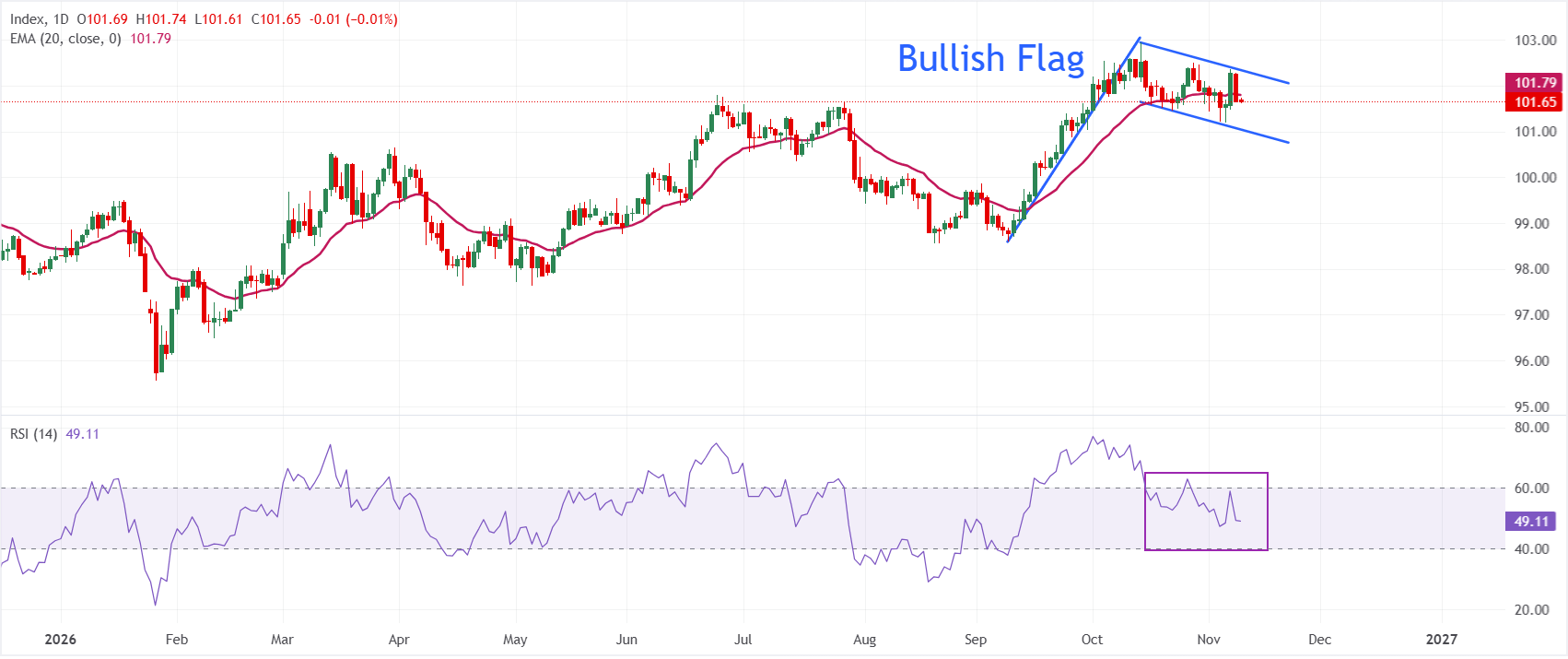
At 101.65 on the daily chart, Dollar Index Spot remains close to its 20-period exponential moving average (EMA) of 101.79, leaving the technical bias neutral.
A Relative Strength Index (RSI) reading near 49 also signals neutral momentum, offering little counterweight to the prevailing structural pressure.
A Bullish Flag formation suggests the neutral phase may be a pause before another upward move, consistent with the pattern’s historical behaviour.
The 20-EMA around 101.79 provides the first resistance level, ahead of the reclaimed trend-line area near 102.20. Sellers may seek to defend the broader corrective structure there. Should the index break above that structure, a return to its yearly high near 103.00 would become more likely.
(The technical analysis of this story was written with the help of an AI tool. Know more.)
As the official currency of the United States of America, the US Dollar (USD) also serves as the ‘de facto’ currency in a significant number of other countries, circulating alongside their local banknotes. Data from 2022 show that it accounts for over 88% of global foreign exchange turnover, equivalent to average daily transactions of $6.6 trillion, making it the world’s most traded currency. The USD replaced the British Pound as the global reserve currency after the Second World War. Gold backed the US Dollar for most of its history, until the Bretton Woods Agreement in 1971 brought the Gold Standard to an end.
Monetary policy, set by the Federal Reserve (Fed), is the single most influential factor in determining the US Dollar’s value. Adjusting interest rates is the Fed’s principal means of fulfilling its dual mandate: price stability, through controlling inflation, and full employment. If prices climb too rapidly and inflation exceeds the Fed’s 2% target, the central bank raises rates, supporting the USD. Conversely, inflation below 2% or an excessively high unemployment rate may prompt rate cuts, putting pressure on the Greenback.
When conditions become extreme, the Federal Reserve may print additional Dollars and introduce quantitative easing (QE). Through QE, the Fed substantially expands the supply of credit within a financial system that has become impaired. This unconventional policy is deployed when credit dries up because banks, fearing counterparty defaults, refuse to lend to one another. It serves as a last resort when interest rate cuts alone are unlikely to deliver the required outcome. During the Great Financial Crisis in 2008, QE was the Fed’s preferred response to the credit crunch. The process involves printing more Dollars to purchase US government bonds, mainly from financial institutions. The US Dollar generally weakens as a result.
The opposite process, quantitative tightening (QT), involves the Federal Reserve halting bond purchases from financial institutions and allowing its existing holdings to mature without reinvesting the principal in further purchases. This generally supports the US Dollar.







Phone: +61 2 8036 8388
Fax: +61 2 8036 8388
Email: support@tmgm.com



The information provided on this website is of a general nature only and does not constitute personal financial advice. Before acting on any information on this website, you should consider the suitability of the information in relation to your objectives, financial situation and needs. Investing in CFDs and FX Margin Contracts carries significant risks and is not suitable for all investors. You may lose more than your initial deposit. You do not own, or have, any interest in the underlying asset. We recommend that you seek independent advice and ensure you fully understand the risks involved before trading. It is important that you read and consider the disclosure document before you acquire any product listed on the website. The information and advertisements offered on this website are not intended for use by any person in any country or jurisdiction where such use would be contrary to local laws and regulations. The Products and Services offered on this website are not intended for residents of the United States, Malaysia and Thailand.
TMGM is authorized and regulated in various jurisdictions.
Trademax Australia Limited, trading as TMGM, is regulated by the Australian Securities and Investments Commission (ASIC), AFSL no. 436416 and is located at Level 28, One International Tower, 100 Barangaroo Avenue, 2000 Sydney, NSW Australia.
Email: support@tmgm.com.au
Trademax Global Limited, trading as TMGM, is authorized and regulated by the Vanuatu Financial Services Commission (VFSC), registration number 40356 and registered at 1276, Kumul Highway, Port Vila, Vanuatu, Republic of Vanuatu.
Email: support@tmgm.com
Trademax Global Markets (SE) Limited, trading as TMGM, is authorized and regulated by the Financial Services Authority (FSA) of Seychelles, with license number SD224. The company is registered at Office No 13, Providence Estate ABIS Centre, Mahe, Seychelles.
Email: support@tmgm.com
Trademax Global Markets (International) Pty Ltd, trading as TMGM, is authorized and regulated by the Financial Services Commission, Mauritius (FSC) with license no. GB22201012, and registered at 33, Edith Cavell Street C/o IQ EQ Fund Services (Mauritius) Ltd Port Louis, 11324 Mauritius.
Email: support@tmgm.com
Copyright © TMGM. All rights reserved


