

Сауда
Бәсекеге қабілетті бағалар, жоғары өтімділік және озық сауда құралдары арқылы нарықтардың кең ауқымын зерттеңіз.
Толығырақ 
Платформа
TMGM-нің жылдамдыққа, дәлдікке және жоғары деңгейлі сауда тәжірибесіне арналған қуатты платформасымен сауданы кедергісіз жүргізіңіз.
Толығырақ Сауда платформасы
Академия
Бастауыштарға арналған нұсқаулықтар, вебинарлар және нарық талдаулары сияқты ресурстар арқылы сауданың негіздерін үйреніңіз.
Толығырақ TMGM Академиясы
Жаңалықтар және талдау
Сауда мүмкіндіктерінен алда болу үшін нақты уақыттағы нарық жаңартулары мен сараптамалық талдауды алыңыз
Толығырақ Жаңалықтар және талдау
Туралы
TMGM-ді ерекшелендіретін жайттарды біліңіз — біздің жаһандық ауқымымыз, реттеушілік беріктігіміз және трейдингтегі инновацияларға деген адалдығымыз.
Толығырақ Неліктен TMGM-ді таңдау керек
1.3137: To act as key support for GBP/USD as markets await UK CPI data
- The British Pound finds cushion near 1.3169 against the US Dollar as the Greenback’s rally hits a pause.
- ING warns further AI trade unwinding could weigh on the US Dollar.
- Investors keenly await Wednesday's UK CPI data for October.
The British Pound (GBP) strives to snap a five-day losing streak against the US Dollar (USD) on Tuesday. The GBP/USD pair finds temporary support near 1.3169 as the rally in the US Dollar Index (DXY) hits a pause after hitting a fresh 19-month high near 103.70.

Market experts have tied the US Dollar’s rally to the outlook of Artificial Intelligence (AI) trade unwinding, citing that further sell-off in global tech stocks could lead to a correction in the currency of the United States (US).
Analysts at ING highlight that the recent “drop in US tech stocks has done little to dent the Dollar’s strong momentum.” They argue this is largely because “the sell-off has spilled over sufficiently into broader US and global equities for the Dollar to benefit from its safe-haven role."
Looking ahead, ING cautions that “we still think further weakness in tech/AI stocks should make additional greenback appreciation less sustainable as it drives more dovish Federal Reserve (Fed) repricing,” suggesting the US Dollar’s current strength may be harder to extend if the AI complex comes under renewed pressure.
Currently, financial markets expect back-to-back interest rate hikes by the Fed due to upside inflation risks. Analysts at MUFG/BTMU highlight that the sharp hawkish repricing of Fed policy has filtered directly into the US rates market, which is now "assigning a higher probability to three consecutive hikes in December, January and March, which would lift the effective Fed funds rate towards 4.6%."
On the British Pound front, investors await the United Kingdom (UK) Consumer Price Index (CPI) data for October, which will be released on Wednesday. The headline CPI is expected to arrive at 3.7% Year-on-Year (YoY), up from 3.5% in September. In the same period, the core CPI – which excludes volatile food and energy items – is seen to remain steady at 2.8%.
The inflation data is expected to have a significant impact on the Bank of England’s (BoE) interest rate expectations.
GBP/USD Technical Analysis
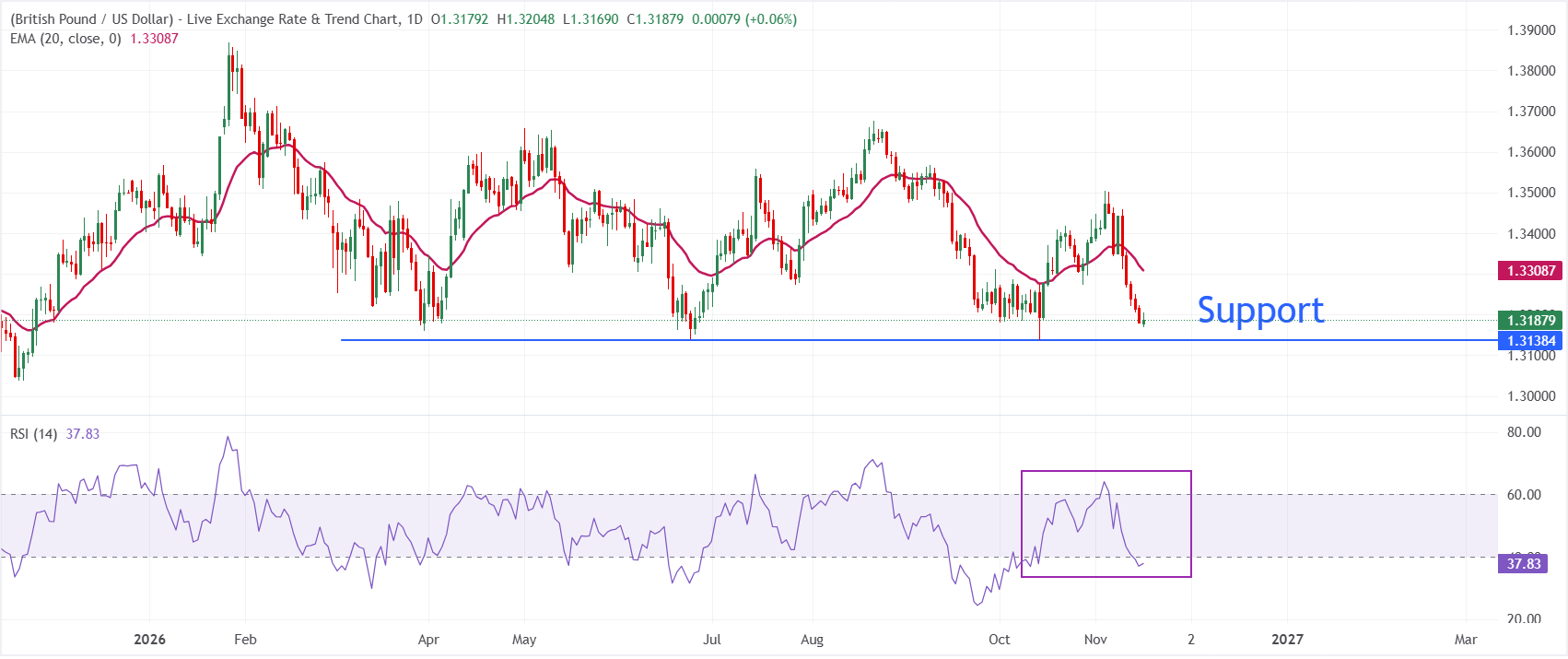
On the daily chart, GBP/USD trades at 1.3187, holding a bearish near-term bias as spot remains below the 20-day Exponential Moving Average (EMA) at 1.3309. The positioning under this key dynamic barrier suggests the latest pullback is still in play, while the Relative Strength Index (RSI) at 37.83 stays below the neutral 50 line, hinting that downside pressure persists rather than signaling an imminent bullish reversal.
On the topside, initial resistance is defined by the 20-day EMA at 1.3309, which caps recovery attempts and would need to be reclaimed to ease the current bearish tone. Looking down, the October 14 low at 1.3137 is the key support level; a break below the same would expose the pair to 1.3100, followed by 1.3000.
(The technical analysis of this story was written with the help of an AI tool. Know more.)
Economic Indicator
Consumer Price Index (YoY)
The United Kingdom (UK) Consumer Price Index (CPI), released by the Office for National Statistics on a monthly basis, is a measure of consumer price inflation – the rate at which the prices of goods and services bought by households rise or fall – produced to international standards. It is the inflation measure used in the government’s target. The YoY reading compares prices in the reference month to a year earlier. Generally, a high reading is seen as bullish for the Pound Sterling (GBP), while a low reading is seen as bearish.
Read more.Next release: Wed Nov 18, 2026 07:00
Frequency: Monthly
Consensus: 3.7%
Previous: 3.5%
Source: Office for National Statistics
The Bank of England is tasked with keeping inflation, as measured by the headline Consumer Price Index (CPI) at around 2%, giving the monthly release its importance. An increase in inflation implies a quicker and sooner increase of interest rates or the reduction of bond-buying by the BOE, which means squeezing the supply of pounds. Conversely, a drop in the pace of price rises indicates looser monetary policy. A higher-than-expected result tends to be GBP bullish.
Үздік мақалалар
1Қытайдың сауда профициті қазанда қысқарған тұста австралиялық доллар әлсіз күйде қалды.2Қытайдың сауда профициті қазанда күтілгеннен де көп қысқарып, CNY 712,72 млрд болды.3АҚШ долларының индексі (DXY) 101,70 маңында өзгеріссіз қалып, Иранға қатысты белгісіздік аясында АҚШ-тың CPI есебін күтуде4Қытай экспорты қазанда жылдық мәнде 35,2%-ға өсіп, 33,5% болған болжамнан асып түсті.5Қытай импортының жылдық өсімі қазанда күтілгеннен жоғары болды (32%): нақты көрсеткіш — 41,6%6Қытайдың сауда балансы қазан айында $105.28B болды, бұл күтілген $125.8B көрсеткішінен төмен.7Қытайдың қазан айындағы сауда балансының көрсеткіші 712,78 млрд юань болды, бұл 859 млрд юаньдық болжамнан төмен.8Қытай экспорты (ж/ж), CNY: қазанда алдыңғы 29,6%-дан 28,7%-ға дейін төмендеді.9Иранмен келіссөздер NZD/USD бағамын көтере алмаған соң, Жаңа Зеландия доллары тұрақтанды.


Бастау!
Тіркеліп, 3 минуттан аз уақытта жаһандық нарықтарға қол жеткізіңіз

Бізбен байланысыңыз









Байланыстар
Телефон: +61 2 8036 8388
Факс: +61 2 8036 8388
Эл. пошта: support@tmgm.com



Осы веб-сайтта берілген ақпарат тек жалпы сипатта ғана ұсынылады және жеке қаржылық кеңес болып табылмайды. Осы веб-сайттағы кез келген ақпаратқа сүйенбес бұрын, оның сіздің мақсаттарыңызға, қаржылық жағдайыңызға және қажеттіліктеріңізге сәйкестігін бағалауыңыз керек. CFD және FX Margin Contracts-қа инвестиция салу елеулі тәуекелдермен байланысты және барлық инвесторлар үшін қолайлы емес. Сіз бастапқы салымыңыздан артық қаражат жоғалтуыңыз мүмкін. Сіз базалық активке ешқандай меншік құқығына немесе үлеске ие болмайсыз. Сауда жасамас бұрын тәуелсіз кеңес алуды және тәуекелдерді толық түсінуді ұсынамыз. Веб-сайтта көрсетілген кез келген өнімді сатып алмас бұрын, ақпараттық құжатты оқып, оны мұқият қарастыру маңызды. Осы веб-сайтта ұсынылған ақпарат пен жарнамалар жергілікті заңдар мен ережелерге қайшы келетін кез келген елде немесе юрисдикцияда тұратын адамдардың пайдалануына арналмаған. Осы веб-сайтта ұсынылатын Өнімдер мен Қызметтер Америка Құрама Штаттары, Малайзия және Таиланд тұрғындарына арналмаған.
TMGM әртүрлі юрисдикцияларда уәкілетті және реттеледі.
Trademax Australia Limited, TMGM атауымен жұмыс істейді, Австралияның Бағалы қағаздар және инвестициялар жөніндегі комиссиясымен (ASIC) реттеледі, AFSL № 436416 және мына мекенжайда орналасқан: Level 28, One International Tower, 100 Barangaroo Avenue, 2000 Sydney, NSW Australia.
Электрондық пошта: support@tmgm.com.au
Trademax Global Limited, TMGM атауымен жұмыс істейді, Вануату Қаржылық қызметтер комиссиясымен (VFSC) уәкілетті және реттеледі, тіркеу нөмірі 40356, тіркелген мекенжайы: 1276, Kumul Highway, Port Vila, Vanuatu, Republic of Vanuatu.
Электрондық пошта: support@tmgm.com
Trademax Global Markets (SE) Limited, TMGM атауымен жұмыс істейді, Сейшел аралдарының Қаржылық қызметтер басқармасы (FSA) тарапынан уәкілетті және реттеледі, лицензия нөмірі SD224. Компания мына мекенжайда тіркелген: Office No 13, Providence Estate ABIS Centre, Mahe, Seychelles.
Электрондық пошта: support@tmgm.com
Trademax Global Markets (International) Pty Ltd, TMGM атауымен жұмыс істейді, Mauritius Қаржылық қызметтер комиссиясымен (FSC) № GB22201012 лицензиясы бойынша уәкілетті және реттеледі, тіркелген мекенжайы: 33, Edith Cavell Street C/o IQ EQ Fund Services (Mauritius) Ltd Port Louis, 11324 Mauritius.
Электрондық пошта: support@tmgm.com
Авторлық құқық © TMGM. Барлық құқықтар қорғалған