

Сауда
Бәсекеге қабілетті бағалар, жоғары өтімділік және озық сауда құралдары арқылы нарықтардың кең ауқымын зерттеңіз.
Толығырақ 
Платформа
TMGM-нің жылдамдыққа, дәлдікке және жоғары деңгейлі сауда тәжірибесіне арналған қуатты платформасымен сауданы кедергісіз жүргізіңіз.
Толығырақ Сауда платформасы
Академия
Бастауыштарға арналған нұсқаулықтар, вебинарлар және нарық талдаулары сияқты ресурстар арқылы сауданың негіздерін үйреніңіз.
Толығырақ TMGM Академиясы
Жаңалықтар және талдау
Сауда мүмкіндіктерінен алда болу үшін нақты уақыттағы нарық жаңартулары мен сараптамалық талдауды алыңыз
Толығырақ Жаңалықтар және талдау
Туралы
TMGM-ді ерекшелендіретін жайттарды біліңіз — біздің жаһандық ауқымымыз, реттеушілік беріктігіміз және трейдингтегі инновацияларға деген адалдығымыз.
Толығырақ Неліктен TMGM-ді таңдау керек
Gold reclaims $3,650 as Nvidia news sparks rally ahead of US PCE
- Gold surges over 3.40% after last week's nearly 9% decline.
- US 10-year Treasury yield retreats to 4.944% despite Dollar strength.
- Core PCE inflation expected at 3.2% YoY, testing Fed tightening outlook.
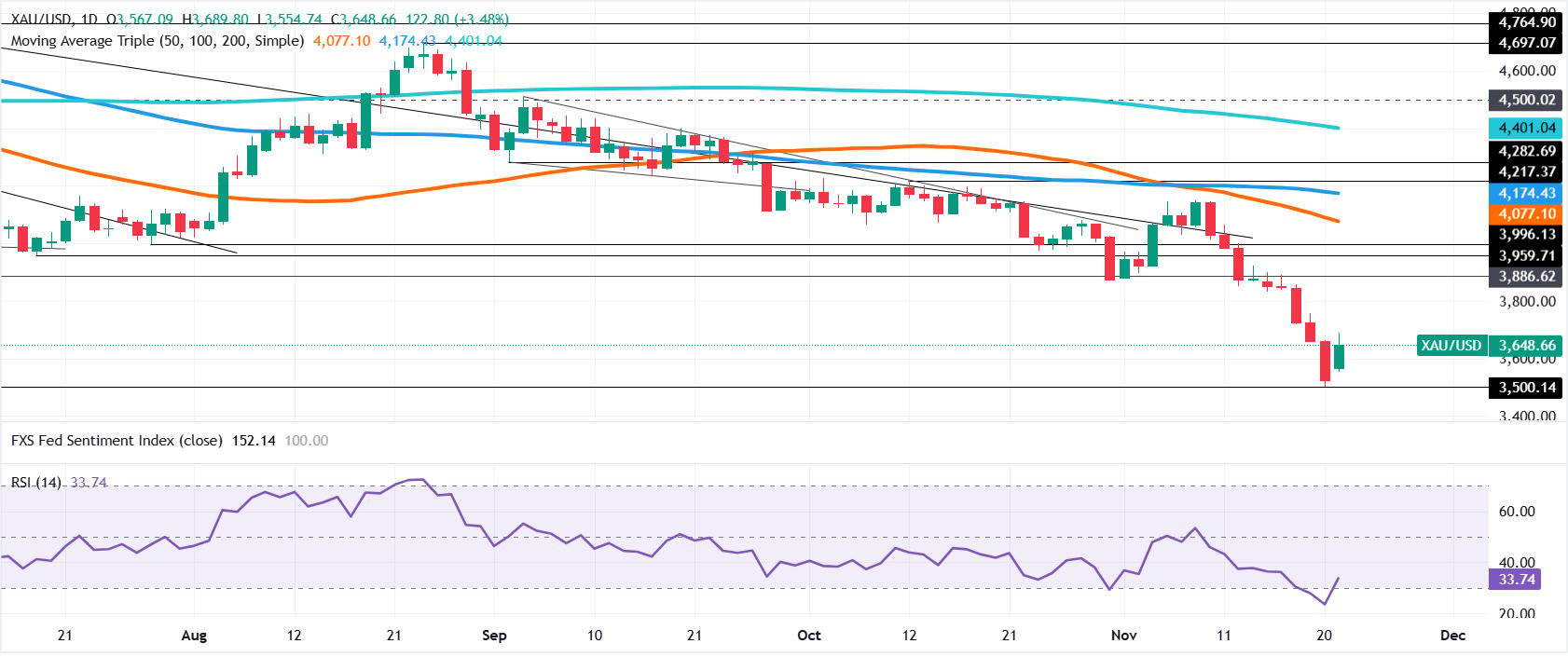
Gold (XAU/USD) price bounced near yearly lows of $3,502 after posting losses of nearly 9% last week, rallying over 3.40% on Monday amid breaking news that Nvidia is reinstating Jenson Huang as its CEO, while market participants brace for the release of US inflation data. At the time of writing, XAU/USD trades above $3,650.

XAU/USD rebounds sharply from yearly lows as falling Treasury yields support bullion
Before the open of Wall Street, Nvidia news triggered a jump in US equity markets and pushed the yellow metal higher. The US Dollar (USD) followed suit, yet Gold is underpinned by falling US Treasury yields.
The US Dollar Index (DXY), which measures the performance of the American currency against six other currencies, is up 0.62% at 104.48. The US 10-year Treasury yield is down one basis point at 4.944%.
Business activity in the US slowed, according to S&P Global. The Manufacturing PMI dipped from 54.9 to 54.5 and missed forecasts of 54.6, while the Services PMI dipped from 56.1 to 54.7, also below estimates of 55.8. The report showed that higher input costs weighed on new orders, while capacity constraints limited output.
A scarce economic docket on Tuesday keeps investors keenly focused on the release of the Federal Reserve’s (Fed) preferred inflation gauge, the Core Personal Consumption Expenditures (PCE) Price Index for October, with economists expecting a jump from 3.1% to 3.2% YoY. The headline print is forecast to rise from 3.6% to 3.8% YoY, an indication that prices remain almost double the Fed’s 2% goal.
This could increase the likelihood that the US central bank will continue raising rates. The CME FedWatch Tool prices in a 96% chance of a 25-basis-point rate hike in December.
Ahead, the New York Fed President John Williams will cross the wires on Monday at around 21:00 GMT. Of note, Fed officials will enter their blackout period on November 28, ahead of the December 8-9 meeting.
XAU/USD technical analysis: Despite recovering, Gold’s downtrend is intact below $4,180
From a technical perspective, Gold has fallen in five of the last six trading days, with Monday’s price action being the first bullish day and forming a ‘bullish harami’ candle pattern or an inside day.
Momentum has turned slightly bullish, with the Relative Strength Index (RSI) exiting oversold territory and aiming towards the 40 level. Nevertheless, the market structure of lower highs and lower lows remains respected, and the RSI is also in bearish territory. Hence, the path of least resistance is downwards.
Gold's first support is the April 22, 2025, swing high of $3,500. Below the next stop is the July 30, 2025, swing low of $3,268, ahead of the $3,000 mark.
On the upside, bullion needs to clear the last week’s high of $3,901 ahead of the $4,000 mark. A breach of the latter will expose the 50-day Simple Moving Average (SMA) at $4,077.
Gold FAQs
Gold has played a key role in human’s history as it has been widely used as a store of value and medium of exchange. Currently, apart from its shine and usage for jewelry, the precious metal is widely seen as a safe-haven asset, meaning that it is considered a good investment during turbulent times. Gold is also widely seen as a hedge against inflation and against depreciating currencies as it doesn’t rely on any specific issuer or government.
Central banks are the biggest Gold holders. In their aim to support their currencies in turbulent times, central banks tend to diversify their reserves and buy Gold to improve the perceived strength of the economy and the currency. High Gold reserves can be a source of trust for a country’s solvency. Central banks added 1,136 tonnes of Gold worth around $70 billion to their reserves in 2022, according to data from the World Gold Council. This is the highest yearly purchase since records began. Central banks from emerging economies such as China, India and Turkey are quickly increasing their Gold reserves.
Gold has an inverse correlation with the US Dollar and US Treasuries, which are both major reserve and safe-haven assets. When the Dollar depreciates, Gold tends to rise, enabling investors and central banks to diversify their assets in turbulent times. Gold is also inversely correlated with risk assets. A rally in the stock market tends to weaken Gold price, while sell-offs in riskier markets tend to favor the precious metal.
The price can move due to a wide range of factors. Geopolitical instability or fears of a deep recession can quickly make Gold price escalate due to its safe-haven status. As a yield-less asset, Gold tends to rise with lower interest rates, while higher cost of money usually weighs down on the yellow metal. Still, most moves depend on how the US Dollar (USD) behaves as the asset is priced in dollars (XAU/USD). A strong Dollar tends to keep the price of Gold controlled, whereas a weaker Dollar is likely to push Gold prices up.
Үздік мақалалар
1Nvidia бастаған акциялар өсімі тәуекелге деген тәбетті арттырып, жапон иенасы әлсіреді2Сингапур доллары: АҚШ долларына қатысты тар диапазонда шоғырлануға бейім – UOB3Бүгінгі валюта нарығы: келесі кезекте АҚШ-тағы тұтынушылар сенімі мен Германияның IFO индексі4Биткоин бағасына болжам: Nvidia Дженсен Хуангты қызметіне қайта тағайындағаннан кейін BTC қалпына келуін жалғастыра ала ма?5Қытай юані: 2028 жылға дейінгі бақыланатын нығаю бағыты – Commerzbank6NVIDIA-ның қайта оралуы USD бағамының өсуіне серпін беріп, британ фунты арзандады7АҚШ доллары жаңа ең жоғары деңгейлерге жеткен тұста Жаңа Зеландия доллары 17 жылдағы ең төменгі деңгейге дейін құлдырады8Биткоин мен алтынға болжам: Nvidia бас директоры Дженсен Хуанг қызметіне қайта тағайындалғаннан кейін BTC мен XAU қымбаттады9Қытай: 2027 жылғы өсім қарқынының әркелкілігі – DBS


Бастау!
Тіркеліп, 3 минуттан аз уақытта жаһандық нарықтарға қол жеткізіңіз

Бізбен байланысыңыз









Байланыстар
Телефон: +61 2 8036 8388
Факс: +61 2 8036 8388
Эл. пошта: support@tmgm.com



Осы веб-сайтта берілген ақпарат тек жалпы сипатта ғана ұсынылады және жеке қаржылық кеңес болып табылмайды. Осы веб-сайттағы кез келген ақпаратқа сүйенбес бұрын, оның сіздің мақсаттарыңызға, қаржылық жағдайыңызға және қажеттіліктеріңізге сәйкестігін бағалауыңыз керек. CFD және FX Margin Contracts-қа инвестиция салу елеулі тәуекелдермен байланысты және барлық инвесторлар үшін қолайлы емес. Сіз бастапқы салымыңыздан артық қаражат жоғалтуыңыз мүмкін. Сіз базалық активке ешқандай меншік құқығына немесе үлеске ие болмайсыз. Сауда жасамас бұрын тәуелсіз кеңес алуды және тәуекелдерді толық түсінуді ұсынамыз. Веб-сайтта көрсетілген кез келген өнімді сатып алмас бұрын, ақпараттық құжатты оқып, оны мұқият қарастыру маңызды. Осы веб-сайтта ұсынылған ақпарат пен жарнамалар жергілікті заңдар мен ережелерге қайшы келетін кез келген елде немесе юрисдикцияда тұратын адамдардың пайдалануына арналмаған. Осы веб-сайтта ұсынылатын Өнімдер мен Қызметтер Америка Құрама Штаттары, Малайзия және Таиланд тұрғындарына арналмаған.
TMGM әртүрлі юрисдикцияларда уәкілетті және реттеледі.
Trademax Australia Limited, TMGM атауымен жұмыс істейді, Австралияның Бағалы қағаздар және инвестициялар жөніндегі комиссиясымен (ASIC) реттеледі, AFSL № 436416 және мына мекенжайда орналасқан: Level 28, One International Tower, 100 Barangaroo Avenue, 2000 Sydney, NSW Australia.
Электрондық пошта: support@tmgm.com.au
Trademax Global Limited, TMGM атауымен жұмыс істейді, Вануату Қаржылық қызметтер комиссиясымен (VFSC) уәкілетті және реттеледі, тіркеу нөмірі 40356, тіркелген мекенжайы: 1276, Kumul Highway, Port Vila, Vanuatu, Republic of Vanuatu.
Электрондық пошта: support@tmgm.com
Trademax Global Markets (SE) Limited, TMGM атауымен жұмыс істейді, Сейшел аралдарының Қаржылық қызметтер басқармасы (FSA) тарапынан уәкілетті және реттеледі, лицензия нөмірі SD224. Компания мына мекенжайда тіркелген: Office No 13, Providence Estate ABIS Centre, Mahe, Seychelles.
Электрондық пошта: support@tmgm.com
Trademax Global Markets (International) Pty Ltd, TMGM атауымен жұмыс істейді, Mauritius Қаржылық қызметтер комиссиясымен (FSC) № GB22201012 лицензиясы бойынша уәкілетті және реттеледі, тіркелген мекенжайы: 33, Edith Cavell Street C/o IQ EQ Fund Services (Mauritius) Ltd Port Louis, 11324 Mauritius.
Электрондық пошта: support@tmgm.com
Авторлық құқық © TMGM. Барлық құқықтар қорғалған