

Gold Price Forecast: XAU/USD holds above $4.600 with all eyes on Fed Warsh’s speech
- XAU/USD flatlines at $4.600 after rejection at $4,700 earlier this week.
- Investors bide their time on Friday, awaiting Fed Warsh's speech at Jackson Hole.
- Gold maintains a bullish bias while above the 200-day SMA.
Gold (XAU/USD) trades practically flat for the second consecutive day on Friday, with the rejection from three-month highs near $4,700 hit earlier in the week contained at a previous resistance area, just below $4,600. Market volatility remains subdued on Friday, with investors focusing on Federal Reserve Chairman Kevin Warsh’s speech at the Jackson Hole Symposium, due later in the day.

Investors expect Warsh to overcome his distaste for forward guidance and show some hints about the central bank’s near-term policy plans to tame price pressures, amid calls for interest rate hikes from board members.
On Thursday, Kansas Fed President Jeffrey Schmidt said on CNBC that inflation is “still sticky and we've got to continue to find ways to break through", Later on the day, Cleveland Fed President Beth Hammack reiterated that it is “time to act” to bring inflation back to target.
Technical Analysis: Bulls remain in charge while above the 200-day SMA
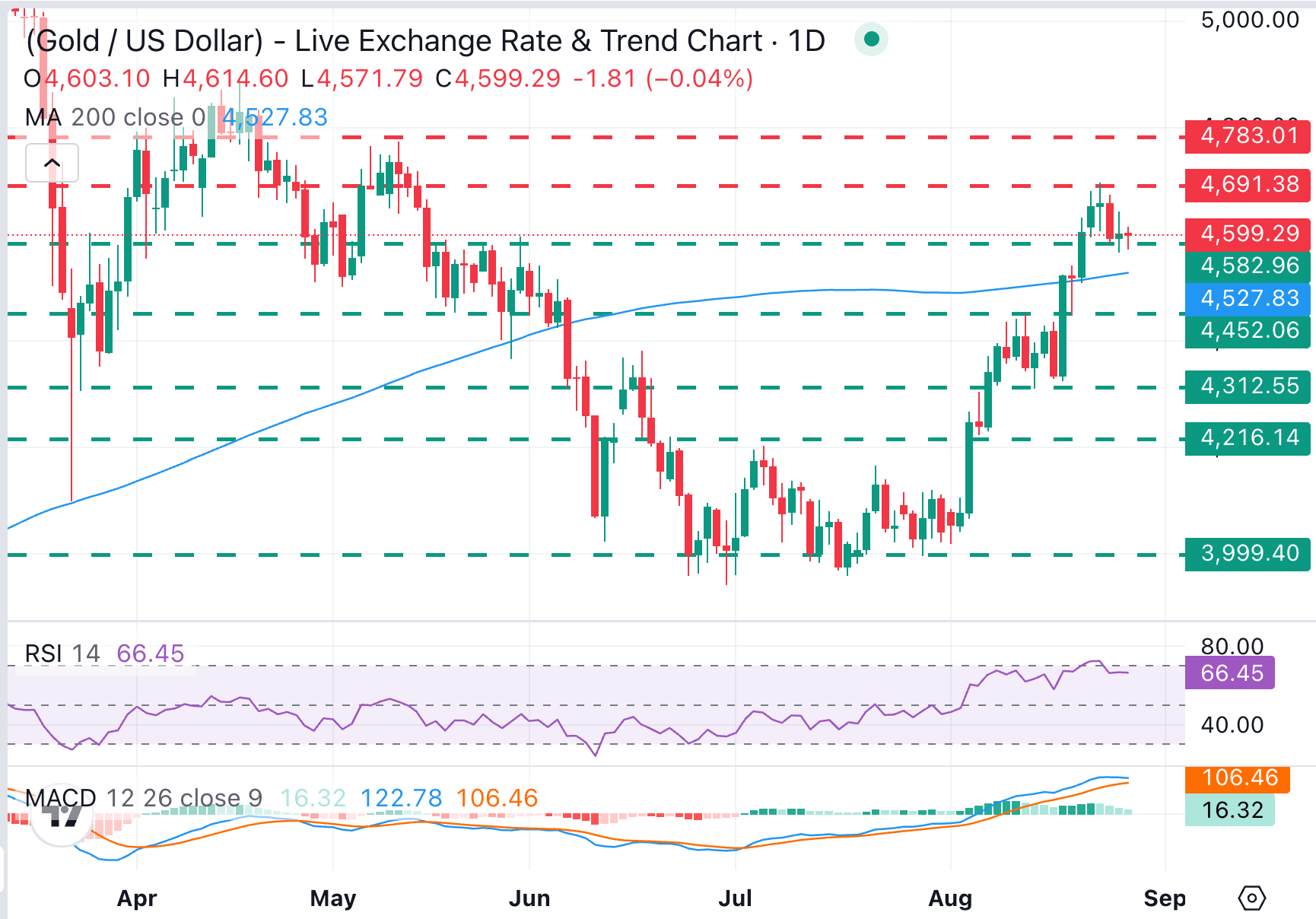
XAU/USD trades at $4,599 with the broader bullish stance in play as spot price holds well above the 200-day Simple Moving Average (SMA), now around $4,525. Momentum indicators in the daily chart endorse the bullish view, with the Relative Strength Index (RSI) at 66.48 after pulling back from overbought extremes, and the Moving Average Convergence Divergence (MACD) holding within positive territory.
Bears remain contained above late-May highs in the $4,590 area so far, closing the path to the mentioned 200-day SMA at $4,527. Below there, the next downside target would be the August 13 high and August 20 low, at the $4,450 area.
Upside attempts remain capped ahead of the $4,700 level (Tuesday's high), ahead of the May 12 high at $4,773 and April's peak, near $4,900.
(The technical analysis of this story was written with the help of an AI tool. Know more.)
Gold FAQs
Gold has played a key role in human’s history as it has been widely used as a store of value and medium of exchange. Currently, apart from its shine and usage for jewelry, the precious metal is widely seen as a safe-haven asset, meaning that it is considered a good investment during turbulent times. Gold is also widely seen as a hedge against inflation and against depreciating currencies as it doesn’t rely on any specific issuer or government.
Central banks are the biggest Gold holders. In their aim to support their currencies in turbulent times, central banks tend to diversify their reserves and buy Gold to improve the perceived strength of the economy and the currency. High Gold reserves can be a source of trust for a country’s solvency. Central banks added 1,136 tonnes of Gold worth around $70 billion to their reserves in 2022, according to data from the World Gold Council. This is the highest yearly purchase since records began. Central banks from emerging economies such as China, India and Turkey are quickly increasing their Gold reserves.
Gold has an inverse correlation with the US Dollar and US Treasuries, which are both major reserve and safe-haven assets. When the Dollar depreciates, Gold tends to rise, enabling investors and central banks to diversify their assets in turbulent times. Gold is also inversely correlated with risk assets. A rally in the stock market tends to weaken Gold price, while sell-offs in riskier markets tend to favor the precious metal.
The price can move due to a wide range of factors. Geopolitical instability or fears of a deep recession can quickly make Gold price escalate due to its safe-haven status. As a yield-less asset, Gold tends to rise with lower interest rates, while higher cost of money usually weighs down on the yellow metal. Still, most moves depend on how the US Dollar (USD) behaves as the asset is priced in dollars (XAU/USD). A strong Dollar tends to keep the price of Gold controlled, whereas a weaker Dollar is likely to push Gold prices up.














