




Indian Rupee opens lower as Trump demands war compensation
- The Indian Rupee falls further against the US Dollar as oil prices extend the advance.
- US President Trump demands reparations for the war, as Iran did the same.
- Investors await the CPI data for July from both India and the US.
The Indian Rupee (INR) opens on a cautious note against the US Dollar (USD) on Tuesday. The USD/INR pair rises further to near 95.40 as surging oil prices due to escalating fears of a prolonged global supply disruption have weakened the Indian currency.
In the opening session, the MCX Crude Oil contract expiring on August 19 trades 0.45% higher to near Rs. 7,835, closer to its weekly high.
Trump also demands reparations for war
On Monday, United States (US) President Donald Trump also demanded compensation for war casualties in the Middle East from Iran, through a post on Truth Social, in a direct answer to Iran's own call for compensation, as a key condition for reopening the Strait of Hormuz, a vital passage to almost one-fifth of global energy supply.
US President Trump added that Iran should be held "responsible for the damages and death" caused to the people of Lebanon, Syria, Yemen and Gaza.
Over the weekend, Iran’s Mohammad Bagher Zolghadr, secretary of the council, set out six conditions for the Hormuz reopening.
Both sides demanding compensation for war damages have heightened uncertainty over the truce in the near term, boosting oil prices.
Currencies from economies, such as India, which rely heavily on oil imports to meet their energy needs, tend to underperform in a high-oil-price environment.
India-US CPI data comes under the spotlight
This week, the major trigger for the Indian Rupee and the US Dollar will be respective Consumer Price Index (CPI) data for July from their economies, which will be released on Wednesday.
India inflation holds steady as DBS flags mixed food trends and benign core
Economists at DBS Group Research note that key “inflation and trade numbers are due in the second week of August,” with “headline inflation in July… largely steady at 4.4% YoY vs June.” They point out that “high frequency data on food staples point to a rise in pulses, sugar, milk and edible oils, while vegetables have stabilized,” adding that “a catch-up in rainfall in July has helped boost sowing activity.” On the price side, DBS highlights that “adjustments in domestic retail fuel products (non-subsidized LPG was up 10% YoY in July) are also likely to reflect in the utilities and fuel segments.” Even so, they expect underlying pressures to remain contained, with “core readings… benign at sub-4% in July, helped also by moderation in precious metals in the period.”
In the US, both headline and core CPI are expected to have cooled down, with figures seen arriving lower at 3.4% and 2.5% Year-on-Year (YoY), respectively.
Signs of US inflationary pressures cooling down would ease fears of Federal Reserve (Fed) interest rate hikes further. This week, financial markets have rolled back hawkish Fed after the release of the US Nonfarm Payrolls (NFP) data for July, which showed a reduction in the overall labor force against estimates of a fresh addition of 80K workers.
Technical Analysis: USD/INR holds key 60-day EMA
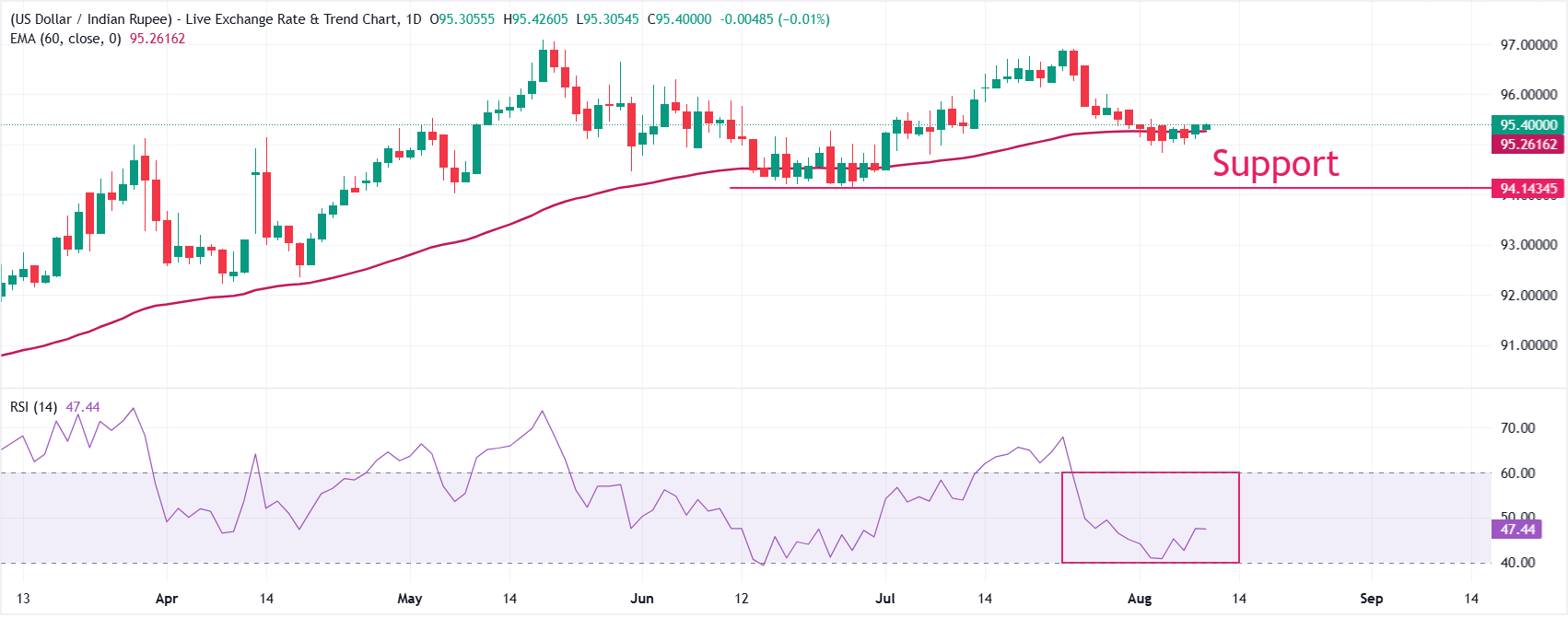
In the daily chart, USD/INR trades at 95.40. The pair holds above the 60-day exponential moving average (EMA) at 95.26, keeping a modest bullish near-term bias as price respects this dynamic support zone.
Momentum is less conclusive, with the 14-day Relative Strength Index (RSI) hovering near 47, hinting at a consolidative tone rather than strong directional conviction, but the preservation of levels above the EMA favors mild upside while this floor holds.
On the downside, initial support is seen at the 60-day EMA at 95.26, followed by the June 26 low at 94.15. With no clearly defined overhead technical barriers in the immediate dataset, any sustained advance above the recent close would likely be driven by momentum shifts, while a daily close back below 95.2616 would weaken the current constructive bias and expose a broader corrective phase.
(The technical analysis of this story was written with the help of an AI tool. Know more.)
Indian Rupee FAQs
The Indian Rupee (INR) is one of the most sensitive currencies to external factors. The price of Crude Oil (the country is highly dependent on imported Oil), the value of the US Dollar – most trade is conducted in USD – and the level of foreign investment, are all influential. Direct intervention by the Reserve Bank of India (RBI) in FX markets to keep the exchange rate stable, as well as the level of interest rates set by the RBI, are further major influencing factors on the Rupee.
The Reserve Bank of India (RBI) actively intervenes in forex markets to maintain a stable exchange rate, to help facilitate trade. In addition, the RBI tries to maintain the inflation rate at its 4% target by adjusting interest rates. Higher interest rates usually strengthen the Rupee. This is due to the role of the ‘carry trade’ in which investors borrow in countries with lower interest rates so as to place their money in countries’ offering relatively higher interest rates and profit from the difference.
Macroeconomic factors that influence the value of the Rupee include inflation, interest rates, the economic growth rate (GDP), the balance of trade, and inflows from foreign investment. A higher growth rate can lead to more overseas investment, pushing up demand for the Rupee. A less negative balance of trade will eventually lead to a stronger Rupee. Higher interest rates, especially real rates (interest rates less inflation) are also positive for the Rupee. A risk-on environment can lead to greater inflows of Foreign Direct and Indirect Investment (FDI and FII), which also benefit the Rupee.
Higher inflation, particularly, if it is comparatively higher than India’s peers, is generally negative for the currency as it reflects devaluation through oversupply. Inflation also increases the cost of exports, leading to more Rupees being sold to purchase foreign imports, which is Rupee-negative. At the same time, higher inflation usually leads to the Reserve Bank of India (RBI) raising interest rates and this can be positive for the Rupee, due to increased demand from international investors. The opposite effect is true of lower inflation.













