




RBI set to keep interest rates unchanged as inflation risks persist
- The RBI is set to leave policy rates unchanged on Wednesday.
- The Reserve Bank of India might retain the data-dependent approach for the monetary policy outlook.
- Investors will closely track comments on FCNR deposits, inflation and the economic outlook.
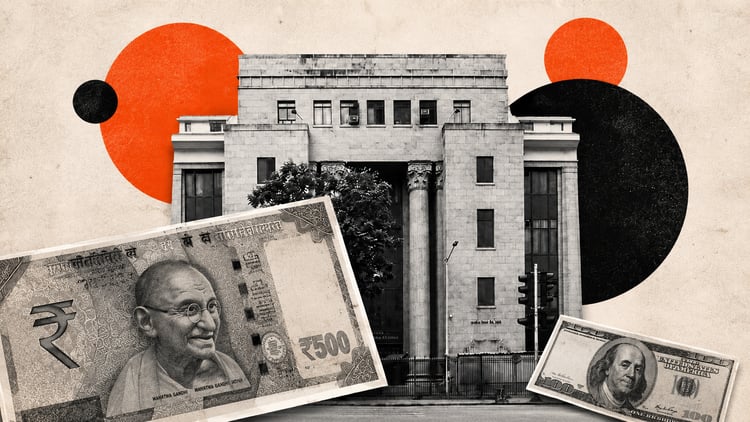
The Reserve Bank of India (RBI) is set to announce its bi-monthly monetary policy decision on Wednesday at 10:00 AM IST (04:30 GMT), another meeting coming at a time when uncertainty remains high over the duration and economic fallout of the ongoing Middle East conflict.
RBI seen on hold as inflation remains within target band
Analysts at Commerzbank expect the Reserve Bank of India to maintain its current policy stance, noting that the RBI is “expected to leave the benchmark repurchase rate unchanged at 5.25% at its next meeting on 5 August.” While they acknowledge that “inflation risks remain tilted to the upside due to higher global commodity prices and a weaker monsoon season,” Commerzbank highlights that the June Consumer Price Index (CPI) print “rose 4.4% yoy, which was within RBI's 2-6% target range,” reinforcing the case for policy continuity in the near term.
The RBI is also expected to leave the Standing Deposit Facility (SDF) and the Marginal Standing Facility (MSF) rates unchanged at 5% and 5.5%, respectively.
According to the latest Reuters poll, 68 of the 72 economists expect the RBI to leave its policy rates at their current levels.
So far this year, the RBI has maintained the status quo at all three policy meetings and has kept rates unchanged since cutting the Repo Rate by 25 basis points (bps) to 5.25% in the December 2025 meeting.
What happened in the last meeting?
In the June policy meeting, the Indian central bank raised its inflation forecast, after leaving policy rates steady, for FY26-27 to 5.1% Year-on-Year (YoY) from 4.6% projected earlier, citing that higher input prices such as base metals, plastic and rubber, and rising commercial Liquefied Petroleum Gas (LPG) prices are putting upward pressure on overall prices.
The RBI also lowered its real Gross Domestic Product (GDP) growth forecast for the current year to 6.6% from its prior expectations of 6.9%.
On the monetary policy outlook, RBI Governor Sanjay Malhotra said that it is “prudent to wait for greater clarity to emerge” and the central bank will remain “data-dependent”.
Key things to watch
Investors will pay close attention to commentary from RBI Governor Malhotra regarding inflation and the economic outlook on the back of the ongoing geopolitical crisis.
In the last meeting, RBI Governor Malhotra acknowledged heightened global uncertainty amid geopolitical risks, and said that the extended disruption in global supply chains and higher energy prices have prompted risks both to inflation and growth. However, he assured that the economy is able to “withstand these shocks with minimum pain”.
In an interview with Businessline, released last week, RBI Governor Malhotra made clear that price stability is their key priority, but policymakers don’t see any signs of price pressures entrenching. “Our primary mandate is inflation and price stability. Therefore, we will do whatever is required first, to keep price stability and then, to see to what extent we can support growth,” Malhotra said.
Investors will also focus on commentary about India’s interest rate outlook. Analysts at Axis Bank say, "The MPC is likely to shift language acknowledging risks of firmer inflation and policy action ahead, while maintaining a data-dependent approach.”
Financial markets would also be keen to know the performance of Foreign Currency Non-resident (FCNR) deposits, which were announced in the June meeting, aiming to increase the inflow of foreign funds to support forex reserves. The tool allows commercial banks to raise funds via foreign currency deposits whose full hedging cost is borne by the RBI.
India flows recover as DBS flags stronger debt, equity and FCNR(B) momentum
Analysts at DBS Group Research highlight that “the flows picture is, meanwhile, on the mend,” pointing to a “resumption in portfolio inflows into equity and debt markets as well as positive cues on the swap schemes.” They note that “July saw debt markets attract more than $2bn in inflows, bringing FYTD debt inflows to $7.7bn, while equities recorded $1.5bn worth flows following consecutive months of outflows.”
In addition, DBS cites comments from RBI Governor Malhotra, who said in an interview that “banks had mobilized a cumulative $32bn via the swap windows to-date, already surpassing the scale of inflows raised back in 2013.” Against this backdrop, DBS reiterates that “we expect the scale of the FCNR(B) deposits, in particular, to pick up in second half of the scheme’s validity period, as KYC/compliance requirements are completed,” and cautions that “at the current run-rate, our conservative estimate of $45-50bn of total inflows under the special schemes could be overshot.”
USD/INR technical outlook points to a mild bearish bias
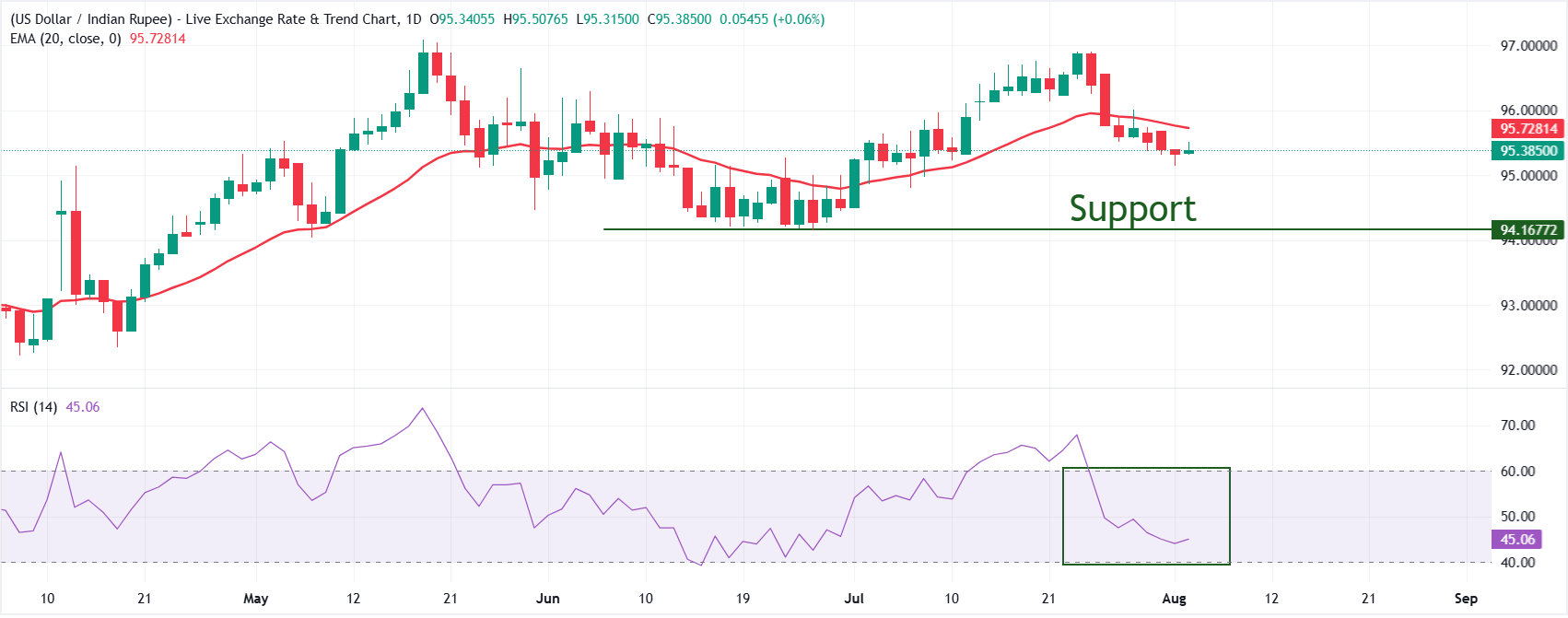
USD/INR retains a mildly bearish near-term bias as it holds below the 20-day Exponential Moving Average (EMA) at 95.72. The short-term trend structure suggests the pair is capped by this dynamic resistance, while the 14-day Relative Strength Index (RSI) at 45 keeps momentum in a neutral-to-bearish zone, hinting at a lack of strong buying conviction after the recent pullback from the 96.00 area.
On the topside, immediate resistance is defined by the 20-day EMA at 95.73, and a daily close above this barrier would be needed to extend the recovery towards 96.00. On the downside, major support levels are the July 7 low at 94.80 and the June low at 94.15.
Economic Indicator
RBI Interest Rate Decision (Repo Rate)
The RBI Interest Rate Decision is announced by the Reserve Bank of India. If the bank is hawkish about the inflationary outlook of the economy and rises the interest rates, it is seen as positive, or bullish, for the INR, while a dovish outlook for the economy (or a rate cut) is seen as negative, or bearish, for the currency.
Read more.Next release: Wed Aug 05, 2026 04:30
Frequency: Irregular
Consensus: 5.25%
Previous: 5.25%
Source: Reserve Bank of India













