

Savdo
Raqobatbardosh narxlar, chuqur likvidlik va ilg‘or savdo vositalari bilan keng turdagi bozorlarni kashf eting.
Batafsil ma’lumot 
Platforma
TMGM’ning tezlik, aniqlik va yuqori savdo tajribasi uchun yaratilgan kuchli platformasi bilan uzluksiz savdo qiling.
Batafsil ma’lumot Savdo platformasi
Savdo vositalari
Akademiya
Boshlovchilar uchun qulay resurslar, jumladan qo‘llanmalar, vebinarlar va bozor tahlillari orqali savdoning asoslarini o‘rganing.
Batafsil ma’lumot Yangiliklar va tahlil
Savdo imkoniyatlaridan oldinda bo‘lish uchun bozor yangilanishlari va ekspert tahlillarini real vaqt rejimida oling
Batafsil ma’lumot Yangiliklar va tahlil
Haqida
TMGMni boshqalardan ajratib turadigan jihatlarni bilib oling — bizning global mavjudligimiz, tartibga solishdagi mustahkamligimiz va savdoda innovatsiyalarga sodiqligimiz.
Batafsil ma’lumot Nega TMGMni tanlash kerak
Silver Price Forecast: XAG/USD slides to fresh 14-month low near $41 amid hawkish Fed undertone
- Silver price tumbles to a fresh 14-month low near $41.00 amid Fed narrative.
- UOB expects two additional interest rates hikes in the near term, with risks of a bigger rate hike too.
- BBH indicates that the debate is more on the pace and terminal Fed policy rate.
Silver price (XAG/USD) hits a fresh 14-month low near $41.00 during the European trading session on Friday. The white metal extends its downside run as financial markets are confident about a series of Federal Reserve (Fed) interest rate hikes in the near term.
Theoretically, higher Fed interest rates diminish the appeal of non-yielding assets, such as Silver.
FOMC minutes underscore broad backing for further Fed tightening
Strategists at Brown Brothers Harriman (BBH) highlight that the minutes of the FOMC’s October 27–28 meeting “confirmed broad support for further rate hikes, with the debate moving to how much and how fast to tighten.”
BBH notes that the discussion has become more explicitly focused on the potential pace and magnitude of future moves, with the minutes revealing that “a couple of participants noted that an increase of more than 25 basis points could warrant consideration at the next meeting if incoming inflation data were unfavorable.”
BBH also points out that “a few participants observed that inflation could prove more persistent than anticipated, in which case a shift to a more restrictive policy stance could become necessary,” underscoring the Committee’s readiness to respond more forcefully if price pressures fail to moderate.
Economists at UOB said that they “expect two additional 25-bps hikes, in Dec 2026 and 1Q 27, thereafter on hold for the rest of 2027 as inflation fades in a more durable fashion in the later part of 2027 as the most likely course of action,” while “recognising growing risks of a larger-than-expected tightening response if inflation remains persistent.”
The hawkish Fed narrative has been lending strength to the US Dollar (USD). As of writing, the USD Index is 0.19% down to near 103.72 from its fresh 19-month high of around 104.00 posted the previous day.
Technically, a higher US Dollar makes the Silver price an unfavorable risk-reward bet for investors.
Silver Technical Analysis
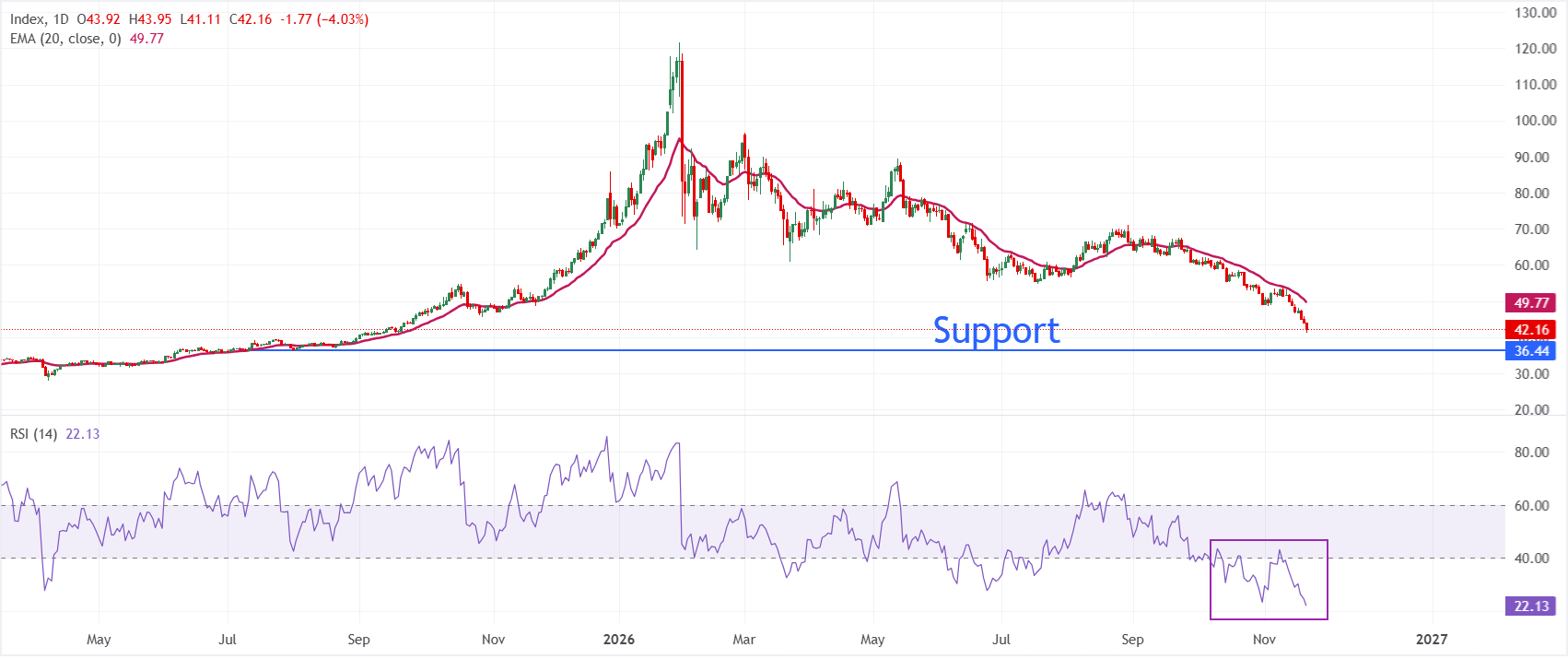
In the daily chart, XAG/USD trades at $42.16, maintaining a bearish near-term bias as price holds well beneath the 20-day Exponential Moving Average (EMA) at around $49.77. The wide gap between spot and this dynamic resistance suggests persistent downside pressure, while the 14-day Relative Strength Index near 22 signals deeply oversold conditions that could slow the pace of the decline rather than establish a durable floor.
On the topside, the 20-day EMA at $49.77 is the first meaningful resistance that bulls would need to reclaim to ease the current bearish structure and open the way to a broader recovery. Looking down, the Silver price would be exposed toJuly 31 low at $36.21 if it fails to hold $40.00
(The technical analysis of this story was written with the help of an AI tool. Know more.)
Silver FAQs
Silver is a precious metal highly traded among investors. It has been historically used as a store of value and a medium of exchange. Although less popular than Gold, traders may turn to Silver to diversify their investment portfolio, for its intrinsic value or as a potential hedge during high-inflation periods. Investors can buy physical Silver, in coins or in bars, or trade it through vehicles such as Exchange Traded Funds, which track its price on international markets.
Silver prices can move due to a wide range of factors. Geopolitical instability or fears of a deep recession can make Silver price escalate due to its safe-haven status, although to a lesser extent than Gold's. As a yieldless asset, Silver tends to rise with lower interest rates. Its moves also depend on how the US Dollar (USD) behaves as the asset is priced in dollars (XAG/USD). A strong Dollar tends to keep the price of Silver at bay, whereas a weaker Dollar is likely to propel prices up. Other factors such as investment demand, mining supply – Silver is much more abundant than Gold – and recycling rates can also affect prices.
Silver is widely used in industry, particularly in sectors such as electronics or solar energy, as it has one of the highest electric conductivity of all metals – more than Copper and Gold. A surge in demand can increase prices, while a decline tends to lower them. Dynamics in the US, Chinese and Indian economies can also contribute to price swings: for the US and particularly China, their big industrial sectors use Silver in various processes; in India, consumers’ demand for the precious metal for jewellery also plays a key role in setting prices.
Silver prices tend to follow Gold's moves. When Gold prices rise, Silver typically follows suit, as their status as safe-haven assets is similar. The Gold/Silver ratio, which shows the number of ounces of Silver needed to equal the value of one ounce of Gold, may help to determine the relative valuation between both metals. Some investors may consider a high ratio as an indicator that Silver is undervalued, or Gold is overvalued. On the contrary, a low ratio might suggest that Gold is undervalued relative to Silver.
Eng yaxshi maqolalar
1Anthropic IPOsidan keyin texnologiya aksiyalarining sotilishi va Fedning qatʼiy pul-kredit siyosati kutilmalari fonida Dow Jones fyucherslari biroz pasaydi2USD/CAD narxi prognozi: juftlik koʻtariluvchi kanalning 1,4300 yaqinidagi quyi chegarasida joylashmoqda3Yevro: AQSh dollariga nisbatan pasayishning davom etishi kunlik savdolar 1,0950 dan pastda yopilishiga bogʻliq - UOB4CPI maʼlumotlari Yaponiya banki dekabrda foiz stavkasini oshirishi haqidagi kutilmalarni kuchaytirgani fonida yapon iyenasi biroz mustahkamlanmoqda5Fedning qatʼiy pul-kredit siyosati kutilmalariga qaramay, AQSh dollari zaiflashar ekan, Shveysariya franki oʻz pozitsiyasini saqlab qolmoqda6Hindiston rupiyasi AQSh dollariga nisbatan soʻnggi yetti oydagi yangi eng yuqori darajaga koʻtarildi7Indoneziya rupiyasi tarixiy eng past darajalariga yaqin qolmoqda8AUD/USD kursi prognozi: navbatdagi tayanch 0,6600 yaqinidagi 78,6% Fibonachchi darajasida9EUR/USD kursi prognozi: 1,0950 dan yuqorida mustahkamlanmoqda, biroq 100 kunlik oddiy sirgʻaluvchi oʻrtacha (SMA) qarshilik darajasidan pastda qolmoqda

Boshlang!
Ro‘yxatdan o‘ting va 3 daqiqadan kamroq vaqt ichida Global bozorlariga kirish imkoniga ega bo‘ling

Biz bilan bog‘laning









Kontaktlar
Telefon: +61 2 8036 8388
Faks: +61 2 8036 8388
Email: support@tmgm.com



Ushbu veb-saytda taqdim etilgan ma’lumotlar faqat umumiy xususiyatga ega bo‘lib, shaxsiy moliyaviy maslahat hisoblanmaydi. Ushbu veb-saytdagi har qanday ma’lumot asosida harakat qilishdan oldin, ma’lumotning sizning maqsadlaringiz, moliyaviy ahvolingiz va ehtiyojlaringizga mosligini ko‘rib chiqishingiz kerak. CFD va FX Margin shartnomalariga sarmoya kiritish sezilarli xavflarni o‘z ichiga oladi va barcha investorlar uchun mos emas. Siz boshlang‘ich depozitingizdan ko‘proq yo‘qotishingiz mumkin. Siz asosiy aktivga egalik qilmaysiz va unda hech qanday manfaatga ega emassiz. Savdo qilishdan oldin mustaqil maslahat olishni va ishtirok etuvchi xavflarni to‘liq tushunishingizni tavsiya qilamiz. Veb-saytda keltirilgan har qanday mahsulotni xarid qilishdan oldin oshkor qilish hujjatini o‘qib chiqishingiz va ko‘rib chiqishingiz muhimdir. Ushbu veb-saytda taklif etilgan ma’lumotlar va reklama materiallari bunday foydalanish mahalliy qonunlar va qoidalarga zid bo‘ladigan har qanday mamlakat yoki yurisdiksiyadagi shaxslar tomonidan foydalanish uchun mo‘ljallanmagan. Ushbu veb-saytda taklif etilgan Mahsulotlar va Xizmatlar AQSh, Malayziya va Tailand rezidentlari uchun mo‘ljallanmagan.
TMGM turli yurisdiksiyalarda vakolatli va tartibga solinadi.
Trademax Australia Limited, TMGM nomi ostida faoliyat yuritadi, Avstraliya Qimmatli qog‘ozlar va investitsiyalar komissiyasi (ASIC) tomonidan tartibga solinadi, AFSL raqami 436416 va manzili: Level 28, One International Tower, 100 Barangaroo Avenue, 2000 Sydney, NSW Australia.
Email: support@tmgm.com.au
Trademax Global Limited, TMGM nomi ostida faoliyat yuritadi, Vanuatu Moliyaviy Xizmatlar Komissiyasi (VFSC) tomonidan vakolatli va tartibga solinadi, ro‘yxatga olish raqami 40356 va ro‘yxatdan o‘tgan manzili: 1276, Kumul Highway, Port Vila, Vanuatu, Vanuatu Respublikasi.
Email: support@tmgm.com
Trademax Global Markets (SE) Limited, TMGM nomi ostida faoliyat yuritadi, Seyshel orollari Moliyaviy Xizmatlar Boshqarmasi (FSA) tomonidan 224-sonli SD litsenziyasi bilan vakolatli va tartibga solinadi. Kompaniya Office No 13, Providence Estate ABIS Centre, Mahe, Seychelles manzilida ro‘yxatdan o‘tgan.
Email: support@tmgm.com
Trademax Global Markets (International) Pty Ltd, TMGM nomi ostida faoliyat yuritadi, Mauritius Moliyaviy Xizmatlar Komissiyasi (FSC) tomonidan GB22201012 litsenziya raqami bilan vakolatli va tartibga solinadi hamda 33, Edith Cavell Street C/o IQ EQ Fund Services (Mauritius) Ltd Port Louis, 11324 Mauritius manzilida ro‘yxatdan o‘tgan.
Email: support@tmgm.com
Mualliflik huquqi © TMGM. Barcha huquqlar himoyalangan