

Savdo
Raqobatbardosh narxlar, chuqur likvidlik va ilg‘or savdo vositalari bilan keng turdagi bozorlarni kashf eting.
Batafsil ma’lumot 
Platforma
TMGM’ning tezlik, aniqlik va yuqori savdo tajribasi uchun yaratilgan kuchli platformasi bilan uzluksiz savdo qiling.
Batafsil ma’lumot Savdo platformasi
Savdo vositalari
Akademiya
Boshlovchilar uchun qulay resurslar, jumladan qo‘llanmalar, vebinarlar va bozor tahlillari orqali savdoning asoslarini o‘rganing.
Batafsil ma’lumot Yangiliklar va tahlil
Savdo imkoniyatlaridan oldinda bo‘lish uchun bozor yangilanishlari va ekspert tahlillarini real vaqt rejimida oling
Batafsil ma’lumot Yangiliklar va tahlil
Haqida
TMGMni boshqalardan ajratib turadigan jihatlarni bilib oling — bizning global mavjudligimiz, tartibga solishdagi mustahkamligimiz va savdoda innovatsiyalarga sodiqligimiz.
Batafsil ma’lumot Nega TMGMni tanlash kerak
The Euro takes a priced-in hike into a week that belongs to American inflation
- EUR/USD stalls under 1.1000 at a 19-month low after a five-session slide from 1.1250.
- Eurozone core inflation was revised up to 2.6% and the Euro still fell.
- Eurozone PMIs on Monday, US core PCE on Wednesday, ECB accounts on Thursday.
1.1000 has turned EUR/USD back in each of the past three sessions, and it did so in a week when most of the news leaned the Euro's way. Eurozone core inflation was revised higher, the ZEW sentiment survey beat its forecast, and the US factory numbers missed. The pair trades just above 1.0950 regardless, its lowest in 19 months, and has gone nowhere since Monday's break of the round number.

Good news for the Euro bought nothing above 1.1000
Eurostat's final October figures on Wednesday put core inflation at 2.6% YoY, up from a first estimate of 2.5%, and confirmed the headline rate at 4.0%. Tuesday's ZEW survey of economic sentiment came in at 26.5 against a 19.1 forecast. Traders put the odds of a European Central Bank (ECB) hike on December 17 above 90%, a move that would take the deposit rate from 2.50% to 2.75%.
The pair made its low for the year on the day of the inflation revision. A hike that's more than 90% priced has less than 10% left to add to a currency, so stronger inflation data now confirms a decision the market has already traded.
The Fed voted to hold and has argued about hiking ever since
The US calendar leaned the Euro's way as well. The Empire State and Philadelphia Fed factory surveys both came in at less than half their forecasts, industrial production fell 0.4% in October, and weekly jobless claims rose to 203K.
The Dollar didn't need the data. Minutes of the Fed's October meeting, released on Wednesday, showed almost all officials expect further hikes and a couple open to more than a quarter-point in December, and Fed Governor Waller asked for a half-point the same day. The Fed's rate is 3.75%-4.00% against the ECB's 2.50%, a gap of at least 1.25 points before either moves. October's vote was 10-2 to hold, both dissenters wanted a hike, and the committee has spent November debating how quickly to do what it voted not to do.
A December hike raises France's bill too
An ECB hike doesn't land evenly across the bloc. The extra yield investors demand to hold French 10-year debt over Germany's reached about 1.6 points earlier in November, the widest since the Eurozone debt crisis, and France's 2027 budget is still being fought over in parliament. Bank of France Governor Moulin said on Friday that France faces a budget crisis and is in a very different situation from Greece, the second time since early October he has raised the comparison in order to dismiss it.
For EUR/USD, higher ECB rates lift the yield on holding Euros and the cost of rolling French debt at the same time, which may be why a well-flagged hike hasn't put a floor under the pair. European Union (EU) leaders meet on November 26 and 27 with that budget fight unresolved.
PMIs, then PCE, then an account of a meeting already traded
The Hamburg Commercial Bank (HCOB) Purchasing Managers Index (PMI) surveys for November are due on Monday at 09:00 GMT, after a composite reading of 51.7 in October, with the US versions at 14:45 GMT. ECB Chief Economist Lane speaks the same day at 14:30 GMT.
Wednesday at 13:30 GMT is the release that matters most to the pair: October core Personal Consumption Expenditures (PCE) inflation, forecast at 3.2% YoY after 3.1%, alongside a first estimate of third-quarter Gross Domestic Product (GDP) forecast at 3.5% annualized. Traders pared their December Fed bets on Friday as US stocks sold off, so a core number at or above forecast could rebuild them and take the pair through 1.0950. A miss would hand the Euro a second look at 1.1000 with the Fed's preferred measure on its side.
US markets are shut on Thursday for Thanksgiving, which leaves the ECB's account of its October 29 meeting, due at 12:30 GMT, to a thin market. The account will show how close the Governing Council came to hiking in October, which is detail about a decision traders have already made on its behalf.
Technical levels
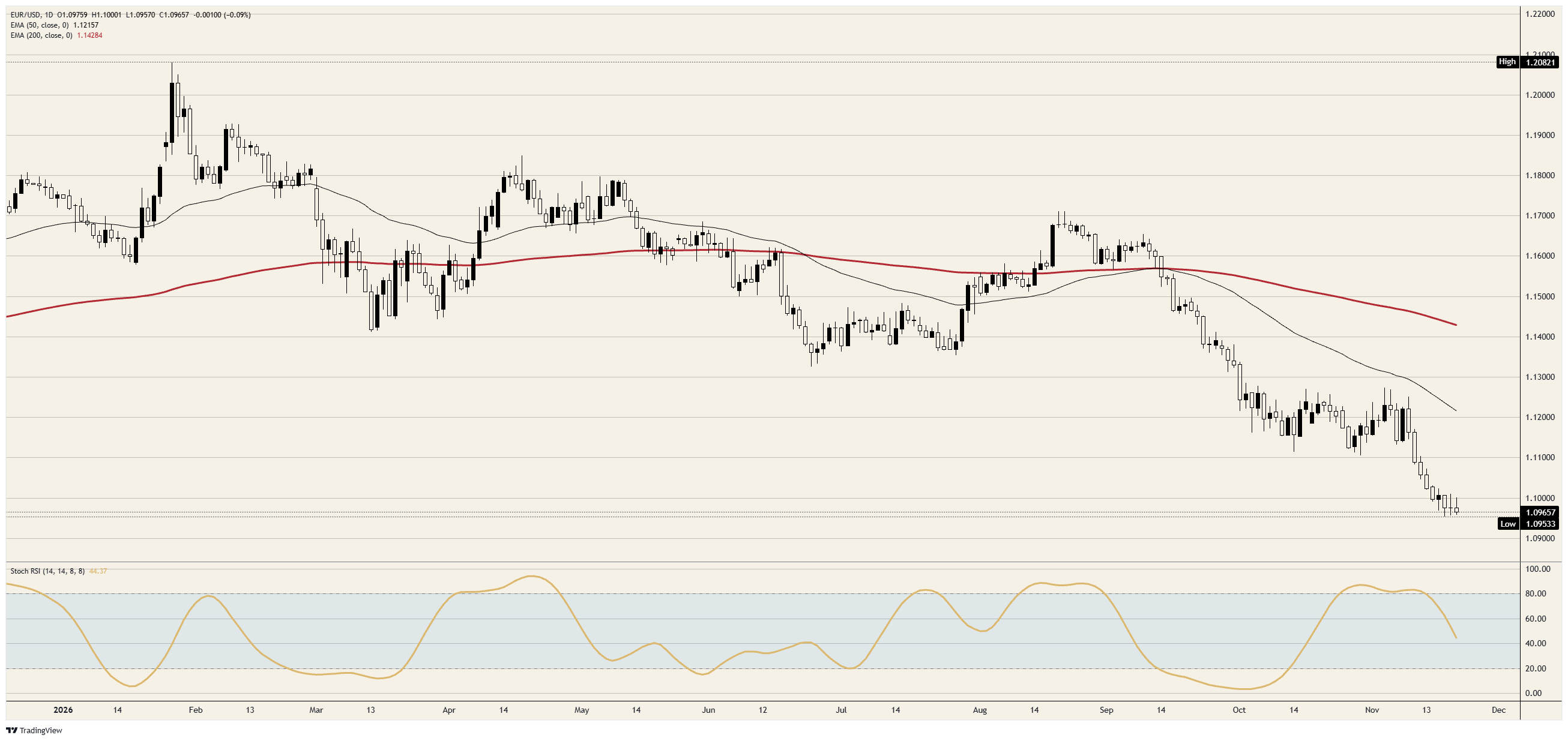
Resistance: 1.1000 has capped three straight sessions, with each high within about 10 pips of it. Above it, 1.1050 is where the pair paused on November 12 and 13 before breaking lower, and 1.1100 is the October floor it fell through on November 11.
Support: Wednesday's low just above 1.0950 is the 19-month low and has held on both sessions since. There's no 2026 level beneath it on the daily chart, which leaves 1.0900 as the next round number.
Bias: The lean is short while the pair stays under 1.1000. A daily close below 1.0950 targets 1.0900 first and 1.0850 after it. The daily Stochastic Relative Strength Index (Stoch RSI) is in the mid-40s and falling, so momentum isn't stretched enough to argue for a bounce on its own. A daily close above 1.1050 would put the pair back in the range it broke, and the short case ends there.
EUR/USD daily chart
Euro FAQs
The Euro is the currency for the 20 European Union countries that belong to the Eurozone. It is the second most heavily traded currency in the world behind the US Dollar. In 2022, it accounted for 31% of all foreign exchange transactions, with an average daily turnover of over $2.2 trillion a day. EUR/USD is the most heavily traded currency pair in the world, accounting for an estimated 30% off all transactions, followed by EUR/JPY (4%), EUR/GBP (3%) and EUR/AUD (2%).
The European Central Bank (ECB) in Frankfurt, Germany, is the reserve bank for the Eurozone. The ECB sets interest rates and manages monetary policy. The ECB’s primary mandate is to maintain price stability, which means either controlling inflation or stimulating growth. Its primary tool is the raising or lowering of interest rates. Relatively high interest rates – or the expectation of higher rates – will usually benefit the Euro and vice versa. The ECB Governing Council makes monetary policy decisions at meetings held eight times a year. Decisions are made by heads of the Eurozone national banks and six permanent members, including the President of the ECB, Christine Lagarde.
Eurozone inflation data, measured by the Harmonized Index of Consumer Prices (HICP), is an important econometric for the Euro. If inflation rises more than expected, especially if above the ECB’s 2% target, it obliges the ECB to raise interest rates to bring it back under control. Relatively high interest rates compared to its counterparts will usually benefit the Euro, as it makes the region more attractive as a place for global investors to park their money.
Data releases gauge the health of the economy and can impact on the Euro. Indicators such as GDP, Manufacturing and Services PMIs, employment, and consumer sentiment surveys can all influence the direction of the single currency. A strong economy is good for the Euro. Not only does it attract more foreign investment but it may encourage the ECB to put up interest rates, which will directly strengthen the Euro. Otherwise, if economic data is weak, the Euro is likely to fall. Economic data for the four largest economies in the euro area (Germany, France, Italy and Spain) are especially significant, as they account for 75% of the Eurozone’s economy.
Another significant data release for the Euro is the Trade Balance. This indicator measures the difference between what a country earns from its exports and what it spends on imports over a given period. If a country produces highly sought after exports then its currency will gain in value purely from the extra demand created from foreign buyers seeking to purchase these goods. Therefore, a positive net Trade Balance strengthens a currency and vice versa for a negative balance.
Eng yaxshi maqolalar
1Sunʼiy intellekt sektoridagi keskin sotuvlar kengaygani sari Dow Jones Industrial Average indeksi ketma-ket beshinchi kun pasaymoqda2Xitoy yuani: AQSh dollariga nisbatan qisqa muddatli pasayish nazorat choralari joriy etilishiga sabab boʻldi - Commerzbank3Malayziya ringgiti: Chiplar eksportiga cheklovlar va obligatsiyalar daromadliligi MYRga AQSh dollariga nisbatan bosim oʻtkazmoqda – OCBC4Xitoy yuani: qatʼiy boshqaruv ostida bosqichma-bosqich mustahkamlanish – BNY5Fed va RBA siyosati boʻyicha kutilmalar oʻrtasidagi tafovut ortib borar ekan, Avstraliya dollari bosim ostida qolmoqda6Malayziya ringgiti: iqtisodiy oʻsish valyuta kursi oʻsishidan ildamroq, kurs esa barqaror diapazonda qolmoqda – Commerzbank7Indoneziya rupiyasi: BI choralari AQSH dollariga nisbatan qadrsizlanishni yumshatmoqda - OCBC8Koreya banki: pul-kredit siyosatini qatʼiylashtirishga moyillik noyabrda ham saqlanib qoladi – DBS9Kanadada chakana savdo koʻrsatkichlari Kanada dollarining pasayishini 19 oylik minimumda vaqtincha toʻxtatdi

Boshlang!
Ro‘yxatdan o‘ting va 3 daqiqadan kamroq vaqt ichida Global bozorlariga kirish imkoniga ega bo‘ling

Biz bilan bog‘laning









Kontaktlar
Telefon: +61 2 8036 8388
Faks: +61 2 8036 8388
Email: support@tmgm.com



Ushbu veb-saytda taqdim etilgan ma’lumotlar faqat umumiy xususiyatga ega bo‘lib, shaxsiy moliyaviy maslahat hisoblanmaydi. Ushbu veb-saytdagi har qanday ma’lumot asosida harakat qilishdan oldin, ma’lumotning sizning maqsadlaringiz, moliyaviy ahvolingiz va ehtiyojlaringizga mosligini ko‘rib chiqishingiz kerak. CFD va FX Margin shartnomalariga sarmoya kiritish sezilarli xavflarni o‘z ichiga oladi va barcha investorlar uchun mos emas. Siz boshlang‘ich depozitingizdan ko‘proq yo‘qotishingiz mumkin. Siz asosiy aktivga egalik qilmaysiz va unda hech qanday manfaatga ega emassiz. Savdo qilishdan oldin mustaqil maslahat olishni va ishtirok etuvchi xavflarni to‘liq tushunishingizni tavsiya qilamiz. Veb-saytda keltirilgan har qanday mahsulotni xarid qilishdan oldin oshkor qilish hujjatini o‘qib chiqishingiz va ko‘rib chiqishingiz muhimdir. Ushbu veb-saytda taklif etilgan ma’lumotlar va reklama materiallari bunday foydalanish mahalliy qonunlar va qoidalarga zid bo‘ladigan har qanday mamlakat yoki yurisdiksiyadagi shaxslar tomonidan foydalanish uchun mo‘ljallanmagan. Ushbu veb-saytda taklif etilgan Mahsulotlar va Xizmatlar AQSh, Malayziya va Tailand rezidentlari uchun mo‘ljallanmagan.
TMGM turli yurisdiksiyalarda vakolatli va tartibga solinadi.
Trademax Australia Limited, TMGM nomi ostida faoliyat yuritadi, Avstraliya Qimmatli qog‘ozlar va investitsiyalar komissiyasi (ASIC) tomonidan tartibga solinadi, AFSL raqami 436416 va manzili: Level 28, One International Tower, 100 Barangaroo Avenue, 2000 Sydney, NSW Australia.
Email: support@tmgm.com.au
Trademax Global Limited, TMGM nomi ostida faoliyat yuritadi, Vanuatu Moliyaviy Xizmatlar Komissiyasi (VFSC) tomonidan vakolatli va tartibga solinadi, ro‘yxatga olish raqami 40356 va ro‘yxatdan o‘tgan manzili: 1276, Kumul Highway, Port Vila, Vanuatu, Vanuatu Respublikasi.
Email: support@tmgm.com
Trademax Global Markets (SE) Limited, TMGM nomi ostida faoliyat yuritadi, Seyshel orollari Moliyaviy Xizmatlar Boshqarmasi (FSA) tomonidan 224-sonli SD litsenziyasi bilan vakolatli va tartibga solinadi. Kompaniya Office No 13, Providence Estate ABIS Centre, Mahe, Seychelles manzilida ro‘yxatdan o‘tgan.
Email: support@tmgm.com
Trademax Global Markets (International) Pty Ltd, TMGM nomi ostida faoliyat yuritadi, Mauritius Moliyaviy Xizmatlar Komissiyasi (FSC) tomonidan GB22201012 litsenziya raqami bilan vakolatli va tartibga solinadi hamda 33, Edith Cavell Street C/o IQ EQ Fund Services (Mauritius) Ltd Port Louis, 11324 Mauritius manzilida ro‘yxatdan o‘tgan.
Email: support@tmgm.com
Mualliflik huquqi © TMGM. Barcha huquqlar himoyalangan