

Trading
Explore a wide range of markets with competitive pricing, deep liquidity, and advanced trading tools.
Learn More 
Platform
Trade seamlessly with TMGM's powerful platform, built for speed, precision, and a superior trading experience.
Learn More Trading Platform
Academy
Learn the fundamentals of trading with beginner-friendly resources, including guides, webinars, and market insights.
Learn More News & Analysis
Get real-time market updates and expert analysis to stay ahead of trading opportunities
Learn More News & Analysis
About
Learn what sets TMGM apart — our global presence, regulatory strength, and commitment to innovation in trading.
Learn More Why Choose TMGM
Sponsorship
EUR/USD Price Forecast: Can Bulls Maintain Their Defence of 1.0950?
- EUR/USD advances towards 1.0996 as the US Dollar’s rally loses momentum.
- An interest rate increase at the Fed’s December meeting is viewed as almost certain.
- Flash private-sector PMI readings from the Eurozone and US are firmly in investors’ focus.
A pause in the US Dollar’s rally lifts the Euro (EUR) by 0.3% to around 1.0996 against the US Dollar (USD) in Monday’s European trading session. Despite the major currency pair’s advance, the Dollar’s outlook remains strong, supported by expectations of consecutive interest rate increases from the Federal Reserve (Fed) in the near term.

The US Dollar Index (DXY) trades around 103.64 at the time of writing, a decline of 0.2%. It nevertheless remains near last week’s 19-month peak of 104.00.
Further Fed tightening is firmly reflected at the front end of the curve, according to strategists at Rabobank. They point out that “the OIS curve implies that investors are positioned for a full hike in December, followed by close to 70% of a 25bp hike priced in for the January meeting.” In their view, this positioning is “in line with Waller’s comments, after having moved from one of the most hawkish to one of the most dovish FOMC members and now back among the most hawkish.”
With expectations leaning towards a hawkish Fed, market experts anticipate further Euro losses against the US Dollar.
Can a hawkish Fed drive EUR/USD towards Nordea’s lower target?
A stronger Dollar remains central to Nordea’s outlook, with its strategists arguing that “a more hawkish Fed will support the Dollar, strengthening our case for a lower EURUSD going forward.” In support of that assessment, the bank observes that “statements from certain members over the week have also confirmed that market expectations of two to three rate hikes before summer are reasonable, in line with our Fed call.” Nordea therefore reiterates that “our baseline for the EUR/USD remains robust, and we continue to see further downside in the pair, to 1.08 during H1 2027.”
Also on investors’ radar are November’s preliminary, or flash, Purchasing Managers’ Index (PMI) readings for the Eurozone and United States (US), due later in the day.
EUR/USD Technical Analysis: Can the pair ease its bearish bias?
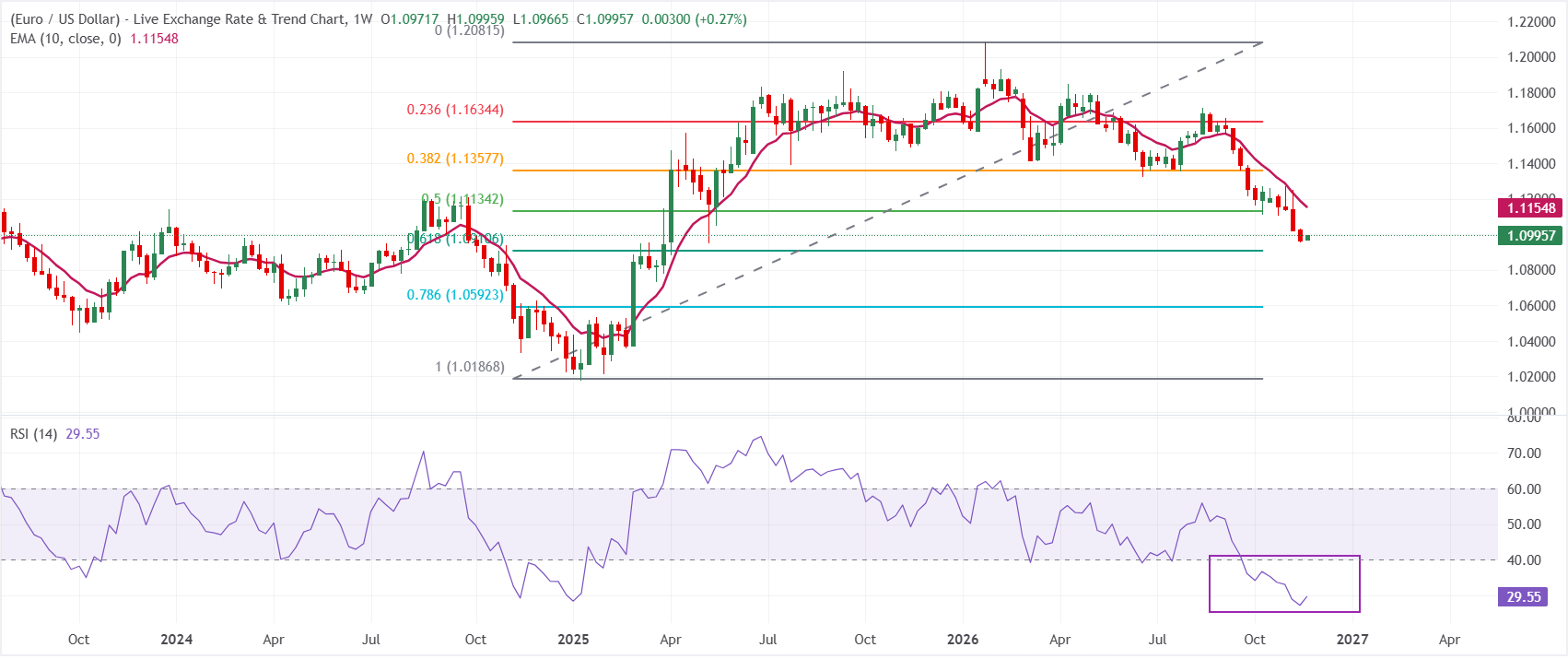
The bearish tone in EUR/USD persists on the weekly chart, where the pair trades at 1.0996, below its 10-week exponential moving average (EMA) of 1.1155. Following the extended retreat from the 1.20 area, this positioning leaves the broader downtrend in place. At roughly 29.6, the weekly Relative Strength Index (RSI) is in oversold territory, suggesting that downward momentum is stretched. However, the inability to recover the 50.00% Fibonacci retracement at 1.1134 indicates that rallies continue to attract selling pressure.
For any recovery, the first hurdle is the 50.00% Fibonacci retracement at 1.1134, with the 10-week EMA at 1.1155 just above it. These levels create a key supply zone, and only a weekly close above that zone would ease the immediate bearish tone. Beyond it, resistance stands at the 38.20% retracement of 1.1358 and the 23.60% level of 1.1634, followed by the cycle-high area around the 0.00% retracement at 1.2082. If losses continue instead, initial support lies at the 61.80% Fibonacci retracement of 1.0911. Further support is at 1.0592 (78.60%) and 1.0187 (100.00%), where buyers may try to limit a deeper decline should the current slide persist.
(The technical analysis of this story was written with the help of an AI tool. Know more.)
Questions about the Fed
The Federal Reserve (Fed) sets US monetary policy with a dual mandate of maintaining price stability and promoting full employment. Adjusting interest rates is its main means of meeting these objectives. If prices climb too rapidly and inflation exceeds the Fed’s 2% target, the central bank increases interest rates. Borrowing then becomes more expensive across the economy, while the US becomes a more attractive destination for international investors’ funds, strengthening the US Dollar (USD). Conversely, inflation below 2% or an excessively high unemployment rate may prompt the Fed to cut interest rates to stimulate borrowing. Such a move puts pressure on the Greenback.
At eight policy meetings each year, the Federal Open Market Committee (FOMC) reviews the economy and takes monetary policy decisions for the Federal Reserve (Fed). Twelve Fed officials attend the FOMC: all seven members of the Board of Governors, the president of the Federal Reserve Bank of New York and four presidents drawn from the other eleven regional Reserve Banks. These four serve rotating one-year terms.
To restore credit flows when the financial system is stalled, the Federal Reserve may turn to Quantitative Easing (QE) in extreme circumstances. Through QE, the Fed substantially expands the flow of credit. Reserved for crises or periods of exceptionally low inflation, this unconventional policy was the Fed’s preferred response during the Great Financial Crisis in 2008. The process entails printing additional Dollars to purchase high-grade bonds from financial institutions. The US Dollar typically weakens as a result of QE.
Reversing QE, quantitative tightening (QT) involves the Federal Reserve halting bond purchases from financial institutions. It also refrains from using principal repayments on its maturing bond holdings to buy new bonds. This process generally supports the US Dollar’s value.
POPULAR ARTICLES
1As traders scale back Fed rate hike bets, British Pound inches higher above 1.31002EUR/USD Price Forecast: Can Bulls Maintain Their Defence of 1.0950?3Euro: Does downside risk against the US Dollar hinge on a break of 1.0950? – UOB4Chainlink Price Forecast: Is LINK’s recovery signalling a bull trap amid strong ETF outflows?5Indian Rupee rally takes a breather as India’s HSBC PMI posts another expansion6Indonesian Rupiah gains as USD/IDR comes under pressure from MSCI talks and BI rate hike7New Zealand Dollar near multi-year low: Why are bulls unmoved by upbeat data and a softer USD?8Solana Price Forecast: How are ETF inflows cushioning the sell-off as SOL holds above $70?9EUR/JPY Price Forecast: Can gains above 174.50 offset the bearish bias below the 100-day SMA?


Get Started!
Sign up and access the Global Markets in less than 3 minutes

Connect With Us









Contacts
Phone: +61 2 8036 8388
Fax: +61 2 8036 8388
Email: support@tmgm.com



The information provided on this website is of a general nature only and does not constitute personal financial advice. Before acting on any information on this website, you should consider the suitability of the information in relation to your objectives, financial situation and needs. Investing in CFDs and FX Margin Contracts carries significant risks and is not suitable for all investors. You may lose more than your initial deposit. You do not own, or have, any interest in the underlying asset. We recommend that you seek independent advice and ensure you fully understand the risks involved before trading. It is important that you read and consider the disclosure document before you acquire any product listed on the website. The information and advertisements offered on this website are not intended for use by any person in any country or jurisdiction where such use would be contrary to local laws and regulations. The Products and Services offered on this website are not intended for residents of the United States, Malaysia and Thailand.
TMGM is authorized and regulated in various jurisdictions.
Trademax Australia Limited, trading as TMGM, is regulated by the Australian Securities and Investments Commission (ASIC), AFSL no. 436416 and is located at Level 28, One International Tower, 100 Barangaroo Avenue, 2000 Sydney, NSW Australia.
Email: support@tmgm.com.au
Trademax Global Limited, trading as TMGM, is authorized and regulated by the Vanuatu Financial Services Commission (VFSC), registration number 40356 and registered at 1276, Kumul Highway, Port Vila, Vanuatu, Republic of Vanuatu.
Email: support@tmgm.com
Trademax Global Markets (SE) Limited, trading as TMGM, is authorized and regulated by the Financial Services Authority (FSA) of Seychelles, with license number SD224. The company is registered at Office No 13, Providence Estate ABIS Centre, Mahe, Seychelles.
Email: support@tmgm.com
Trademax Global Markets (International) Pty Ltd, trading as TMGM, is authorized and regulated by the Financial Services Commission, Mauritius (FSC) with license no. GB22201012, and registered at 33, Edith Cavell Street C/o IQ EQ Fund Services (Mauritius) Ltd Port Louis, 11324 Mauritius.
Email: support@tmgm.com
Copyright © TMGM. All rights reserved