

Trading
Explore a wide range of markets with competitive pricing, deep liquidity, and advanced trading tools.
Learn More 
Platform
Trade seamlessly with TMGM's powerful platform, built for speed, precision, and a superior trading experience.
Learn More Trading Platform
Academy
Learn the fundamentals of trading with beginner-friendly resources, including guides, webinars, and market insights.
Learn More News & Analysis
Get real-time market updates and expert analysis to stay ahead of trading opportunities
Learn More News & Analysis
About
Learn what sets TMGM apart — our global presence, regulatory strength, and commitment to innovation in trading.
Learn More Why Choose TMGM
Sponsorship
Why is the US Dollar shrugging off Bessent's warning against Fed overtightening?
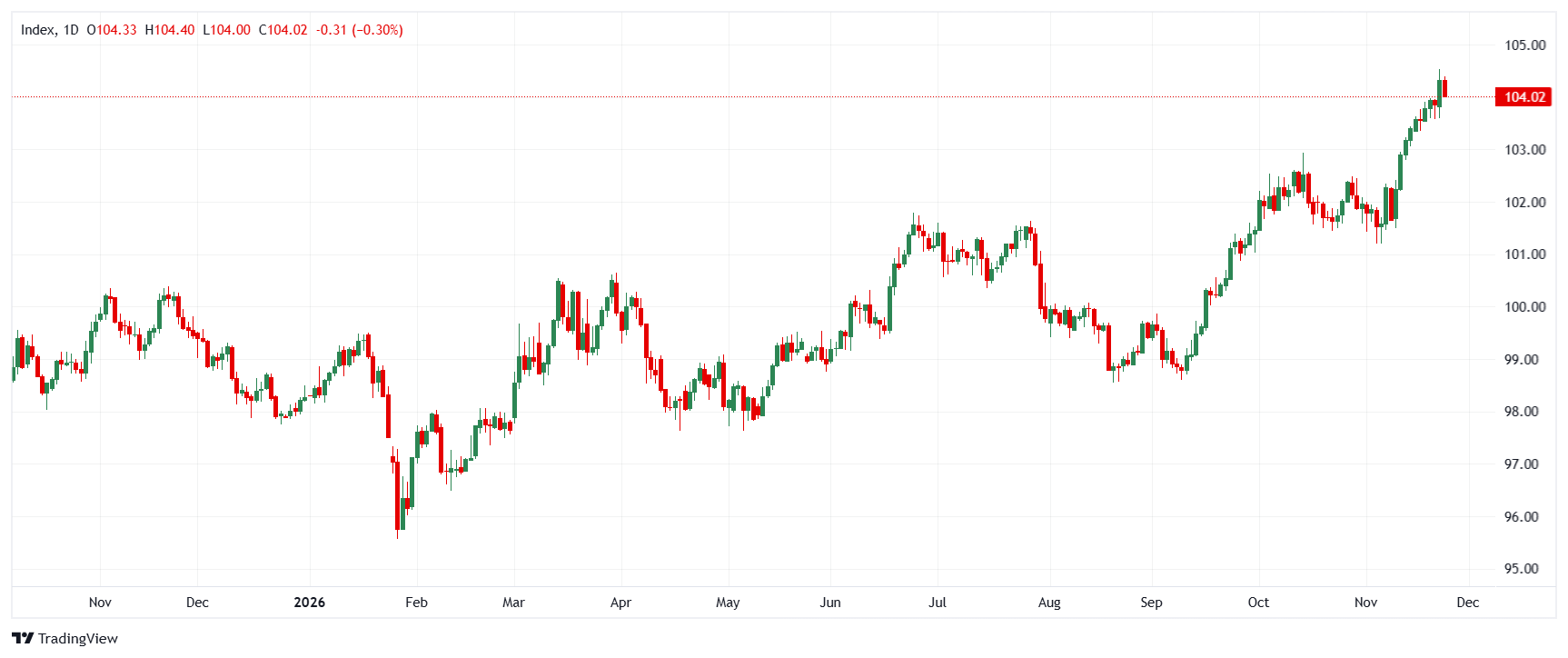
The US Dollar (USD) is holding firm as rebounding US equity futures and resilient domestic economic fundamentals offset concerns over potential Federal Reserve (Fed) overtightening ahead of the Thanksgiving holiday week. While Treasury Secretary Scott Bessent has pushed back against aggressive rate increases — arguing that falling crude Oil prices and tighter financial conditions reduce the case for a 50 bps move — sticky underlying inflation, AI-driven capital expenditure, and a stabilizing labor market keep a 25 bps December Fed funds rate hike firmly on track. Institutional strategists at TD Securities and Brown Brothers Harriman (BBH) are assessing whether persistent inflationary pressures will drive a broader tightening cycle or if a narrowing US growth advantage against major peers will erode a key pillar of US Dollar strength.
TD Securities expects resilient growth and four total Fed hikes to underpin US Dollar
Strategists at TD Securities note that strong underlying US economic activity — supported by AI investment and high-income consumers — alongside inflationary risks from the Iran conflict should prompt four total Federal Reserve rate hikes, providing a constructive backdrop for the US Dollar. Although GDP growth is projected to moderate from 2.6% in 2026 to 2.3% in 2027 with a 25% recession probability, a stabilizing labor market and internal FOMC debate over forward guidance keep upward policy pressure in place ahead of key Gross Domestic Product (GDP) and Personal Consumption Expenditures (PCE) inflation data.
"GDP growth will likely moderate in 2027 to 2.3% Q4/Q4 after ending a firm 2.6% in 2026. Stable growth should result in a still-low unemployment rate of 4.2% by Q4 2027... We expect output growth to move sideways through next year, reflecting the lingering impact of the oil shock. The Iran conflict, AI build-out, and resilient economic activity present inflationary risks, which we expect will lead to four total Fed hikes... In an interview, Waller confirmed he would support a 50bp hike if it is not communicated that additional tightening in the meetings following December is likely."
Brown Brothers Harriman sees 25bps December hike intact while watching US growth advantage
Elias Haddad at Brown Brothers Harriman (BBH) observes that the US Dollar recovered earlier losses alongside a rebound in US equity futures, turning immediate focus to the November US S&P Global Composite Purchasing Managers’ Index (PMI) (forecast at 55.6 versus 55.9 previously). While Treasury Secretary Scott Bessent’s warnings against overtightening dampen prospects for a 50 bps rate hike, robust growth, favorable labor conditions, and sticky underlying inflation keep a 25 bps December hike on course — though Haddad cautions that any further narrowing in the US growth advantage relative to the Eurozone, UK, and Japan would erode a core support for the Greenback.
"USD clawed back most of its early losses and US equity futures are mounting a rebound from last week’s tech selloff. The US November S&P Global PMI takes the spotlight today... The composite PMI is expected to dip to 55.6 vs. 55.9 in October. The US growth advantage has narrowed against the Eurozone, UK, and Japan but remains sizeable. A further narrowing of the gap, particularly if driven by weaker US activity, would erode a key pillar of USD strength... Bessent’s comments are unlikely to knock a 25bps December fed funds rate hike off course... Importantly, robust US growth, favorable labor market conditions and sticky underlying inflation support the Fed’s hawkish bias."
Key Takeaway
The US Dollar remains supported by solid domestic economic momentum and a Federal Reserve committed to curbing sticky inflation, even as policymakers debate the pace of tightening. While TD Securities highlights that inflationary pressures from energy shocks and AI investment could ultimately drive four total Fed hikes alongside 2.6% GDP growth in 2026, Brown Brothers Harriman (BBH) underscores that although a 25 bps December hike remains firmly on track despite pushback from Treasury Secretary Bessent, traders must closely watch November PMI figures (55.6 expected) for any signs that a narrowing US growth advantage could begin to erode the Greenback's foundational strength.
(This article was created with the help of an Artificial Intelligence tool and reviewed by an editor. Know more.)
POPULAR ARTICLES
1Why is the US Dollar shrugging off Bessent's warning against Fed overtightening?2BRL: Currency Weakens Against US Dollar as Fiscal Concerns Mount – Societe Generale3Are Fed interest rate hike bets taking the momentum out of gold’s rebound?4Crypto Today: ETF redemptions persist as Bitcoin and Ethereum ease lower and XRP steadies5Mexican Peso: Can fading Fed hike bets drive expected gains against US Dollar? – Rabobank6South African Rand: Can the upbeat outlook withstand political risk? – Commerzbank7Hungarian Forint: How are Moody’s and MNB supporting the rebound against the Euro? – Societe Generale8Silver price today: FXStreet data shows a decline9Japanese Yen: Upside risk against US Dollar amid range-bound trading – UOB

Get Started!
Sign up and access the Global Markets in less than 3 minutes

Connect With Us









Contacts
Phone: +61 2 8036 8388
Fax: +61 2 8036 8388
Email: support@tmgm.com



The information provided on this website is of a general nature only and does not constitute personal financial advice. Before acting on any information on this website, you should consider the suitability of the information in relation to your objectives, financial situation and needs. Investing in CFDs and FX Margin Contracts carries significant risks and is not suitable for all investors. You may lose more than your initial deposit. You do not own, or have, any interest in the underlying asset. We recommend that you seek independent advice and ensure you fully understand the risks involved before trading. It is important that you read and consider the disclosure document before you acquire any product listed on the website. The information and advertisements offered on this website are not intended for use by any person in any country or jurisdiction where such use would be contrary to local laws and regulations. The Products and Services offered on this website are not intended for residents of the United States, Malaysia and Thailand.
TMGM is authorized and regulated in various jurisdictions.
Trademax Australia Limited, trading as TMGM, is regulated by the Australian Securities and Investments Commission (ASIC), AFSL no. 436416 and is located at Level 28, One International Tower, 100 Barangaroo Avenue, 2000 Sydney, NSW Australia.
Email: support@tmgm.com.au
Trademax Global Limited, trading as TMGM, is authorized and regulated by the Vanuatu Financial Services Commission (VFSC), registration number 40356 and registered at 1276, Kumul Highway, Port Vila, Vanuatu, Republic of Vanuatu.
Email: support@tmgm.com
Trademax Global Markets (SE) Limited, trading as TMGM, is authorized and regulated by the Financial Services Authority (FSA) of Seychelles, with license number SD224. The company is registered at Office No 13, Providence Estate ABIS Centre, Mahe, Seychelles.
Email: support@tmgm.com
Trademax Global Markets (International) Pty Ltd, trading as TMGM, is authorized and regulated by the Financial Services Commission, Mauritius (FSC) with license no. GB22201012, and registered at 33, Edith Cavell Street C/o IQ EQ Fund Services (Mauritius) Ltd Port Louis, 11324 Mauritius.
Email: support@tmgm.com
Copyright © TMGM. All rights reserved