

Trading
Explore a wide range of markets with competitive pricing, deep liquidity, and advanced trading tools.
Learn More 
Platform
Trade seamlessly with TMGM's powerful platform, built for speed, precision, and a superior trading experience.
Learn More Trading Platform
Academy
Learn the fundamentals of trading with beginner-friendly resources, including guides, webinars, and market insights.
Learn More News & Analysis
Get real-time market updates and expert analysis to stay ahead of trading opportunities
Learn More News & Analysis
About
Learn what sets TMGM apart — our global presence, regulatory strength, and commitment to innovation in trading.
Learn More Why Choose TMGM
Sponsorship
19-month lows: Canadian Dollar remains under pressure as US Dollar recoups losses
- Mid-1.4300s regained by USD/CAD. The pair is approaching the 19-month high of 1-4357.
- Weak data from the Eurozone and UK give the US Dollar renewed support on Monday.
- Falling Oil prices and uncertainty over the BoC’s December decision keep the Canadian Dollar under pressure.
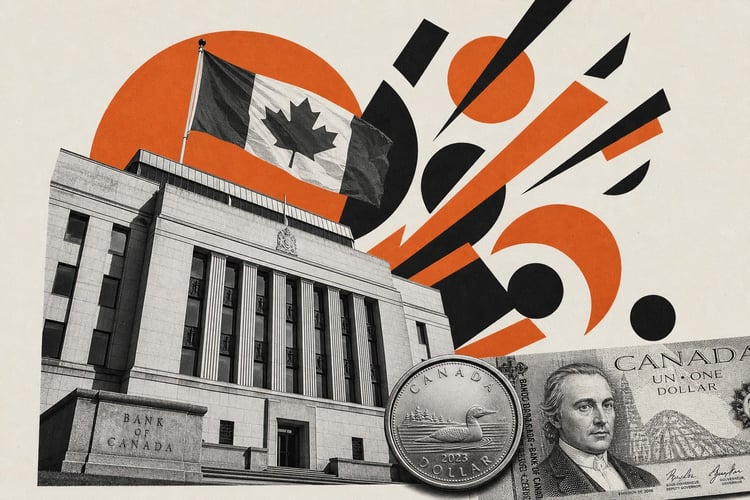
1.4340 is the USD/CAD rate at the time of writing. Having recovered from session lows near 1.4110, the pair is approaching last week’s 19-month high of 1.4357. At Monday’s New York open, the Canadian Dollar (CAD) is virtually unchanged against the US Dollar (USD), sitting just above 19-month lows. The Greenback has recovered most of its losses from the Asian session.
The upbeat sentiment at the European open faded after mixed Eurozone business activity readings and weak UK Flash PMI data. These releases supported broad-based gains in the US Dollar.
At the start of the week, modest risk appetite weighed on the US Dollar. US Treasury Secretary Scott Bessent had warned the US Federal Reserve (Fed) of the risks of overtightening, leading investors to scale back expectations for a half-point rate increase following the December 8 and 9 Federal Open Market Committee (FOMC) meeting.
HSBC expects USD strength, sees sharp gains as less likely
Comparing the current macroeconomic environment with the past, HSBC analysts say it “has some similarities with 2022, when rising interest rates, geopolitical tensions and energy-market disruption supported the USD.” Their qualification is that “the backdrop now is less extreme.”
In the assessment of HSBC experts, “inflation is rising more gradually, interest rates are already at a higher level and labour-market pressures are less tight.” On that basis, the bank concludes that “the USD could remain strong, although a sharp rally may be less likely.”
For the Canadian Dollar, pressure continues to come from weaker Oil prices, Canada’s main export, alongside the soft Canadian inflation figures published last week. Brent Oil is down 1.7% so far on the day. Its cumulative decline from the late-October highs exceeds 20%, creating a substantial drag on Loonie rallies.
Last week’s Canadian Consumer Price Index (CPI) release showed annual inflation holding steady in October. Meanwhile, Trimmed Mean CPI slowed for the first time since May, providing grounds for the Bank of Canada (BoC) to leave rates unchanged in December. Markets are therefore likely to scrutinise BoC Governor Tiff Macklem’s address at the Economic Club of Canada.
Bank of Canada: key questions answered
Based in Ottawa, the Bank of Canada (BoC) sets Canada’s interest rates and directs monetary policy. Decisions are taken at eight scheduled meetings each year, supplemented by emergency meetings when needed. Maintaining price stability is the BoC’s primary mandate, with inflation kept within a 1-3% range. Interest rate increases and cuts are its main means of achieving that goal. Higher relative interest rates generally strengthen the Canadian Dollar (CAD), while lower rates tend to weaken it. The bank can also use quantitative easing and quantitative tightening.
When conditions become extreme, the Bank of Canada may resort to Quantitative Easing. Under QE, the BoC prints Canadian Dollars to purchase assets from financial institutions, typically government or corporate bonds. The policy generally weakens the CAD. It serves as a last resort when interest rate cuts alone are unlikely to deliver price stability. During the Great Financial Crisis of 2009-11, the Bank of Canada deployed QE after banks’ loss of confidence in one another’s capacity to repay debt caused credit to freeze.
Once an economic recovery is under way and inflation begins to rise following QE, the Bank of Canada can undertake the reverse process, Quantitative tightening (QT). QE supplies financial institutions with liquidity through purchases of government and corporate bonds. Under QT, by contrast, the BoC halts further asset purchases and no longer reinvests principal from its existing bonds as they mature. This is generally supportive of, or bullish for, the Canadian Dollar.
POPULAR ARTICLES
119-month lows: Canadian Dollar remains under pressure as US Dollar recoups losses2Polish Zloty: Gains capped by election risks – Commerzbank3XRP consolidates as retail and institutional capital flows out: Ripple Price Forecast4British Pound downside risks moderated by BoE path – BBH5Swiss Franc Advances as Investors Stay Cautious Following Equity Sell-off6Euro pressured by ECB repricing and political risks – Rabobank7Into 2027: Robust Outlook for the US Dollar – HSBC8Weak Eurozone, UK business activity data spur US Dollar Index (DXY) rebound9Swiss Franc: SNB stance signals upside against Euro – ING


Get Started!
Sign up and access the Global Markets in less than 3 minutes

Connect With Us









Contacts
Phone: +61 2 8036 8388
Fax: +61 2 8036 8388
Email: support@tmgm.com



The information provided on this website is of a general nature only and does not constitute personal financial advice. Before acting on any information on this website, you should consider the suitability of the information in relation to your objectives, financial situation and needs. Investing in CFDs and FX Margin Contracts carries significant risks and is not suitable for all investors. You may lose more than your initial deposit. You do not own, or have, any interest in the underlying asset. We recommend that you seek independent advice and ensure you fully understand the risks involved before trading. It is important that you read and consider the disclosure document before you acquire any product listed on the website. The information and advertisements offered on this website are not intended for use by any person in any country or jurisdiction where such use would be contrary to local laws and regulations. The Products and Services offered on this website are not intended for residents of the United States, Malaysia and Thailand.
TMGM is authorized and regulated in various jurisdictions.
Trademax Australia Limited, trading as TMGM, is regulated by the Australian Securities and Investments Commission (ASIC), AFSL no. 436416 and is located at Level 28, One International Tower, 100 Barangaroo Avenue, 2000 Sydney, NSW Australia.
Email: support@tmgm.com.au
Trademax Global Limited, trading as TMGM, is authorized and regulated by the Vanuatu Financial Services Commission (VFSC), registration number 40356 and registered at 1276, Kumul Highway, Port Vila, Vanuatu, Republic of Vanuatu.
Email: support@tmgm.com
Trademax Global Markets (SE) Limited, trading as TMGM, is authorized and regulated by the Financial Services Authority (FSA) of Seychelles, with license number SD224. The company is registered at Office No 13, Providence Estate ABIS Centre, Mahe, Seychelles.
Email: support@tmgm.com
Trademax Global Markets (International) Pty Ltd, trading as TMGM, is authorized and regulated by the Financial Services Commission, Mauritius (FSC) with license no. GB22201012, and registered at 33, Edith Cavell Street C/o IQ EQ Fund Services (Mauritius) Ltd Port Louis, 11324 Mauritius.
Email: support@tmgm.com
Copyright © TMGM. All rights reserved