

Trading
Explore a wide range of markets with competitive pricing, deep liquidity, and advanced trading tools.
Learn More 
Platform
Trade seamlessly with TMGM's powerful platform, built for speed, precision, and a superior trading experience.
Learn More Trading Platform
Academy
Learn the fundamentals of trading with beginner-friendly resources, including guides, webinars, and market insights.
Learn More News & Analysis
Get real-time market updates and expert analysis to stay ahead of trading opportunities
Learn More News & Analysis
About
Learn what sets TMGM apart — our global presence, regulatory strength, and commitment to innovation in trading.
Learn More Why Choose TMGM
Sponsorship
XRP Price Forecast: Ripple approaches oversold levels as traders assess buying opportunities
- $1.20 remains XRP’s trading level. A wider crypto sell-off continues as growing concerns over US regulation pressure the market.
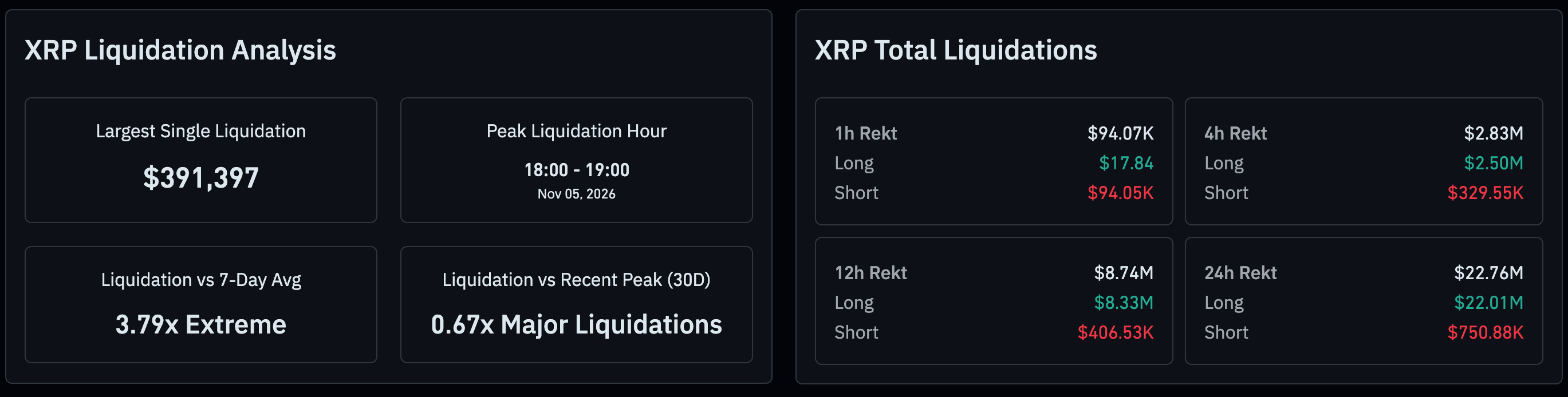
- Despite $22 million in liquidations over 24 hours as XRP falls, futures Open Interest climbs to 2.33 billion XRP, pointing to stronger retail demand.
- Overhead moving averages and bearish momentum signals continue to constrain XRP’s technical outlook.
$1.20 remains the structural ceiling for Ripple (XRP). Selling has erased the early-week advance to $1.34 driven by the United States (US) midterm elections. Ahead of the Democrats taking control of Congress in January, regulatory worries prompted many market participants to reposition and rebalance their portfolios.

XRP under pressure from US regulatory uncertainty
With Democrats due to take control of the House and Senate in January, uncertainty over the future of US crypto regulation is intensifying. These concerns among market participants continue to create mounting headwinds for the broader cryptocurrency market.
Senator Elizabeth Warren is set to chair the Senate Banking Committee, according to a Wall Street Journal report published on Thursday. Expectations are that Warren will push for tighter crypto regulation and consumer protections for crypto entities.
Investigations into alleged insider trading in prediction markets may also feature among Warren’s early priorities, the report notes. Another potential focus is assessing alleged conflicts of interest involving US President Donald Trump and his family. Warren has not yet been confirmed as Senate Banking Committee Chair, but observers see little prospect of another candidate taking the role.
In an opinion piece published in Time on Thursday, Senator Warren wrote: “Democrats won this election by claiming we are on the side of working people, and working people are counting on us to deliver,”
$22 million in XRP derivatives liquidations
XRP derivatives liquidations total $22 million over the last 24 hours as of Friday. The wider cryptocurrency sell-off has inflicted losses on many traders, particularly in derivatives. Long positions account for the heaviest losses, with roughly $21 million liquidated, against nearly $1 million for shorts. If long liquidations persist, forced selling and self-reinforcing price declines could deepen the correction.
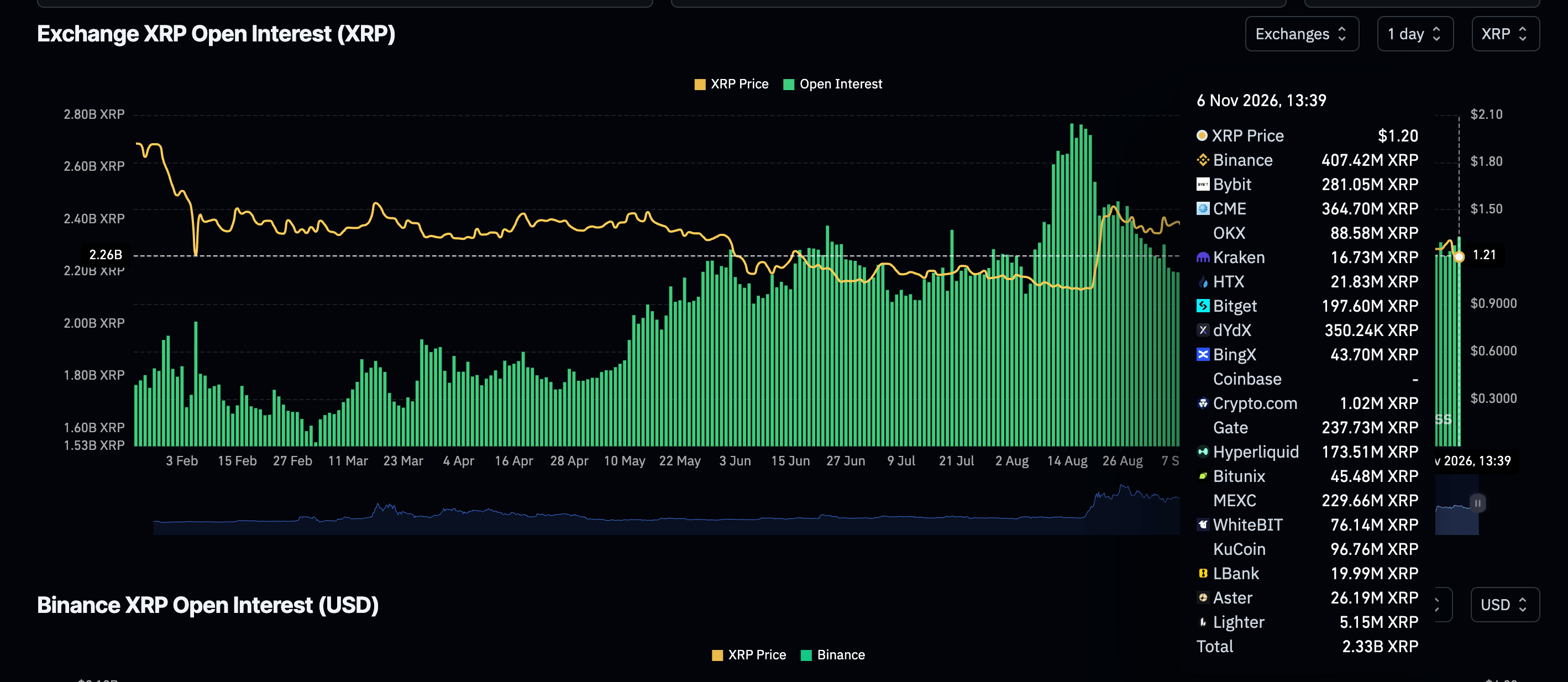
Once excess leverage has been removed, however, fading speculation could allow XRP to stabilise or rebound sharply. Bears should therefore moderate their expectations. Retail traders nevertheless appear to be using the decline to build leveraged exposure: perpetual futures Open Interest (OI) increased to 2.33 billion XRP on Friday from 2.28 billion XRP a day earlier. Further improvement in risk appetite could provide enough support for a short-term XRP recovery towards resistance at $1.30.
$1.20 XRP technical analysis: sellers keep control
At $1.20, XRP retains a bearish bias, trading firmly below all key Exponential Moving Averages (EMAs) and the Bollinger Bands’ midline. Overhead resistance comes from the 50-day Exponential Moving Average (EMA) at $1.33, the 100-day EMA at $1.32 and the 200-day EMA at $1.36, maintaining a downside-oriented structure. Negative territory also continues to contain the Moving Average Convergence Divergence (MACD) indicator. Meanwhile, the Relative Strength Index (RSI) sits near 35, signalling sustained selling pressure that has not yet reached an extreme.
Just above the spot price, the lower Bollinger band around $1.20 forms the nearest resistance, with the Bollinger midline near $1.29 next. Beyond that, a concentrated technical barrier comprises the 100-day EMA at $1.32 and the 50-day EMA at $1.33. Further resistance lies at the 200-day EMA at $1.36 and the upper Bollinger band near $1.37.
Until the pair recovers the $1.29-$1.33 resistance zone, further downside would likely remain a risk. The daily chart shows no clear structural support beneath the current price.
(The technical analysis of this story was written with the help of an AI tool. Know more.)
Open Interest and funding rates: key questions
An increase in Open Interest is linked to greater liquidity and fresh capital entering the market. It is viewed as an improvement in market efficiency, with the prevailing trend continuing. Falling Open Interest, by contrast, is regarded as evidence of market liquidation and investor departures. As overall demand for an asset weakens, bearish sentiment among investors grows.
By raising the liquidation risks traders face, funding fees help close the gap between an asset’s spot price and its futures contract prices. Persistently high, positive funding rates signal bullish market sentiment and expectations of a price increase. Conversely, a funding rate that remains negative indicates bearish sentiment towards the asset. It suggests traders anticipate a decline in the cryptocurrency’s price and that a bearish trend reversal is likely.
POPULAR ARTICLES
1Banxico rate cut puts Mexican Peso at risk – ING2Risk aversion keeps British Pound under pressure against Japanese Yen3United States U6 Underemployment Rate up to 7.9% in October from previous 7.6%4United States Labor Force Participation Rate up to 61.9% in October from previous 61.8%5United States Average Weekly Hours in line with forecasts (34.4) in October6United States Nonfarm Payrolls above forecasts (65K) in October: Actual (165K)7United States Unemployment Rate below forecasts (4.2%) in October: Actual (4.1%)8United States Average Hourly Earnings (YoY) above forecasts (2.9%) in October: Actual (3.1%)9United States Average Hourly Earnings (MoM) came in at 0.4%, above forecasts (0.3%) in October


Get Started!
Sign up and access the Global Markets in less than 3 minutes

Connect With Us









Contacts
Phone: +61 2 8036 8388
Fax: +61 2 8036 8388
Email: support@tmgm.com



The information provided on this website is of a general nature only and does not constitute personal financial advice. Before acting on any information on this website, you should consider the suitability of the information in relation to your objectives, financial situation and needs. Investing in CFDs and FX Margin Contracts carries significant risks and is not suitable for all investors. You may lose more than your initial deposit. You do not own, or have, any interest in the underlying asset. We recommend that you seek independent advice and ensure you fully understand the risks involved before trading. It is important that you read and consider the disclosure document before you acquire any product listed on the website. The information and advertisements offered on this website are not intended for use by any person in any country or jurisdiction where such use would be contrary to local laws and regulations. The Products and Services offered on this website are not intended for residents of the United States, Malaysia and Thailand.
TMGM is authorized and regulated in various jurisdictions.
Trademax Australia Limited, trading as TMGM, is regulated by the Australian Securities and Investments Commission (ASIC), AFSL no. 436416 and is located at Level 28, One International Tower, 100 Barangaroo Avenue, 2000 Sydney, NSW Australia.
Email: support@tmgm.com.au
Trademax Global Limited, trading as TMGM, is authorized and regulated by the Vanuatu Financial Services Commission (VFSC), registration number 40356 and registered at 1276, Kumul Highway, Port Vila, Vanuatu, Republic of Vanuatu.
Email: support@tmgm.com
Trademax Global Markets (SE) Limited, trading as TMGM, is authorized and regulated by the Financial Services Authority (FSA) of Seychelles, with license number SD224. The company is registered at Office No 13, Providence Estate ABIS Centre, Mahe, Seychelles.
Email: support@tmgm.com
Trademax Global Markets (International) Pty Ltd, trading as TMGM, is authorized and regulated by the Financial Services Commission, Mauritius (FSC) with license no. GB22201012, and registered at 33, Edith Cavell Street C/o IQ EQ Fund Services (Mauritius) Ltd Port Louis, 11324 Mauritius.
Email: support@tmgm.com
Copyright © TMGM. All rights reserved