

التداول
اكتشف مجموعة متنوعة من الأسواق العالمية مع تسعير تنافسي، سيولة عالية، وأدوات تداول متقدمة تدعم قراراتك الاستثمارية.
اكتشف المزيد 
منصات التداول
تداول بسلاسة مع منصة TMGM القوية، المصممة للسرعة والدقة وتجربة تداول فائقة.
اكتشف المزيد منصات التداول
الأكاديمية
تعلّم أساسيات التداول من خلال محتوى تعليمي مُبسط ومصمم للمبتدئين، يشمل أدلة تعليمية،ندوات مباشرة عبر الإنترنت، وتحليلات لأهم تحركات السوق.
اكتشف المزيد أكاديمية TMGM
الأخبار والتحليلات
تابع أحدث تطورات الأسواق لحظة بلحظة، مع تحليلات احترافية تساعدك على اتخاذ قرارات مدروسة والاستفادة من فرص التداول.
اكتشف المزيد الأخبار والتحليلات
معلومات عنا
تعرّف على ما يميز TMGM، من حضور عالمي قوي وإشراف تنظيمي موثوق، إلى التزامنا المستمر بالابتكار وتطوير بيئة تداول متقدمة.
اكتشف المزيد لماذا TMGM؟
Gold consolidates near $4,000 as recovery remains fragile ahead of Fed decision
- Gold reclaims $4,000 as Middle East diplomatic efforts prompt a pullback in Oil prices.
- Traders await the Fed's monetary policy announcement scheduled for Wednesday.
- Technical indicators remain bearish, with RSI near oversold territory and MACD in negative territory.
Gold (XAU/USD) consolidates modest gains on Monday after last week’s sharp decline pushed the metal to $3,975, its lowest level since August. A pullback in Oil prices offers support as traders react to diplomatic efforts to ease tensions in the Middle East. At the time of writing, XAU/USD trades around $4,016, up 0.50% on the day.
Reuters reported that officials from Saudi Arabia, Pakistan and Turkey, the three Mecca Pact members, are holding talks with Iranian leaders in Tehran on Monday. Iranian Foreign Ministry spokesman Esmaeil Baghaei said the discussions will cover Israel’s expansionist policies, developments in Lebanon and the US war against Iran.
The meeting follows talks between Qatari mediators and Iranian officials in Tehran on Sunday as part of efforts to ease regional tensions. West Texas Intermediate (WTI) Oil eases to around $100.39 per barrel after reaching $103.28 on Friday, its highest level since May.
The metal lost around 4% last week, its steepest weekly decline since June, as rising Oil prices reinforced expectations of further Federal Reserve (Fed) tightening, outweighing support from falling US Treasury yields and a softer US Dollar (USD). Treasury yields came under pressure as concerns over AI-related investments drove demand for government bonds. The broader equity sell-off may also have prompted some traders to sell Gold to cover losses elsewhere.
The US Dollar and US Treasury yields pause their decline at the start of the week, limiting Gold’s recovery. The US Dollar Index (DXY), which tracks the Greenback’s value against a basket of six major currencies, trades around 101.83, while the benchmark 10-year US Treasury yield stands near 4.99%.
Attention now turns to this week’s Federal Reserve (Fed) monetary policy announcement, which could determine whether Gold holds above the $4,000 psychological mark or faces another round of selling.
The Fed is widely expected to leave interest rates unchanged at 3.75%-4.00% when its two-day meeting concludes on Wednesday. However, a pause may offer little reassurance to Gold buyers if policymakers keep the door open to another increase in December, with traders pricing in around a 79% probability of a hike, according to the CME FedWatch Tool.
Fed seen on hold now but December hike risk builds as inflation stays above target
According to TD Securities, analysts don't expect "much new communication from the FOMC or Chair Warsh." In their view, "a hold in October will make a December hike all the more likely," particularly after the "upside surprise in September CPI," which underscores that "inflation risks are still pertinent." TD Securities therefore "expect the Fed to hike two more times (December and March)," noting that "inflation remains above target while risks are growing." They add that "the evolution of inflation data will determine the extent and pace of hikes later in the cycle," suggesting that incoming price figures will be crucial in shaping the policy path beyond early next year.
Technical analysis: Lower Bollinger Band caps upside
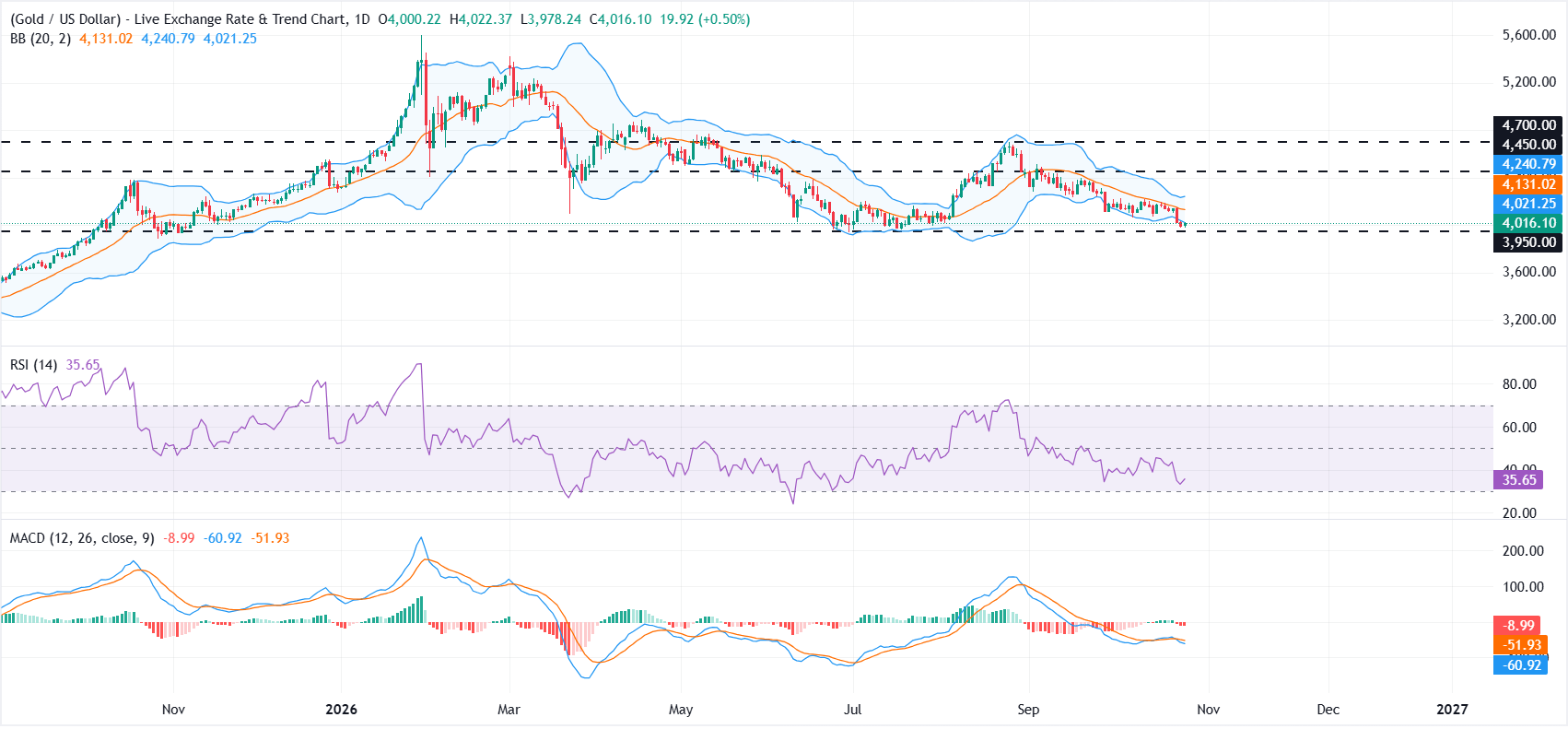
On the daily chart, XAU/USD maintains a bearish near-term bias as prices hover below the lower Bollinger Band at $4,020. The Relative Strength Index (RSI) at 35 sits just above oversold territory, while the Moving Average Convergence Divergence (MACD) histogram remains negative; both indicators hint at persistent downside pressure rather than a decisive exhaustion of the recent slide.
On the upside, initial resistance emerges at the lower Bollinger Band near $4,020, followed by the middle band around $4,131 and the upper band near $4,241. A sustained break above these levels could open the door for a recovery toward the $4,400-$4,500 zone, followed by $4,700.
On the downside, immediate support lies in the $3,975-$3,950 region. A decisive break below this zone could trigger a deeper decline toward the $3,900 psychological mark, followed by $3,800.
(The technical analysis of this story was written with the help of an AI tool. Know more.)
Gold FAQs
Gold has played a key role in human’s history as it has been widely used as a store of value and medium of exchange. Currently, apart from its shine and usage for jewelry, the precious metal is widely seen as a safe-haven asset, meaning that it is considered a good investment during turbulent times. Gold is also widely seen as a hedge against inflation and against depreciating currencies as it doesn’t rely on any specific issuer or government.
Central banks are the biggest Gold holders. In their aim to support their currencies in turbulent times, central banks tend to diversify their reserves and buy Gold to improve the perceived strength of the economy and the currency. High Gold reserves can be a source of trust for a country’s solvency. Central banks added 1,136 tonnes of Gold worth around $70 billion to their reserves in 2022, according to data from the World Gold Council. This is the highest yearly purchase since records began. Central banks from emerging economies such as China, India and Turkey are quickly increasing their Gold reserves.
Gold has an inverse correlation with the US Dollar and US Treasuries, which are both major reserve and safe-haven assets. When the Dollar depreciates, Gold tends to rise, enabling investors and central banks to diversify their assets in turbulent times. Gold is also inversely correlated with risk assets. A rally in the stock market tends to weaken Gold price, while sell-offs in riskier markets tend to favor the precious metal.
The price can move due to a wide range of factors. Geopolitical instability or fears of a deep recession can quickly make Gold price escalate due to its safe-haven status. As a yield-less asset, Gold tends to rise with lower interest rates, while higher cost of money usually weighs down on the yellow metal. Still, most moves depend on how the US Dollar (USD) behaves as the asset is priced in dollars (XAU/USD). A strong Dollar tends to keep the price of Gold controlled, whereas a weaker Dollar is likely to push Gold prices up.
المقالات الشائعة
1الدولار النيوزيلندي يرتفع مقتربًا من 0.5700 مع تزايد الرهانات على رفع بنك الاحتياطي النيوزيلندي أسعار الفائدة2الين الياباني يستقر قرب أعلى مستوى في شهر مقابل الدولار الأمريكي الضعيف مع ترقّب المتداولين اجتماعي الاحتياطي الفيدرالي وبنك اليابان3توقعات أسعار الفضة: XAG/USD يتراجع دون 54.00 دولارًا مع انحسار الطلب على الملاذات الآمنة4اليورو يرتفع قليلًا فوق مستوى 1.1200 رغم المخاوف بشأن الديون الفرنسية5الجنيه الإسترليني يرتفع قليلاً مقابل الدولار الأمريكي الضعيف مع استمرار تركيز الأنظار على اجتماع اللجنة الفيدرالية للسوق المفتوحة هذا الأسبوع6الدولار الكندي يرتفع رغم انخفاض أسعار النفط7بنك الشعب الصيني يحدد السعر المرجعي لزوج USD/CNY عند 6.7162 مقابل 6.7180 سابقًا8خام غرب تكساس الوسيط يتراجع إلى قرب 101.00 مع استبعاد ترامب شن ضربات وشيكة على إيران9الدولار الأسترالي يتراجع رغم تحذيرات بنك الاحتياطي الأسترالي من رفع أسعار الفائدة
أسعار مباشرة


كل شيء عن GOLD & PRECIOUS METALS
كيف يُحسب سعر جرام الذهب في مصر؟ المعادلة التي تفسّر الرقم كل صباح
الارتباط بين الأصول: كيف تقرأ العلاقة بين الذهب والدولار وعوائد السندات
تداول الذهب : لماذا يحبه المتداولون العرب؟
علاقة النفط والذهب بأزواج العملات: دليل التداول الأمثل
قرارات أسعار الفائدة وكيف تتداول عليها بنجاح
أوقات تداول الفوركس والذهب بتوقيت السعودية والإمارات ومصر: جداول الجلسات قبل وبعد التوقيت الشتوي 2026
الذهب والنفط: اللغة الأم لأسواق الشرق الأوسط
استراتيجية الاختراق وإعادة الاختبار في الذهب
كيف تبني نظام تداول خاص بك: من الصفر للاحتراف
ابدأ الآن!
سجّل وابدأ التداول في الأسواق العالمية خلال أقل من 3 دقائق

تواصل معنا









جهات الاتصال
الهاتف +61 2 8036 8388
الفاكس +61 2 8036 8388
البريد الإلكتروني support@tmgm.com
الموقع الإلكتروني https://www.tmgmasia.com/en



المعلومات المقدمة على هذا الموقع الإلكتروني ذات طبيعة عامة فقط ولا تشكل نصيحة مالية شخصية. قبل اتخاذ أي إجراء بناءً على أي معلومات واردة في هذا الموقع الإلكتروني، ينبغي عليك النظر في مدى ملاءمة هذه المعلومات لأهدافك ووضعك المالي واحتياجاتك. ينطوي الاستثمار في عقود الفروقات وعقود الهامش على الفوركس على مخاطر كبيرة، وهو غير مناسب لجميع المستثمرين. قد تخسر أكثر من إيداعك الأولي. أنت لا تملك الأصل الأساسي، ولا لديك أي مصلحة فيه. نوصي بأن تطلب مشورة مستقلة وأن تتأكد من أنك تفهم تمامًا المخاطر التي تنطوي عليها قبل التداول. من المهم أن تقرأ وثيقة الإفصاح وتدرسها قبل الحصول على أي منتج مدرج على الموقع الإلكتروني. إن المعلومات والإعلانات المعروضة على هذا الموقع الإلكتروني غير مخصصة للاستخدام من قبل أي شخص في أي بلد أو ولاية قضائية يكون فيها هذا الاستخدام مخالفًا للقوانين واللوائح المحلية. المنتجات والخدمات المعروضة على هذا الموقع الإلكتروني غير مخصصة للمقيمين في الولايات المتحدة وماليزيا وتايلاند.
TMGM مرخصة ومنظمة في ولايات قضائية مختلفة.
شركة Trademax Australia Limited، التي تتداول باسم TMGM، منظمة من قبل لجنة الأوراق المالية والاستثمارات الأسترالية (ASIC)، رقم AFSL 436416 وتقع في المستوى 28، برج دولي واحد، 100 شارع بارانجارو، 2000 سيدني، نيو ساوث ويلز أستراليا.
البريد الإلكتروني: support@tmgm.com.au
شركة Trademax Global Limited، التي تتداول باسم TMGM، مرخصة ومنظمة من قبل لجنة الخدمات المالية في فانواتو (VFSC)، رقم التسجيل 40356 ومسجلة في 1276، طريق كومول السريع، بورت فيلا، فانواتو، جمهورية فانواتو.
البريد الإلكتروني: support@tmgm.com
شركة Trademax Global Markets (SE) Limited، المعروفة باسم TMGM، مرخصة ومنظمة من قبل هيئة الخدمات المالية (FSA) في سيشيل، برقم الترخيص SD224. الشركة مسجلة في المكتب رقم 13، مركز ABIS العقاري، ماهي، سيشيل.
البريد الإلكتروني: support@tmgm.com
شركة Trademax Global Markets (International) Pty Ltd، التي تتداول باسم TMGM، مرخصة ومنظمة من قبل لجنة الخدمات المالية، موريشيوس (FSC) برقم الترخيص GB22201012، ومسجلة في 33، شارع إديث كافيل c/o IQ EQ Fund Services (Mauritius) Ltd بورت لويس، 11324 موريشيوس.
البريد الإلكتروني: support@tmgm.com
حقوق الطبع والنشر © TMGM. جميع الحقوق محفوظة