
News & AnalysisCareer

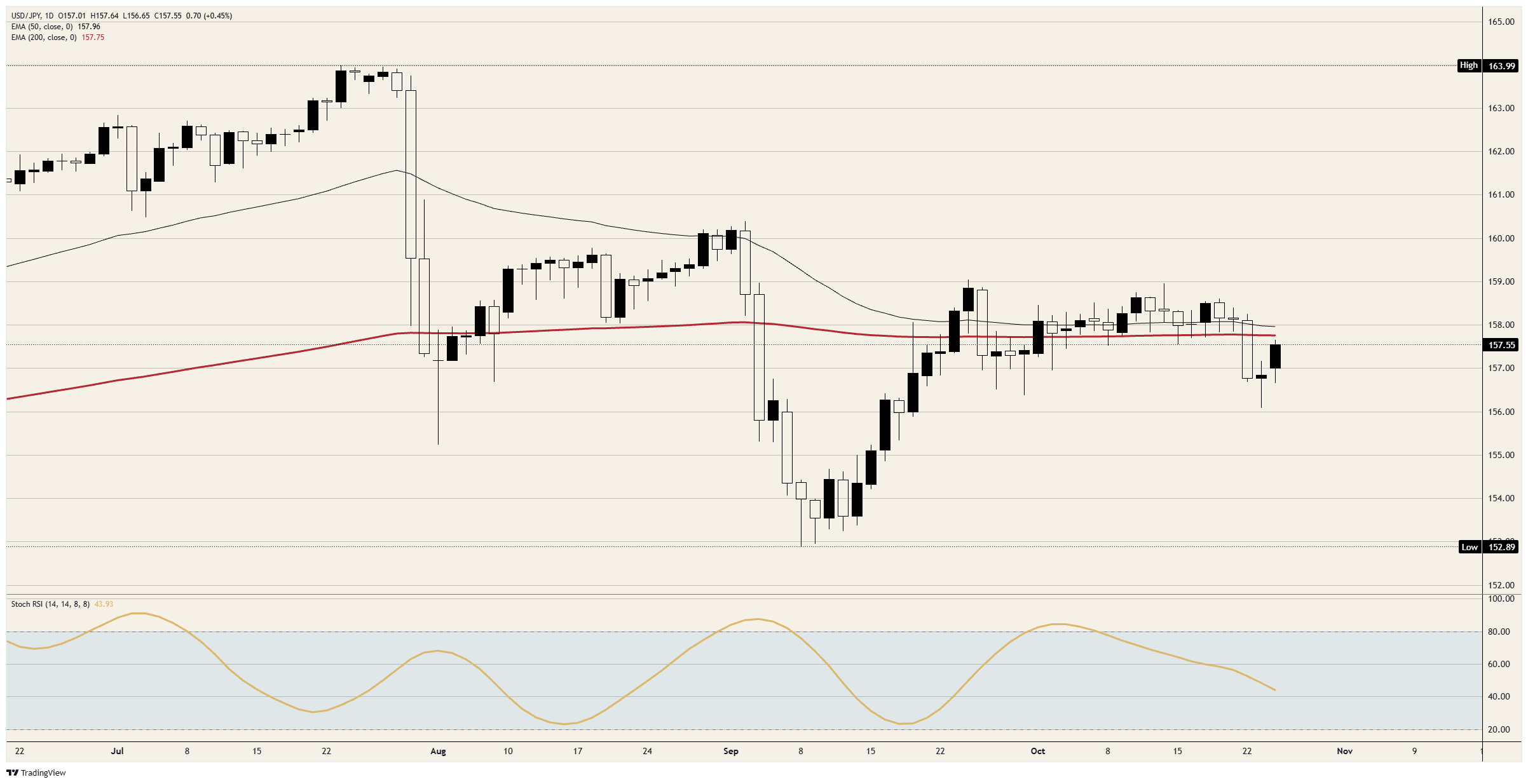
The losses recorded by USD/JPY on 22 and 23 October were roughly halved by Monday's recovery. Buying of the Yen in Tokyo had pushed the pair below 157.00 to its weakest level since 18 September. With the Fed decision two days away, Monday's advance took it from just above 156.50 to just above 157.50, leaving it near the session high at the close.

A September increase took the Bank of Japan (BoJ) rate from 1% to 1.25%, while BoJ Governor Ueda has said consecutive hikes are unnecessary. Following that September move, another increase on Friday would constitute back-to-back tightening, so the Yen is not expected to have a BoJ rate rise to trade on. Economists polled by Bloomberg unanimously expect no increase in October, with most looking to December instead.
The September decision passed by 7-2, with both dissenters opposing the rate increase. For Friday, previews suggest that any dissent would instead favour a hike and come from BoJ board members Takata and Tamura. A vote for higher rates could advance the timing of the December increase that Yen traders are awaiting.
Due at 23:30 GMT on Thursday, Tokyo's October Consumer Price Index (CPI) and Japan's September unemployment rate will be the final data releases before Friday's BoJ decision. At 06:30 GMT on Friday, BoJ Governor Ueda will then hold his press conference. His signals on December are the remaining Tokyo input for USD/JPY to price in.
When the Fed releases its statement at 18:00 GMT on Wednesday, it is expected to leave its rate range unchanged at 3.75%-4.00%. The next US releases, at 12:30 GMT on Thursday, are third-quarter growth and September's Personal Consumption Expenditures Price Index (PCE). Each will inform the case for a December Fed rate rise.
Both the 200-day Exponential Moving Average (EMA) and the 50-day EMA sit just below 158.00, beyond the high reached on Monday. Following the decline on 22 October, the pair registered its first daily close below 157.00 since 18 September. On the chart, the six-month trading range stretches between the 8 September low just below 153.00 and July's high just below 164.00.
Among the most actively traded currencies worldwide, the Japanese Yen (JPY) takes its broad direction from Japan's economic performance. More specific influences include Bank of Japan policy, the gap between Japanese and US bond yields and traders' appetite for risk, alongside other factors.
Currency control is among the Bank of Japan's mandates, making its actions an important influence on the Yen. On occasion, the BoJ has intervened directly in currency markets, usually with the aim of weakening the currency. Political concerns among Japan's principal trading partners, however, discourage frequent intervention. From 2013 to 2024, the BoJ's ultra-loose monetary stance weakened the Yen against its major peers as policy increasingly diverged from that of other leading central banks. The more recent, gradual withdrawal of that exceptionally loose policy has offered the Yen some support.
By maintaining ultra-loose monetary policy over the past decade, the BoJ increasingly diverged from other central banks, notably the US Federal Reserve. The resulting widening in the yield gap between 10-year US and Japanese bonds favoured the US Dollar over the Japanese Yen. That differential is now narrowing as the BoJ's 2024 decision to gradually move away from ultra-loose policy combines with interest rate cuts by other major central banks.
Investors often regard the Japanese Yen as a safe haven, turning more readily to the currency during periods of market strain because of its perceived stability and reliability. As a result, turbulence is likely to lift the Yen against currencies considered riskier investments.







Phone: +61 2 8036 8388
Fax: +61 2 8036 8388
Email: support@tmgm.com



The information provided on this website is of a general nature only and does not constitute personal financial advice. Before acting on any information on this website, you should consider the suitability of the information in relation to your objectives, financial situation and needs. Investing in CFDs and FX Margin Contracts carries significant risks and is not suitable for all investors. You may lose more than your initial deposit. You do not own, or have, any interest in the underlying asset. We recommend that you seek independent advice and ensure you fully understand the risks involved before trading. It is important that you read and consider the disclosure document before you acquire any product listed on the website. The information and advertisements offered on this website are not intended for use by any person in any country or jurisdiction where such use would be contrary to local laws and regulations. The Products and Services offered on this website are not intended for residents of the United States, Malaysia and Thailand.
TMGM is authorized and regulated in various jurisdictions.
Trademax Australia Limited, trading as TMGM, is regulated by the Australian Securities and Investments Commission (ASIC), AFSL no. 436416 and is located at Level 28, One International Tower, 100 Barangaroo Avenue, 2000 Sydney, NSW Australia.
Email: support@tmgm.com.au
Trademax Global Limited, trading as TMGM, is authorized and regulated by the Vanuatu Financial Services Commission (VFSC), registration number 40356 and registered at 1276, Kumul Highway, Port Vila, Vanuatu, Republic of Vanuatu.
Email: support@tmgm.com
Trademax Global Markets (SE) Limited, trading as TMGM, is authorized and regulated by the Financial Services Authority (FSA) of Seychelles, with license number SD224. The company is registered at Office No 13, Providence Estate ABIS Centre, Mahe, Seychelles.
Email: support@tmgm.com
Trademax Global Markets (International) Pty Ltd, trading as TMGM, is authorized and regulated by the Financial Services Commission, Mauritius (FSC) with license no. GB22201012, and registered at 33, Edith Cavell Street C/o IQ EQ Fund Services (Mauritius) Ltd Port Louis, 11324 Mauritius.
Email: support@tmgm.com
Copyright © TMGM. All rights reserved


