
News & AnalysisCareer

An inflation outlook worse than forecast has helped the Australian Dollar (AUD) prolong its run of gains against the US Dollar (USD) on Wednesday, with the pair up 0.26% at around 0.7015 in early European trading. The advance follows comments earlier in the day from Reserve Bank of Australia (RBA) Deputy Governor Andrew Hauser, who warned that the “inflation outlook appears worse than forecast and slightly above expectations”.

Today’s percentage moves in the Australian Dollar (AUD) against the major currencies listed are set out below. Its largest gain was against the New Zealand Dollar.
| USD | EUR | GBP | JPY | CAD | AUD | NZD | CHF | |
|---|---|---|---|---|---|---|---|---|
| USD | 0.11% | 0.12% | 0.00% | 0.02% | -0.25% | 0.19% | 0.18% | |
| EUR | -0.11% | -0.07% | -0.12% | -0.11% | -0.30% | 0.02% | 0.02% | |
| GBP | -0.12% | 0.07% | -0.06% | -0.06% | -0.23% | 0.09% | 0.09% | |
| JPY | 0.00% | 0.12% | 0.06% | 0.00% | -0.16% | 0.15% | 0.16% | |
| CAD | -0.02% | 0.11% | 0.06% | -0.01% | -0.17% | 0.16% | 0.16% | |
| AUD | 0.25% | 0.30% | 0.23% | 0.16% | 0.17% | 0.33% | 0.32% | |
| NZD | -0.19% | -0.02% | -0.09% | -0.15% | -0.16% | -0.33% | 0.00% | |
| CHF | -0.18% | -0.02% | -0.09% | -0.16% | -0.16% | -0.32% | -0.00% |
Percentage movements between major currencies are displayed in the heat map. Select the base currency in the left-hand column and the quote currency in the top row. Selecting the Australian Dollar on the left and following its row across to the US Dollar, for instance, gives the percentage change for AUD (base)/USD (quote) in the corresponding cell.
The RBA’s Hauser said: “Inflation has remained elevated for an extended period,” adding: “Quarterly trimmed mean likely to exceed expectations.” She also stated: “Monetary policy effective, but inflation outlook deteriorates.”
Expectations of another near-term interest rate rise by the central bank could be fuelled by Hauser’s warning that price pressures may stay elevated.
With the Federal Reserve (Fed) now in its blackout period before this month’s policy decision, trading in the US Dollar remains cautious. Rates are widely expected to be held within the 3.75%-4.00% range.
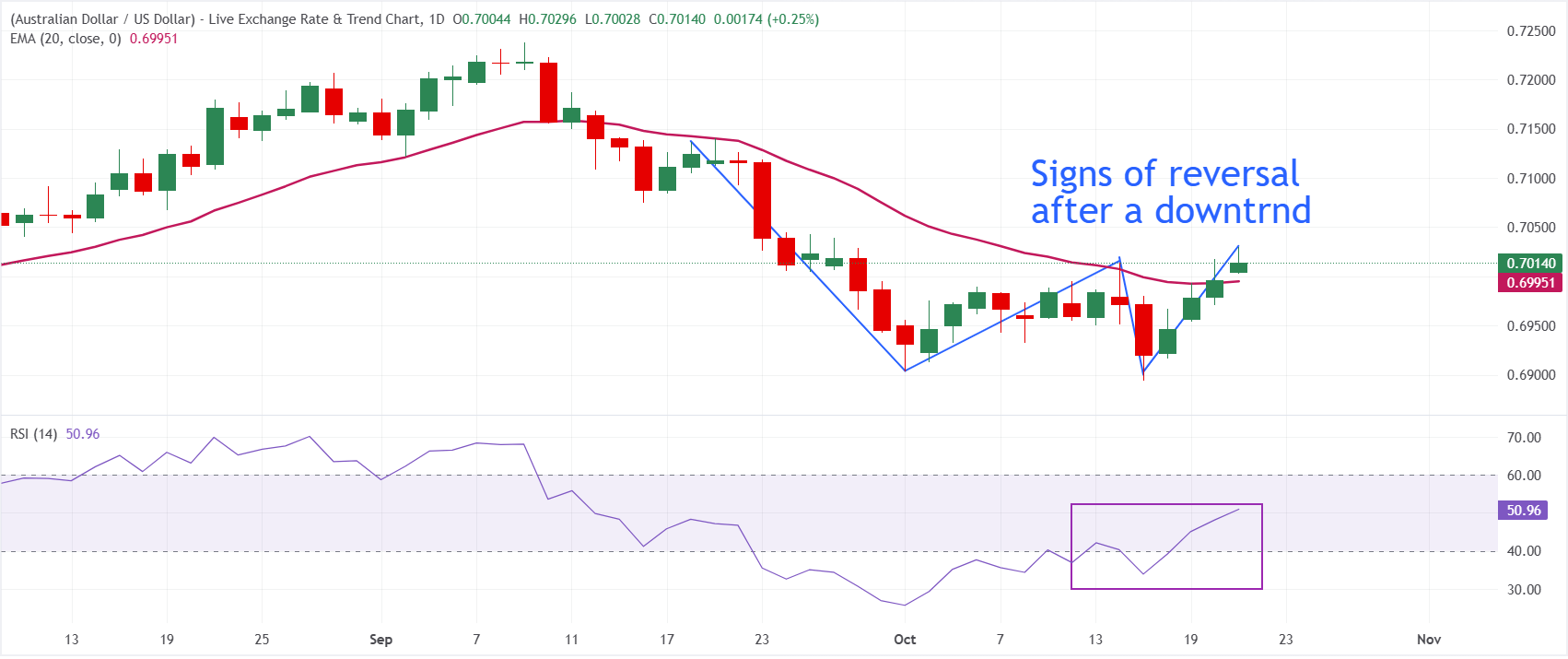
At 0.7014 on the daily chart, AUD/USD remains marginally above its 20-period exponential moving average (EMA) of 0.6995. Holding this underlying trend support points to a modestly positive near-term outlook. A gradually rising base is also suggested by two ascending support trend lines originating around 0.6904 and 0.6903. Meanwhile, the Relative Strength Index (14) reads 50.96, near neutral territory, indicating balanced momentum rather than a forceful move in either direction.
The nearer descending trend line, originating at 0.7020, provides the first resistance on the upside; the higher falling trend line drawn from 0.7138 represents a more substantial hurdle. Initial downside support comes from the 20-period EMA at 0.6995. Beyond that lies the cluster of rising trend-line supports around 0.6904/0.6903, where buyers are likely to seek to protect the wider corrective advance.
(The technical analysis of this story was written with the help of an AI tool. Know more.)
Australia’s interest rates and monetary policy are determined by the Reserve Bank of Australia (RBA). A board of governors takes decisions at 11 scheduled meetings each year, with emergency meetings convened as needed. Maintaining price stability, defined as inflation of 2-3%, is the RBA’s principal mandate. It is also tasked “..to contribute to the stability of the currency, full employment, and the economic prosperity and welfare of the Australian people.” Adjustments to interest rates are its main means of meeting these objectives: relatively high rates strengthen the Australian Dollar (AUD), while the reverse applies to relatively low rates. Quantitative easing and tightening are among the RBA’s other policy tools.
Traditionally, inflation was regarded as harmful to currencies because it erodes the value of money generally. Since cross-border capital controls have been relaxed, however, the reverse has been true in modern times. Moderately higher inflation tends to prompt central banks to raise interest rates, drawing in more capital from international investors looking for attractive returns on their money. The resulting increase in demand supports the domestic currency, which in Australia’s case is the Australian Dollar.
By indicating an economy’s health, macroeconomic releases can affect the value of its currency. Safe, expanding economies are more attractive to investors than unstable, contracting ones. Larger capital inflows lift both overall demand for the domestic currency and its value. Among the established indicators capable of moving AUD are GDP, Manufacturing and Services PMIs, employment figures and consumer sentiment surveys. Economic strength may also prompt the Reserve Bank of Australia to raise interest rates, providing further support for AUD.
When interest rate cuts alone cannot restore credit flows through the economy, Quantitative Easing (QE) can be deployed in extreme circumstances. Under QE, the Reserve Bank of Australia (RBA) prints Australian Dollars (AUD) to purchase assets from financial institutions, usually government or corporate bonds. These purchases supply the institutions with much-needed liquidity. The usual consequence is a weaker AUD.
Once an economic recovery has begun and inflation starts to climb following QE, Quantitative tightening (QT) reverses that policy. Under QE, liquidity is supplied to financial institutions through the Reserve Bank of Australia’s (RBA) purchases of government and corporate bonds. QT instead involves the RBA halting further asset purchases and no longer reinvesting principal repaid as bonds in its portfolio mature. This would support the Australian Dollar, representing a positive, or bullish, influence.







Phone: +61 2 8036 8388
Fax: +61 2 8036 8388
Email: support@tmgm.com



The information provided on this website is of a general nature only and does not constitute personal financial advice. Before acting on any information on this website, you should consider the suitability of the information in relation to your objectives, financial situation and needs. Investing in CFDs and FX Margin Contracts carries significant risks and is not suitable for all investors. You may lose more than your initial deposit. You do not own, or have, any interest in the underlying asset. We recommend that you seek independent advice and ensure you fully understand the risks involved before trading. It is important that you read and consider the disclosure document before you acquire any product listed on the website. The information and advertisements offered on this website are not intended for use by any person in any country or jurisdiction where such use would be contrary to local laws and regulations. The Products and Services offered on this website are not intended for residents of the United States, Malaysia and Thailand.
TMGM is authorized and regulated in various jurisdictions.
Trademax Australia Limited, trading as TMGM, is regulated by the Australian Securities and Investments Commission (ASIC), AFSL no. 436416 and is located at Level 28, One International Tower, 100 Barangaroo Avenue, 2000 Sydney, NSW Australia.
Email: support@tmgm.com.au
Trademax Global Limited, trading as TMGM, is authorized and regulated by the Vanuatu Financial Services Commission (VFSC), registration number 40356 and registered at 1276, Kumul Highway, Port Vila, Vanuatu, Republic of Vanuatu.
Email: support@tmgm.com
Trademax Global Markets (SE) Limited, trading as TMGM, is authorized and regulated by the Financial Services Authority (FSA) of Seychelles, with license number SD224. The company is registered at Office No 13, Providence Estate ABIS Centre, Mahe, Seychelles.
Email: support@tmgm.com
Trademax Global Markets (International) Pty Ltd, trading as TMGM, is authorized and regulated by the Financial Services Commission, Mauritius (FSC) with license no. GB22201012, and registered at 33, Edith Cavell Street C/o IQ EQ Fund Services (Mauritius) Ltd Port Louis, 11324 Mauritius.
Email: support@tmgm.com
Copyright © TMGM. All rights reserved


