
News & AnalysisCareer

A gain of 0.32% leaves the Australian Dollar (AUD) trading at around 0.6638 against the US Dollar (USD) in Monday’s European session. The pair has pulled back from its session high of 0.6657, relinquishing part of its earlier advance as the US Dollar recovers.

Having erased its earlier decline, the US Dollar Index (DXY) edges into positive territory at around 103.89 during European trading. The index tracks the Greenback against a basket of six major currencies.
Confidence in financial markets that the Federal Reserve (Fed) will raise interest rates several times in the near term had already underpinned a positive outlook for the US Dollar.
TD Securities forecasts “a third hike in March.” That would follow the bank’s assessment that “most officials would support consecutive 25bp hikes in December and January,” as its economists see little relief from recent economic releases. They observe that “data last week and our expectations for data this week are in line with recent trends,” adding that “inflation remains above target and is moving in the wrong direction.” Alongside this, they highlight that “the labor market has stabilized, with some signs of strengthening, and activity data has been robust.” Their conclusion is that “the economy can handle more restriction, and the Fed is likely to provide it,” while “the evolution of inflation data” will determine “the extent and pace of hikes later in the cycle.”
Wednesday’s release of the United States (US) Personal Consumption Expenditure (PCE) Price Index for October is the next focus for investors seeking further indications of the Fed’s monetary policy outlook.
Persistent supply-side constraints and sector-specific factors are likely to prolong elevated price pressures, according to TD Securities. Explaining its assessment, the bank states that “with supply chains still stressed amid AI-led price pressures, we do not see room for inflation progress in the near-term,” and forecasts that “core CPI inflation [will] be 2.9% y/y in Q4 2026, higher than the end of 2025, while the core PCE version should end the year firmer.” A return to inflation outcomes consistent with the target is also expected to be delayed, with TD Securities anticipating that “most of the impact of higher oil prices will filter into headline inflation,” while only “gradual disinflation” is likely to “resume by the middle of 2027.”
For the Australian Dollar, attention is on October’s Consumer Price Index (CPI), also due for release on Wednesday.
Forecasts point to annual inflation of 4.8% year-on-year (YoY), up from the previous reading of 4.3%. The release is likely to exert a considerable influence on expectations for Reserve Bank of Australia (RBA) interest rates.
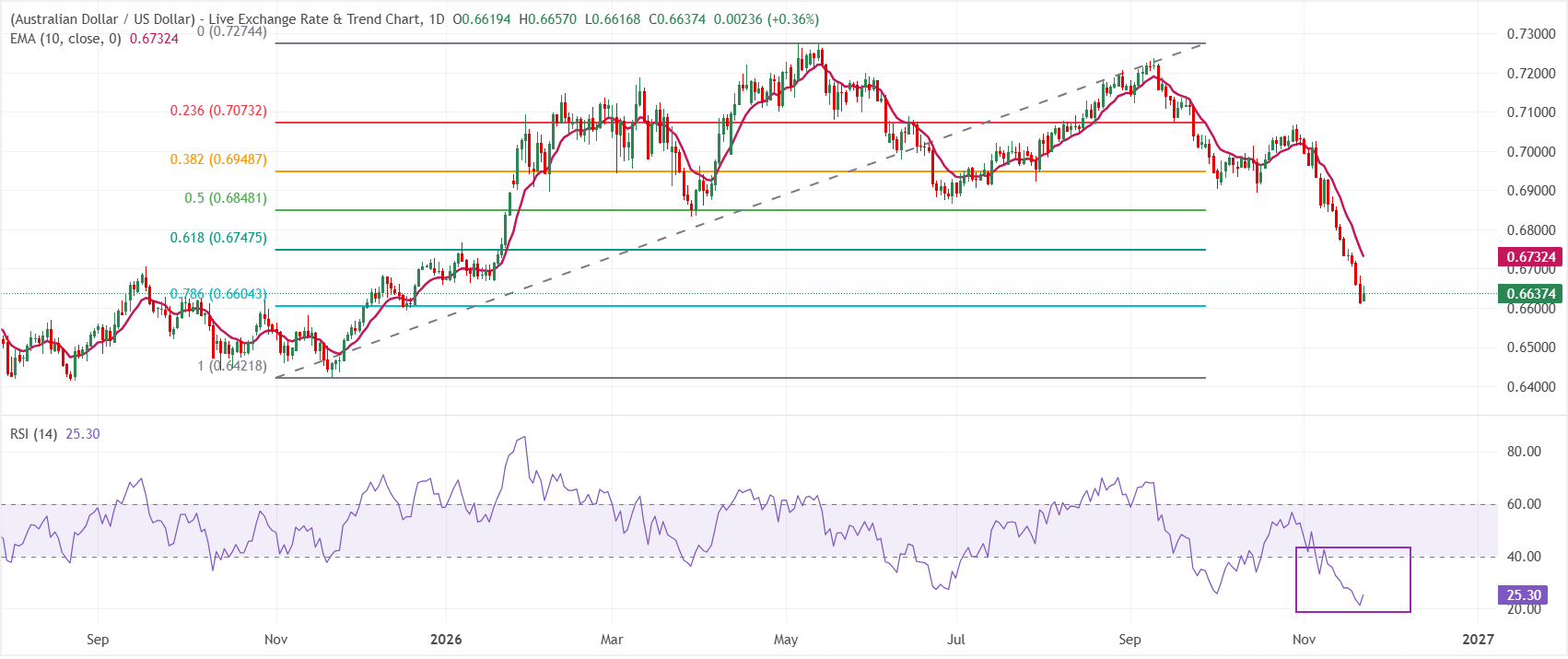
Trading at 0.6638 on the daily chart, AUD/USD retains a distinctly bearish bias below both the 10-day exponential moving average (EMA) at 0.6732 and all nearby Fibonacci retracement levels. Although downward momentum remains strong, the Relative Strength Index (14), in oversold territory near 25, suggests the recent decline could begin to slow as the pair approaches deeper support levels.
The first support on a further decline lies at 0.6604, the 78.6% Fibonacci retracement, before the stronger structural floor near 0.6422 at the 100% retracement. A recovery would first encounter resistance at the 10-day EMA of 0.6732, then the 61.8% retracement at 0.6748. Beyond that, obstacles sit at the 50% level around 0.6848 and the higher Fibonacci levels of 0.6949 and 0.7073.
(The technical analysis of this story was written with the help of an AI tool. Know more.)
Published each month by the Australian Bureau of Statistics, the Consumer Price Index (CPI) tracks price movements across a broad basket of goods and services purchased by household consumers. Following the introduction of a methodology that shifted reporting from quarterly to monthly readings for data from April 2024 onwards, it serves as the principal gauge of headline inflation. Its YoY reading measures prices in the reference month against those in the corresponding month a year earlier. A higher reading is regarded as positive for the Australian Dollar (AUD), whereas a lower reading is regarded as negative.
Find out more.Forthcoming release: Wed 25 Nov 2026 00:30
Release frequency: Monthly
Consensus forecast: 4.8%
Previous reading: 4.3%
Data source: Australian Bureau of Statistics







Phone: +61 2 8036 8388
Fax: +61 2 8036 8388
Email: support@tmgm.com



The information provided on this website is of a general nature only and does not constitute personal financial advice. Before acting on any information on this website, you should consider the suitability of the information in relation to your objectives, financial situation and needs. Investing in CFDs and FX Margin Contracts carries significant risks and is not suitable for all investors. You may lose more than your initial deposit. You do not own, or have, any interest in the underlying asset. We recommend that you seek independent advice and ensure you fully understand the risks involved before trading. It is important that you read and consider the disclosure document before you acquire any product listed on the website. The information and advertisements offered on this website are not intended for use by any person in any country or jurisdiction where such use would be contrary to local laws and regulations. The Products and Services offered on this website are not intended for residents of the United States, Malaysia and Thailand.
TMGM is authorized and regulated in various jurisdictions.
Trademax Australia Limited, trading as TMGM, is regulated by the Australian Securities and Investments Commission (ASIC), AFSL no. 436416 and is located at Level 28, One International Tower, 100 Barangaroo Avenue, 2000 Sydney, NSW Australia.
Email: support@tmgm.com.au
Trademax Global Limited, trading as TMGM, is authorized and regulated by the Vanuatu Financial Services Commission (VFSC), registration number 40356 and registered at 1276, Kumul Highway, Port Vila, Vanuatu, Republic of Vanuatu.
Email: support@tmgm.com
Trademax Global Markets (SE) Limited, trading as TMGM, is authorized and regulated by the Financial Services Authority (FSA) of Seychelles, with license number SD224. The company is registered at Office No 13, Providence Estate ABIS Centre, Mahe, Seychelles.
Email: support@tmgm.com
Trademax Global Markets (International) Pty Ltd, trading as TMGM, is authorized and regulated by the Financial Services Commission, Mauritius (FSC) with license no. GB22201012, and registered at 33, Edith Cavell Street C/o IQ EQ Fund Services (Mauritius) Ltd Port Louis, 11324 Mauritius.
Email: support@tmgm.com
Copyright © TMGM. All rights reserved

