
News & AnalysisCareer

A recovery towards 0.6977 marks Wednesday’s trading in the Australian Dollar (AUD) against the US Dollar (USD), following a steep sell-off over the previous two sessions. Renewed investor appetite for risk is supporting demand for the Australian currency.

Despite remaining 0.6% lower at around 7,530, S&P 500 futures have recouped half their earlier losses in a V-shaped rebound during early European trading. The recovery appears to signal a return of investors’ appetite for risk.
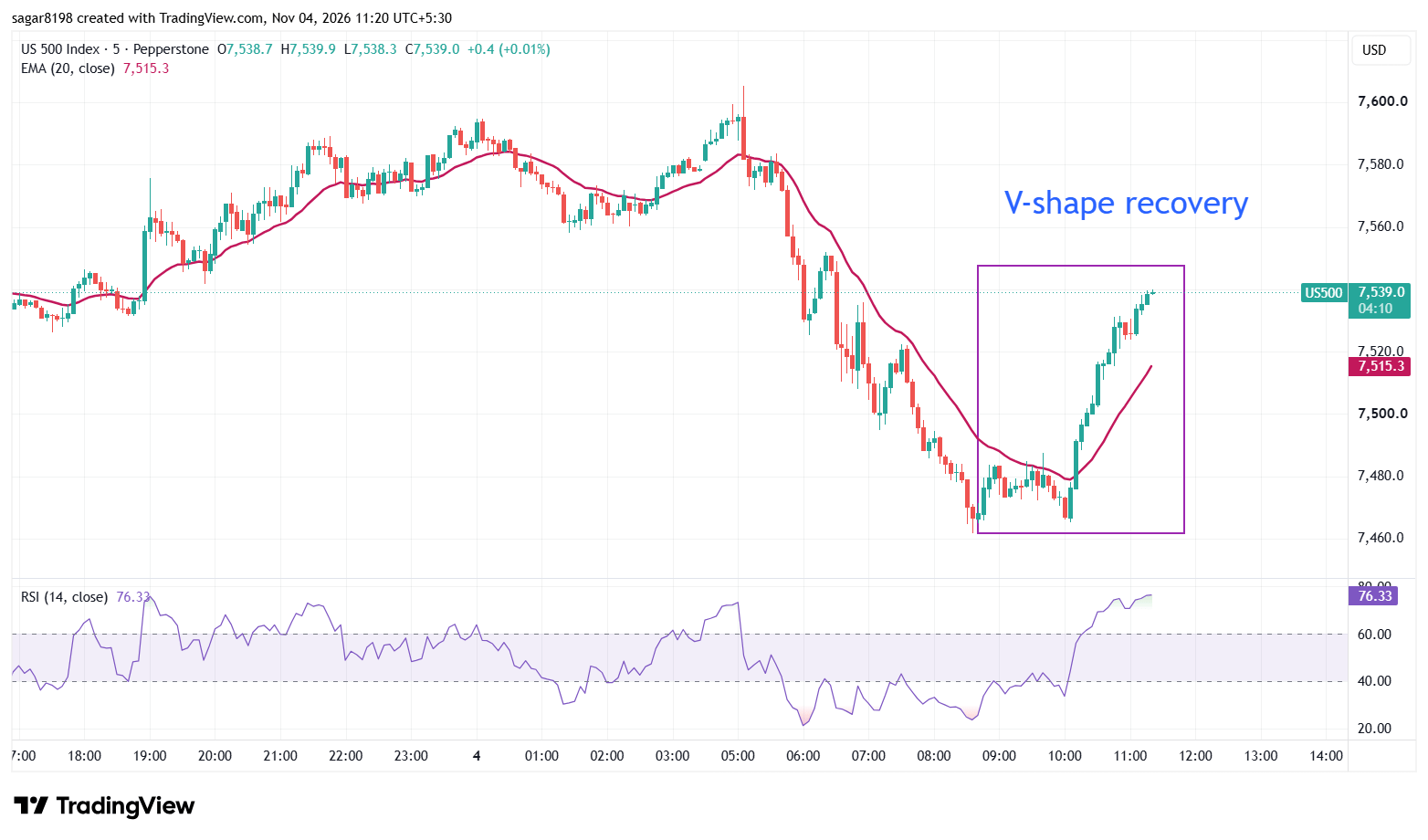
With the Australian currency particularly sensitive to market sentiment, the more favourable risk backdrop has enhanced its appeal.
Even with the Democrats securing a Senate majority and expected to win the House of Representatives, S&P 500 futures have staged a strong rebound. BBC News reports that the Democrats are ahead in the House vote count with 201 seats, against the 218 required for a majority.
Much of the US Dollar’s initial decline has also been reversed. At the time of writing, the US Dollar Index (DXY), which measures the Greenback against six major currencies, is down 0.4% at around 101.48, having recovered sharply from an intraday low of 101.25.
The pronounced recoveries in both S&P 500 futures and the US Dollar point to a “Sell the rumour Buy the News” response.
In Australia, Tuesday’s widely expected decision by the Reserve Bank of Australia (RBA) lifted the Official Cash Rate (OCR) by 25 basis points (bps) to 4.85%. The central bank also indicated that the threshold for a further rate rise is very high.
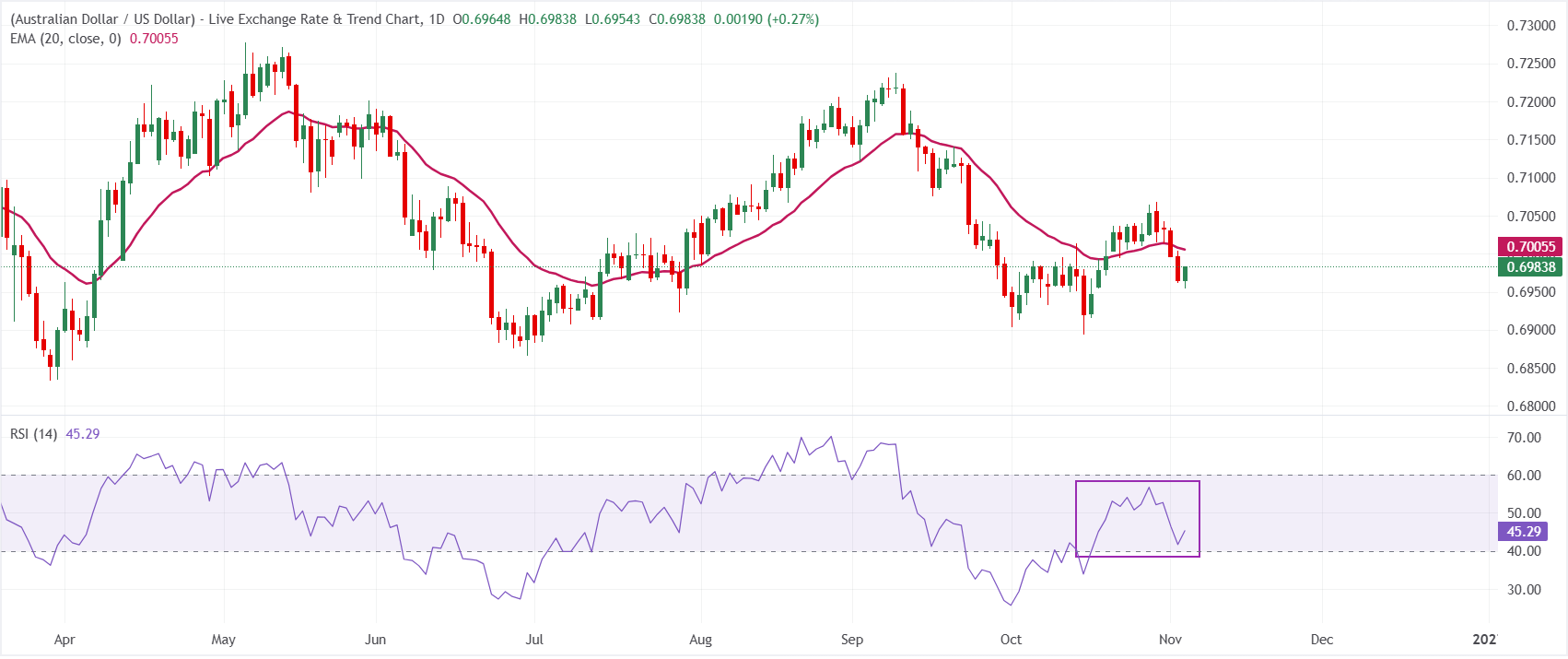
Trading at 0.6982 on the daily chart, AUD/USD retains a bearish short-term bias below its 20-period Exponential Moving Average (EMA) of 0.7005. Failure to regain this short-term average points to continuing resistance to gains. Meanwhile, a Relative Strength Index (RSI) reading of around 45 indicates consolidation rather than oversold conditions, allowing scope for further declines should sellers retain control.
Any recovery first faces resistance at the 20-period EMA, around 0.7005. Only a sustained move above that barrier would ease the prevailing bearish bias and pave the way for a more constructive advance. Until then, rallies remain exposed to fresh selling in the coming sessions.
(The technical analysis of this story was written with the help of an AI tool. Know more.)
At the conclusion of each of its eight scheduled meetings a year, the Reserve Bank of Australia (RBA) publishes its interest rate decision. A hawkish assessment of the economy’s inflation outlook, accompanied by a rate increase, is generally supportive of the Australian Dollar (AUD). Conversely, a dovish assessment of the Australian economy, with rates either held steady or reduced, is regarded as negative for AUD.
Find out more.Latest release: Tue 3 Nov 2026 03:30
Release frequency: Irregular
Reported figure: 4.85%
Consensus forecast: 4.85%
Previous figure: 4.6%
Data source: Reserve Bank of Australia







Phone: +61 2 8036 8388
Fax: +61 2 8036 8388
Email: support@tmgm.com



The information provided on this website is of a general nature only and does not constitute personal financial advice. Before acting on any information on this website, you should consider the suitability of the information in relation to your objectives, financial situation and needs. Investing in CFDs and FX Margin Contracts carries significant risks and is not suitable for all investors. You may lose more than your initial deposit. You do not own, or have, any interest in the underlying asset. We recommend that you seek independent advice and ensure you fully understand the risks involved before trading. It is important that you read and consider the disclosure document before you acquire any product listed on the website. The information and advertisements offered on this website are not intended for use by any person in any country or jurisdiction where such use would be contrary to local laws and regulations. The Products and Services offered on this website are not intended for residents of the United States, Malaysia and Thailand.
TMGM is authorized and regulated in various jurisdictions.
Trademax Australia Limited, trading as TMGM, is regulated by the Australian Securities and Investments Commission (ASIC), AFSL no. 436416 and is located at Level 28, One International Tower, 100 Barangaroo Avenue, 2000 Sydney, NSW Australia.
Email: support@tmgm.com.au
Trademax Global Limited, trading as TMGM, is authorized and regulated by the Vanuatu Financial Services Commission (VFSC), registration number 40356 and registered at 1276, Kumul Highway, Port Vila, Vanuatu, Republic of Vanuatu.
Email: support@tmgm.com
Trademax Global Markets (SE) Limited, trading as TMGM, is authorized and regulated by the Financial Services Authority (FSA) of Seychelles, with license number SD224. The company is registered at Office No 13, Providence Estate ABIS Centre, Mahe, Seychelles.
Email: support@tmgm.com
Trademax Global Markets (International) Pty Ltd, trading as TMGM, is authorized and regulated by the Financial Services Commission, Mauritius (FSC) with license no. GB22201012, and registered at 33, Edith Cavell Street C/o IQ EQ Fund Services (Mauritius) Ltd Port Louis, 11324 Mauritius.
Email: support@tmgm.com
Copyright © TMGM. All rights reserved


