
News & AnalysisCareer

Weaker institutional demand through BTC spot exchange-traded funds (ETFs) so far this week is weighing on sentiment, leaving Bitcoin (BTC) stalled near $65,000 on Wednesday. Buyers have struggled to maintain the recovery following last week’s fall towards $62,000. Attention is now shifting to the minutes of the Federal Reserve’s (Fed) October meeting for indications of the interest rate outlook, which could determine the leading cryptocurrency’s next direction.

The outlook for interest rates remains in focus as traders await the minutes of the Fed’s October monetary policy meeting. Any fresh guidance could shape the next move in the US Dollar (USD) and risk assets.
Strong US inflation readings and hawkish comments from central bankers have, meanwhile, prompted traders to bet overwhelmingly on more aggressive monetary tightening. Those expectations continue to put pressure on risk assets, including BTC.
A December interest rate increase of 25 basis points (bps) is fully priced in, according to the CME Group’s FedWatch Tool, with traders assigning a higher probability to further rises in January. As a result, the US Dollar remains close to its strongest level in over 18 months. Benchmark 10-year US Treasury yields are also holding around 5.09%, constraining the scope for a BTC recovery.
Continued selling by institutional investors is weighing on BTC. According to SoSoValue, BTC spot ETFs registered net outflows of $239.94 million on Tuesday, reversing a modest $7.99 million inflow on Monday. Institutional investors have sold over $2.58 billion so far in November, pointing to softer demand. Should the outflows persist and gather pace through the rest of this week, BTC could face additional pressure and a deeper price correction.
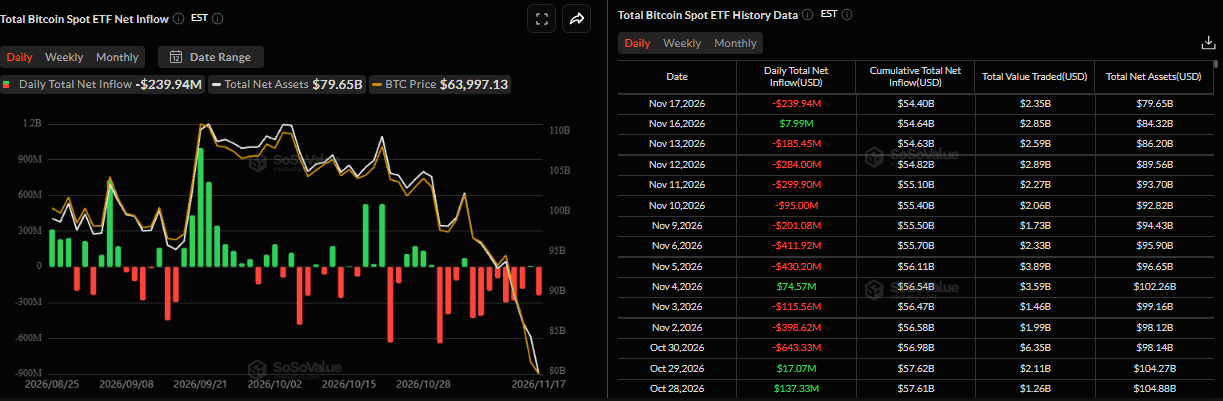
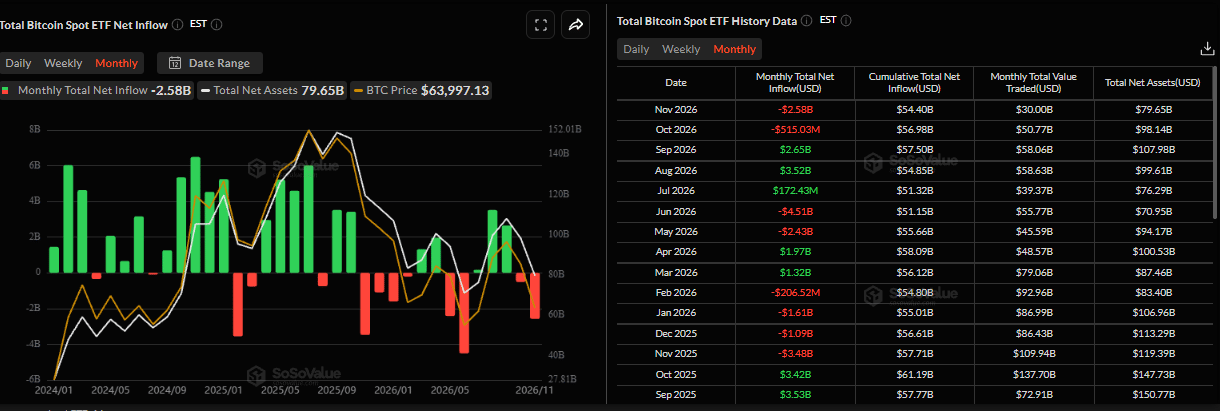
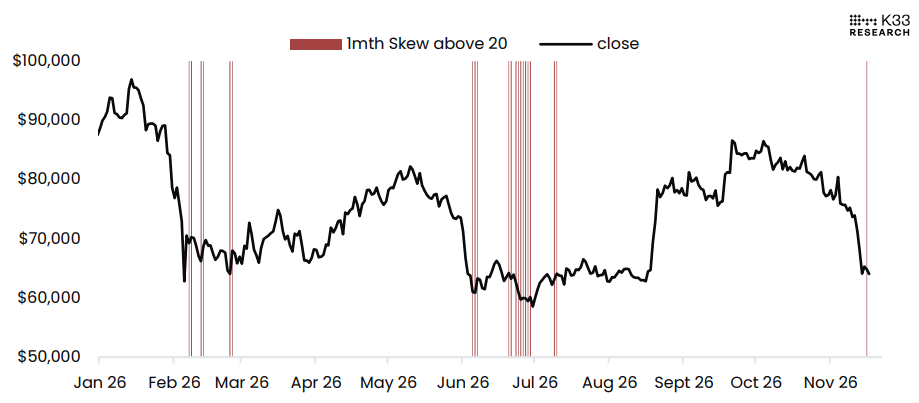
Options hedging has reached levels previously seen around market lows in 2026, according to a K33 Research report published on Tuesday, adding to indications that Bitcoin may be nearing a local bottom. For the first time since July, the 25-delta skew on one-month options has risen above 20, signalling stronger demand for put options to protect against further losses.
As the chart below illustrates, comparable surges in options skew coincided with exhausted selling pressure around local Bitcoin lows in 2022 and 2026.
Other indicators also lend support to the possibility of a market bottom, the report noted. Alongside trading below its 200-week moving average, Bitcoin has a Relative Strength Index (RSI) that remains deeply oversold. ETF outflows are nearing levels recorded around earlier local lows, while funding rates have become negative. More than 50% of the circulating BTC supply is also being held at a loss. A sharp deterioration in social sentiment further reflects widespread bearish positioning.
The analyst concluded: “Taken together, these signals suggest promising odds that BTC has established a local bottom. However, previous recoveries from sub-$70,000 levels were followed by months of choppy price action. Our base case is therefore that BTC will again need time to consolidate and absorb the recent sharp drawdown,”
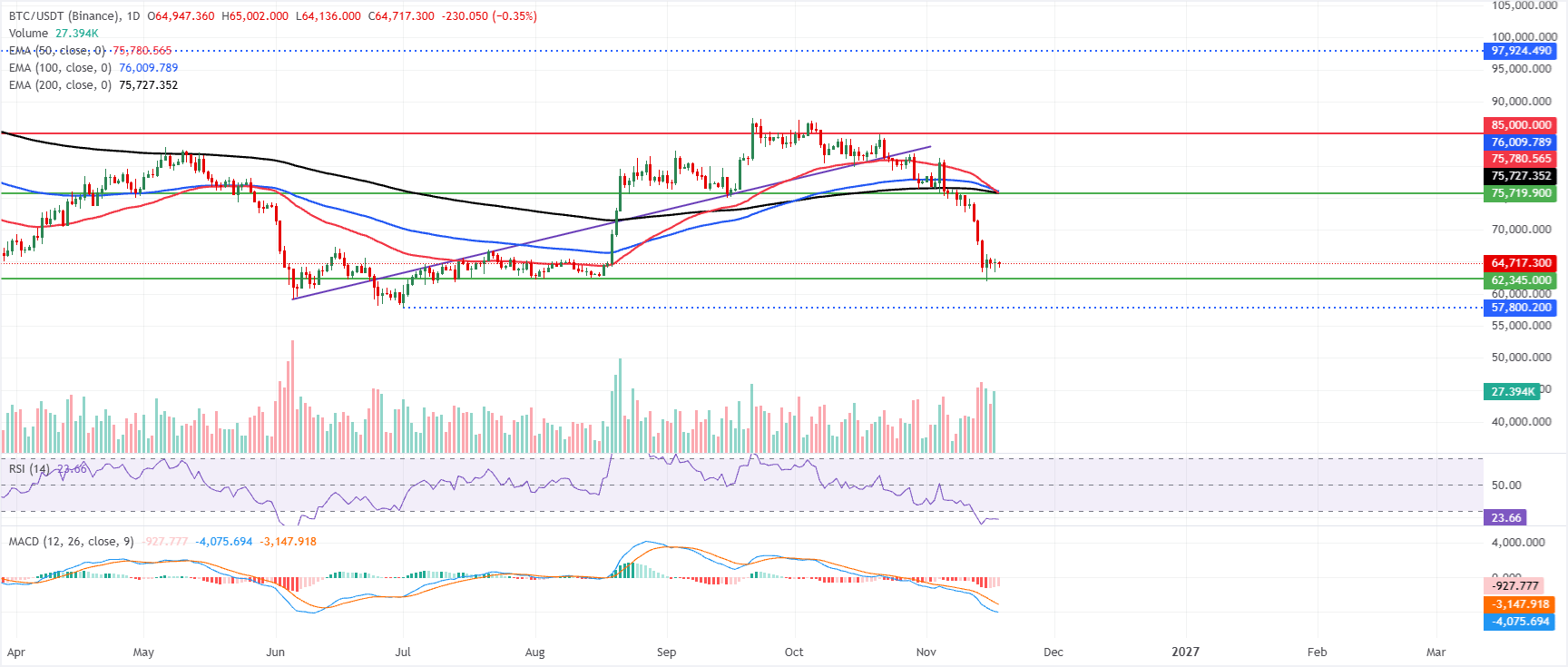
At $64,717 at the time of writing on Wednesday, Bitcoin is consolidating beneath $65,000 following the previous week’s steep decline. With BTC still well below the principal exponential moving averages (EMAs) on the daily chart, the near-term outlook remains bearish.
Roughly $75,780 to $76,000 marks the cluster of 50-day, 100-day and 200-day EMAs, leaving them well above the spot price. This points to continued dominance by overhead supply, even with the Relative Strength Index (RSI) near 23 and conditions deeply oversold. A negative Moving Average Convergence Divergence (MACD) histogram also indicates that downward momentum persists, rather than suggesting a convincing base is forming.
The first resistance area lies in the mid-$75,000s. Here, the 200-day EMA at $75,727, the 50-day EMA at $75,780 and the 100-day EMA at $76,009 create a concentrated supply zone; BTC would need to regain this area to relieve bearish pressure. Further up, horizontal resistance at 85,000 presents a more strategic obstacle, keeping the broader bullish outlook in check for now. In the absence of clear structural support nearby, the price remains exposed to further losses unless buyers establish a sustained recovery towards the EMA cluster.
(The technical analysis of this story was written with the help of an AI tool. Know more.)
Designed to function as money, Bitcoin is a virtual currency and the largest cryptocurrency by market capitalisation. No single person, group or entity can control this means of payment, removing the need for third parties to take part in financial transactions.
Any cryptocurrency other than Bitcoin is classed as an altcoin. Some, however, also exclude Ethereum from this category because these two cryptocurrencies are the starting points for forks. Under that interpretation, Litecoin is the first altcoin: it was forked from the Bitcoin protocol and is therefore an “improved” version of it.
A stablecoin is a cryptocurrency intended to maintain a steady price, backed by a reserve of the asset it represents. Its value is therefore pegged to a commodity or financial instrument, such as the US Dollar (USD), while an algorithm or demand regulates its supply. Stablecoins primarily give investors a route into and out of cryptocurrency trading and investment. They also provide a way to store value, given the volatility generally associated with cryptocurrencies.
Measured as Bitcoin’s market capitalisation divided by the combined market capitalisation of all cryptocurrencies, Bitcoin dominance indicates the level of investor interest in Bitcoin. BTC dominance is typically high before and during a bull run, when investors turn to relatively stable cryptocurrencies with large market capitalisations, such as Bitcoin. When BTC dominance falls, it usually signals that investors are shifting capital and/or profits into altcoins in pursuit of higher returns. This shift generally triggers a surge in altcoin rallies.







Phone: +61 2 8036 8388
Fax: +61 2 8036 8388
Email: support@tmgm.com



The information provided on this website is of a general nature only and does not constitute personal financial advice. Before acting on any information on this website, you should consider the suitability of the information in relation to your objectives, financial situation and needs. Investing in CFDs and FX Margin Contracts carries significant risks and is not suitable for all investors. You may lose more than your initial deposit. You do not own, or have, any interest in the underlying asset. We recommend that you seek independent advice and ensure you fully understand the risks involved before trading. It is important that you read and consider the disclosure document before you acquire any product listed on the website. The information and advertisements offered on this website are not intended for use by any person in any country or jurisdiction where such use would be contrary to local laws and regulations. The Products and Services offered on this website are not intended for residents of the United States, Malaysia and Thailand.
TMGM is authorized and regulated in various jurisdictions.
Trademax Australia Limited, trading as TMGM, is regulated by the Australian Securities and Investments Commission (ASIC), AFSL no. 436416 and is located at Level 28, One International Tower, 100 Barangaroo Avenue, 2000 Sydney, NSW Australia.
Email: support@tmgm.com.au
Trademax Global Limited, trading as TMGM, is authorized and regulated by the Vanuatu Financial Services Commission (VFSC), registration number 40356 and registered at 1276, Kumul Highway, Port Vila, Vanuatu, Republic of Vanuatu.
Email: support@tmgm.com
Trademax Global Markets (SE) Limited, trading as TMGM, is authorized and regulated by the Financial Services Authority (FSA) of Seychelles, with license number SD224. The company is registered at Office No 13, Providence Estate ABIS Centre, Mahe, Seychelles.
Email: support@tmgm.com
Trademax Global Markets (International) Pty Ltd, trading as TMGM, is authorized and regulated by the Financial Services Commission, Mauritius (FSC) with license no. GB22201012, and registered at 33, Edith Cavell Street C/o IQ EQ Fund Services (Mauritius) Ltd Port Louis, 11324 Mauritius.
Email: support@tmgm.com
Copyright © TMGM. All rights reserved


