
News & AnalysisCareer

With Bitcoin (BTC) below $59,000 and Gold (XAU/USD) beneath $3,500, both assets are continuing to retreat on Wednesday as risk aversion prevails.
Expectations of an interest rate increase at the Federal Reserve’s (Fed) December meeting are weighing on both assets. The latest inflation release from the US Bureau of Labor Statistics (BLS) also points to macroeconomic pressure as a major drag.

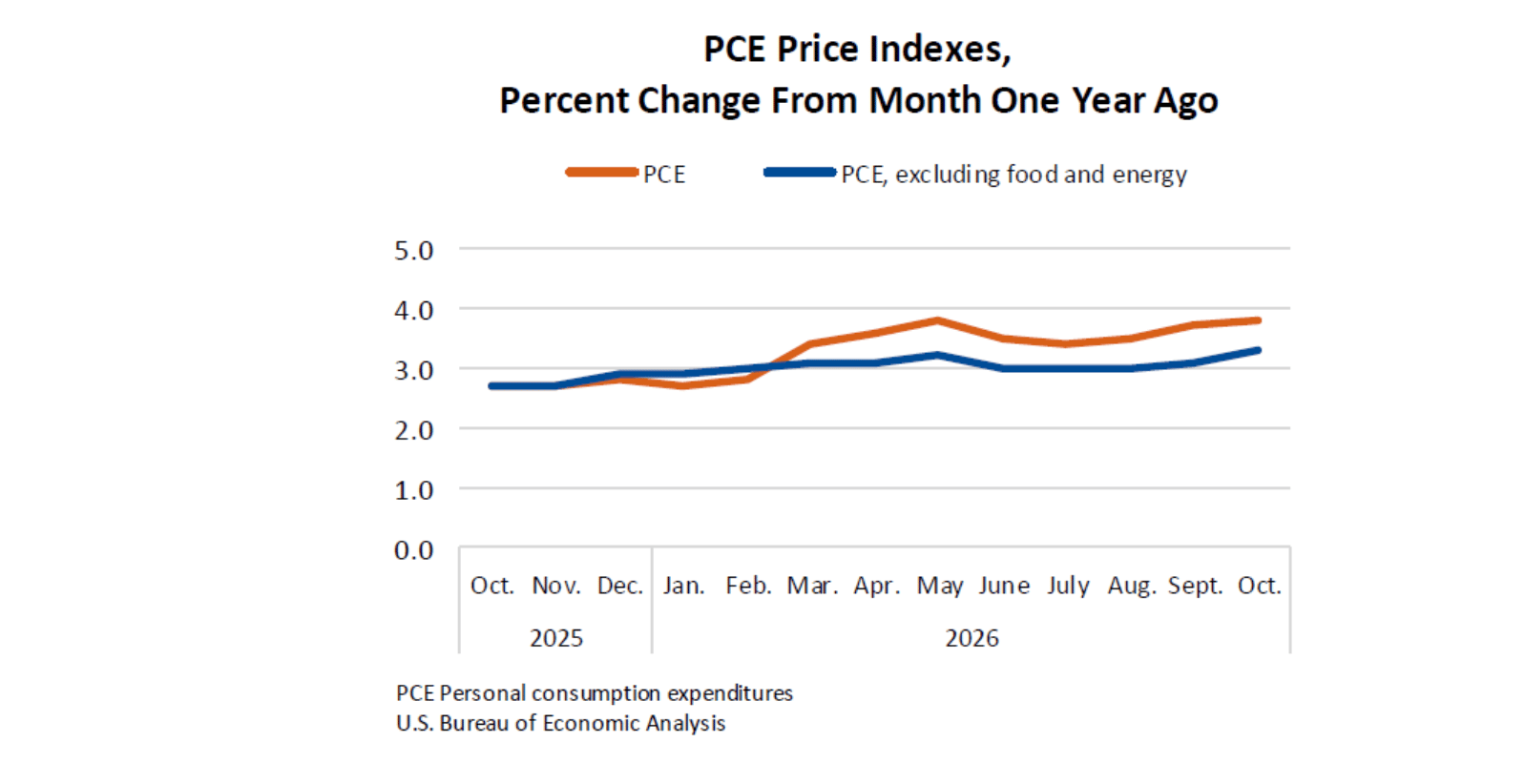
Annual inflation in the United States (US), measured by the Personal Consumption Expenditures (PCE) Price Index, reached 3.8% in October after 3.6% in September. Wednesday’s BLS report put the reading in line with market expectations.
With volatile food and energy prices stripped out, annual PCE Price Index inflation climbed from September’s 3.1% to 3.3%, exceeding the 3.2% anticipated by the market.
On a monthly basis, October’s headline and core PCE Price Indices each advanced 0.3%. Both readings met market expectations.
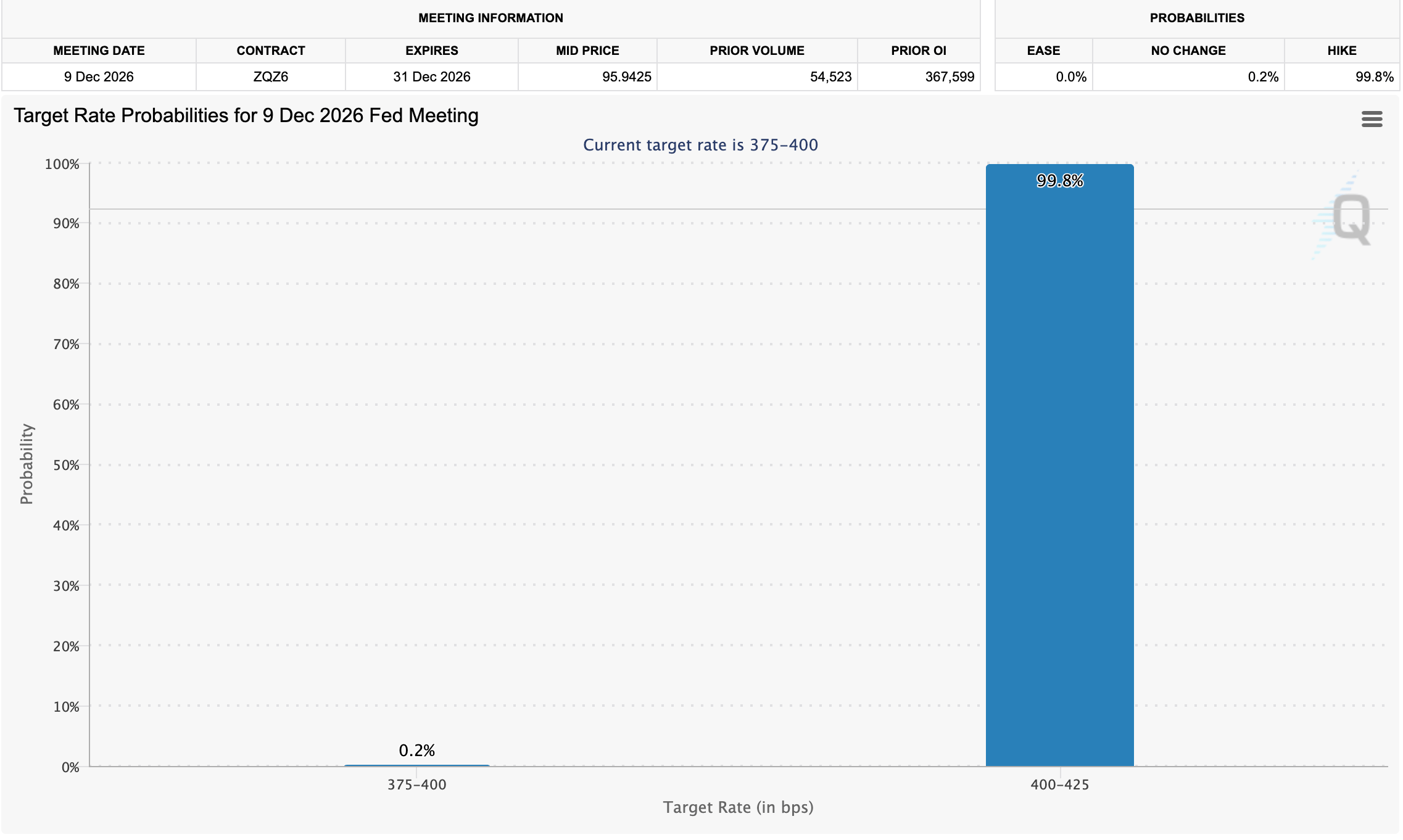
Bets on a December Fed rate rise are also gaining ground among derivatives traders. According to the CME Group’s FedWatch Tool, the probability of a 25 basis points increase to the 4.00-4.25% range stands at 99.8%. Such a move would seek to tackle persistent US inflation, which remains well above the long-term 2% target.
In emailed comments, Markus Levin, Co-founder of XYO, said: “This puts the Fed in a difficult position, with limited room to ease monetary policy without risking another inflationary push,”
By drawing liquidity towards more stable assets such as Treasury bonds, tighter monetary policy tends to hinder rotation into riskier investments. It therefore rarely benefits risk assets such as Bitcoin.
Levin also noted: “Persistent inflation and the prospect of higher interest rates for longer add pressure, making investors more selective about future growth,”
At $58,882, Bitcoin retains a bearish short-term outlook, trading substantially below its 50-day, 100-day and 200-day Exponential Moving Averages (EMAs), grouped at roughly $71,950 to $75,000. Negative momentum persists in the Moving Average Convergence Divergence (MACD) indicator: its line sits below the signal line and its histogram is slightly negative. Meanwhile, a Relative Strength Index (RSI) reading near 23 signals oversold conditions. This points to continued downward pressure, although it also leaves scope for a short-covering rebound.
The first resistance level is the 50-day EMA near $71,952. Above it, the 100-day EMA at about $73,931 and the 200-day EMA around $75,008 complete a concentrated zone of overhead supply. A move back above this area would be needed to temper the wider bearish outlook. The indicators being tracked offer no nearby technical support, leaving the pair exposed to additional losses below this cluster of moving averages. Any rebound is likely to encounter difficulty on approaching these EMA hurdles.
Trading at $3,482, Gold continues to show a bearish short-term bias. Spot prices remain firmly constrained below the 50-day, 100-day and 200-day EMAs, at $3,992, $4,128 and $4,200 respectively. Deep in negative territory, the MACD indicator shows a widening bearish configuration. The RSI, near 28, suggests oversold conditions, yet a meaningful rebound has not materialised. A continued downtrend in On-Balance Volume (OBV) adds weight to the view that sellers remain dominant at this stage.
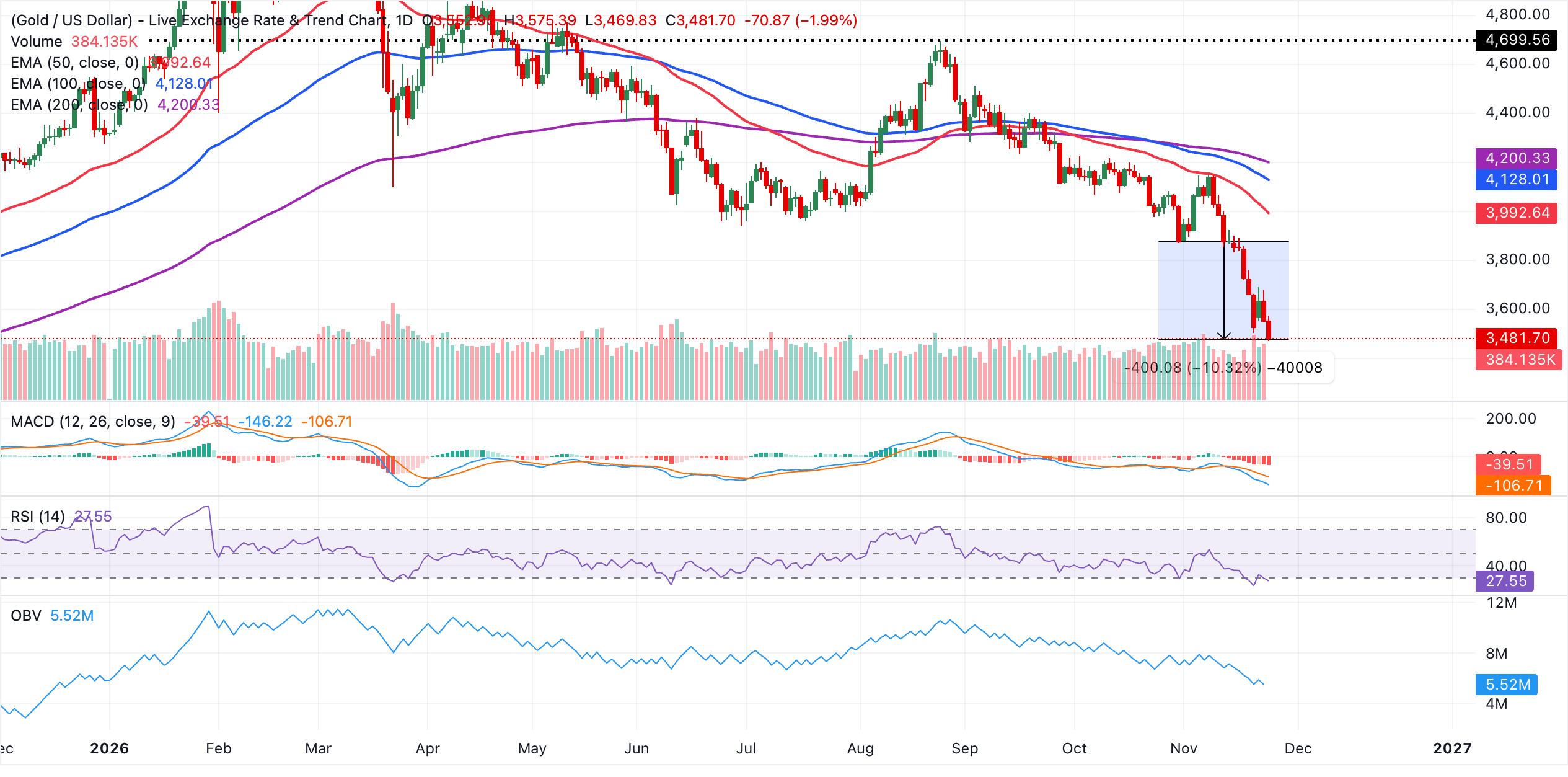
The 50-day EMA near $3,993 presents the first resistance hurdle, ahead of the 100-day EMA at $4,128 and the 200-day EMA at $4,200. These higher levels would expose a broader recovery to more established supply. With neither moving averages nor the daily chart’s structure providing nearby support, further selling could take XAU/USD towards fresh local lows. Traders are therefore left looking to price action and momentum indicators for evidence that the decline is exhausting itself before considering a sustained corrective recovery.
(The technical analysis of this story was written with the help of an AI tool. Know more.)
The biggest cryptocurrency by market capitalisation, Bitcoin is a virtual currency created to function as money. No single individual, group or entity can control this means of payment, removing the need for third parties to take part in financial transactions.
Any cryptocurrency other than Bitcoin is classed as an altcoin. Some, however, also exclude Ethereum, on the grounds that these two cryptocurrencies are the starting points for forks. Under that interpretation, Litecoin is the first altcoin: it was forked from the Bitcoin protocol and is therefore an “improved” version of it.
Designed to maintain a steady price, stablecoins are cryptocurrencies backed by a reserve of the asset they represent. Their value is pegged to a commodity or financial instrument, such as the US Dollar (USD), while supply is governed by an algorithm or by demand. Their primary purpose is to give investors a route into and out of cryptocurrency trading and investment. They also offer a way to store value, given the volatility to which cryptocurrencies are generally subject.
By comparing Bitcoin’s market capitalisation with the combined market capitalisation of all cryptocurrencies, Bitcoin dominance gives a clear indication of investor interest in Bitcoin. BTC dominance is typically high ahead of and during a bull run, as investors favour a relatively stable cryptocurrency with a large market capitalisation, such as Bitcoin. When BTC dominance falls, it generally indicates that investors are shifting capital and/or profits into altcoins in pursuit of greater returns. This usually sets off a surge in altcoin rallies.







Phone: +61 2 8036 8388
Fax: +61 2 8036 8388
Email: support@tmgm.com



The information provided on this website is of a general nature only and does not constitute personal financial advice. Before acting on any information on this website, you should consider the suitability of the information in relation to your objectives, financial situation and needs. Investing in CFDs and FX Margin Contracts carries significant risks and is not suitable for all investors. You may lose more than your initial deposit. You do not own, or have, any interest in the underlying asset. We recommend that you seek independent advice and ensure you fully understand the risks involved before trading. It is important that you read and consider the disclosure document before you acquire any product listed on the website. The information and advertisements offered on this website are not intended for use by any person in any country or jurisdiction where such use would be contrary to local laws and regulations. The Products and Services offered on this website are not intended for residents of the United States, Malaysia and Thailand.
TMGM is authorized and regulated in various jurisdictions.
Trademax Australia Limited, trading as TMGM, is regulated by the Australian Securities and Investments Commission (ASIC), AFSL no. 436416 and is located at Level 28, One International Tower, 100 Barangaroo Avenue, 2000 Sydney, NSW Australia.
Email: support@tmgm.com.au
Trademax Global Limited, trading as TMGM, is authorized and regulated by the Vanuatu Financial Services Commission (VFSC), registration number 40356 and registered at 1276, Kumul Highway, Port Vila, Vanuatu, Republic of Vanuatu.
Email: support@tmgm.com
Trademax Global Markets (SE) Limited, trading as TMGM, is authorized and regulated by the Financial Services Authority (FSA) of Seychelles, with license number SD224. The company is registered at Office No 13, Providence Estate ABIS Centre, Mahe, Seychelles.
Email: support@tmgm.com
Trademax Global Markets (International) Pty Ltd, trading as TMGM, is authorized and regulated by the Financial Services Commission, Mauritius (FSC) with license no. GB22201012, and registered at 33, Edith Cavell Street C/o IQ EQ Fund Services (Mauritius) Ltd Port Louis, 11324 Mauritius.
Email: support@tmgm.com
Copyright © TMGM. All rights reserved


