
News & AnalysisCareer

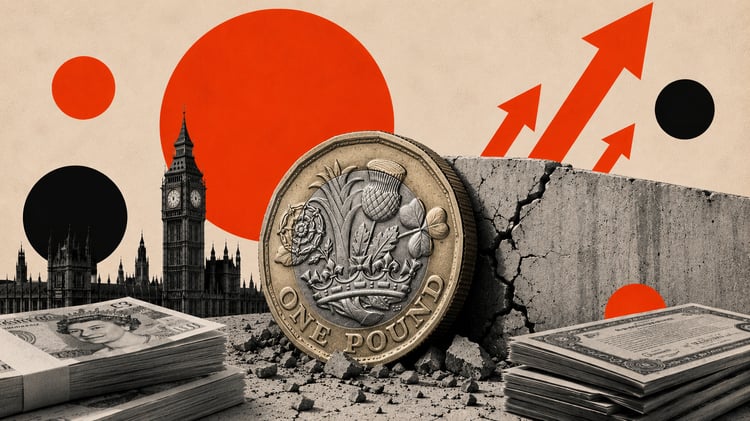
A rebound from the one-year low of 1.3120 reached earlier on Thursday has taken GBP/USD above 1.3160 to session highs, leaving the pair positive on the day. The British Pound (GBP) is recouping some of its earlier losses as brighter market sentiment encourages the US Dollar (USD) to surrender gains, with no major macroeconomic releases to guide trading.
By Thursday's approaching lunch break, most European equity markets are trading higher, reflecting an improvement in sentiment. Wall Street futures also signal a strong start as investors eagerly await the IPO of AI model developer Anthropic later in the day. Valued at $4.1 trillion, Anthropic is expected to surpass SpaceX's record for the largest initial public offering.
October's UK Consumer Price Index (CPI) figures, published on Wednesday, showed price pressures reaching a 12-month high but undershooting market expectations, adding to selling pressure on sterling. The broader picture therefore remains weak: the Pound has lost 0.3% this week and around 1.65% over the past three weeks.
Speaking later at a conference at the Institute of Economic Development, Bank of England (BoE) Governor Andrew Bailey expressed concern over elevated inflation pressures. However, he also said the bank's monetary policy was not “pre-set”. Rather than supporting the Pound, his remarks raised doubts over consecutive rate increases.
Further rate increases remain an option, according to the minutes of October's Federal Open Market Committee (FOMC) meeting in the US. Governor Christopher Waller adopted a stronger stance in a CNBC interview on Thursday, advocating “more aggressive action” and renewing hopes of a 50-basis-point increase next month.
ING analysts point to the latest FOMC minutes, noting that markets are "quite settled on pricing 25bp hikes in December, January and next summer." They argue that "this all seems a very positive story for the Dollar," as policy expectations continue to support the currency despite the possibility that some short-term flow effects may fade.
In a note, ING experts state: "There are good reasons for the dollar to be at current levels, and DXY advancing to the 104.60 area remains our bias for now,"
Maintaining stable prices across a country or region is a central bank's core mandate. As the prices of goods and services fluctuate, economies continually face inflationary or deflationary pressures. A sustained rise in the prices of the same goods constitutes inflation; a sustained decline constitutes deflation. Central banks adjust their policy rates to keep demand in check. For major institutions such as the US Federal Reserve (Fed), the European Central Bank (ECB) and the Bank of England (BoE), the objective is to hold inflation close to 2%.
Adjusting the benchmark policy rate, commonly called the interest rate, is a central bank's main tool for raising or lowering inflation. At scheduled announcements, it publishes its rate decision and explains why it has left the rate unchanged, reduced it or increased it. Domestic banks then change their savings and lending rates accordingly. This affects how easily savers can earn a return and businesses can borrow to invest in their operations. Substantial interest rate increases are known as monetary tightening, while cuts to the benchmark rate are termed monetary easing.
Political independence is common among central banks. Before taking a seat on a central bank's policy board, candidates undergo a series of panel assessments and hearings. Individual members generally hold their own views on controlling inflation and the monetary policy needed to achieve that aim. Those who favour very loose policy, using low rates and inexpensive credit to provide a substantial economic boost while accepting inflation slightly above 2%, are known as ‘doves’. By contrast, ‘hawks’ prefer higher rates that reward savers and seek to keep inflation firmly under control, persisting until it is at or just below 2%.
Meetings are usually led by a chair or president, whose role includes building consensus between hawks and doves. If votes are evenly divided over a policy change, the chair has the casting vote to prevent a 50-50 tie. Speeches by the chair, often available to follow live, set out the current monetary stance and outlook. Central banks aim to advance their policies without provoking sharp movements in interest rates, equities or their currencies. Ahead of policy meetings, all members communicate their positions to the markets. Public comments are then prohibited from a few days before the meeting until the new policy decision has been announced. This restriction is known as the blackout period.







Phone: +61 2 8036 8388
Fax: +61 2 8036 8388
Email: support@tmgm.com



The information provided on this website is of a general nature only and does not constitute personal financial advice. Before acting on any information on this website, you should consider the suitability of the information in relation to your objectives, financial situation and needs. Investing in CFDs and FX Margin Contracts carries significant risks and is not suitable for all investors. You may lose more than your initial deposit. You do not own, or have, any interest in the underlying asset. We recommend that you seek independent advice and ensure you fully understand the risks involved before trading. It is important that you read and consider the disclosure document before you acquire any product listed on the website. The information and advertisements offered on this website are not intended for use by any person in any country or jurisdiction where such use would be contrary to local laws and regulations. The Products and Services offered on this website are not intended for residents of the United States, Malaysia and Thailand.
TMGM is authorized and regulated in various jurisdictions.
Trademax Australia Limited, trading as TMGM, is regulated by the Australian Securities and Investments Commission (ASIC), AFSL no. 436416 and is located at Level 28, One International Tower, 100 Barangaroo Avenue, 2000 Sydney, NSW Australia.
Email: support@tmgm.com.au
Trademax Global Limited, trading as TMGM, is authorized and regulated by the Vanuatu Financial Services Commission (VFSC), registration number 40356 and registered at 1276, Kumul Highway, Port Vila, Vanuatu, Republic of Vanuatu.
Email: support@tmgm.com
Trademax Global Markets (SE) Limited, trading as TMGM, is authorized and regulated by the Financial Services Authority (FSA) of Seychelles, with license number SD224. The company is registered at Office No 13, Providence Estate ABIS Centre, Mahe, Seychelles.
Email: support@tmgm.com
Trademax Global Markets (International) Pty Ltd, trading as TMGM, is authorized and regulated by the Financial Services Commission, Mauritius (FSC) with license no. GB22201012, and registered at 33, Edith Cavell Street C/o IQ EQ Fund Services (Mauritius) Ltd Port Louis, 11324 Mauritius.
Email: support@tmgm.com
Copyright © TMGM. All rights reserved


