
News & AnalysisCareer

A 0.41% fall leaves Dow Jones futures trading at around 51,460 in Tuesday’s European session. S&P 500 futures are also lower, down 0.17% at roughly 7,430, whereas Nasdaq 100 futures advance 0.21% to around 27,340.
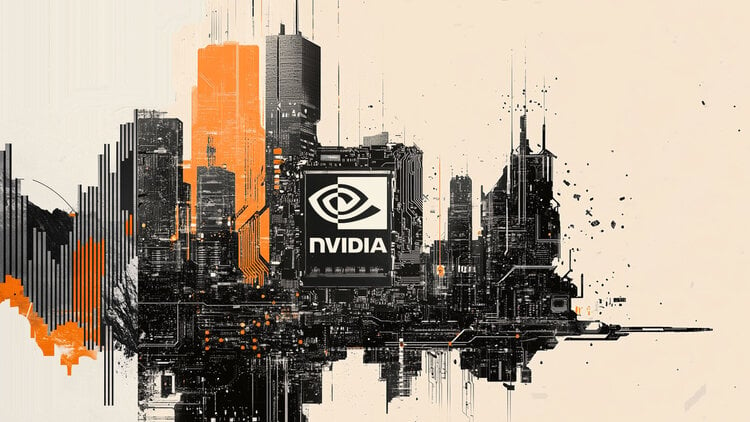
With Nvidia’s earnings due later in the day, US equity futures traded without a clear direction as investors prepared for the release. Attention is also shifting towards Anthropic’s expected market debut on Wednesday, which traders will watch for further evidence of investor appetite for AI-related businesses.
Losses of 2.49% in the technology-heavy Nasdaq Composite, 1.41% in the Dow Jones and 1.92% in the S&P 500 marked Monday’s regular US session. Following CEO Huang’s departure, a leadership crisis at Nvidia sent its shares down a further 4.1%. The decline also weighed on fellow chip stocks Micron, AMD and SanDisk.
Reports of an agreement between the US and its allies added to the pressure on technology shares. Intended to protect AI technologies and supply chains regarded as vulnerable to China, the pact seeks to restrict Chinese remote access to advanced AI chips and servers.
The slide in equities gathered pace, according to Danske Bank strategists, with the moves "much more so than futures had suggested." In their assessment, "the S&P 500 sold off by no less than -1.9%, and the Nasdaq -2.5%, as the tech selloff resumed." Performance across sectors "shifted back to defensives," and the bank noted that "consumer staples and utilities [were] the only sectors higher on the day," whereas technology "sold off by 3% (semis -5%)," highlighting fresh pressure on growth shares and semiconductor stocks.
A FXS Speechtracker reading of 7.1/10 placed Fed policymaker Hammack’s remarks slightly below the historical average of 7.6/10, although the message remained moderately hawkish and firmly centred on inflation risks. Alongside a call to approach FOMC meetings with an open mind, Hammack warned that inflation is “going in the wrong direction,” price pressures are spreading and businesses are increasingly prepared to pass on higher prices. Hammack explicitly favoured smaller, steady interest rate increases to give the economy time to adjust. The assessment that financial conditions are not yet holding back the economy, that market borrowing costs need to rise and that 2% inflation remains a reasonable objective points towards further tightening rather than an imminent policy shift.
At a still-elevated 147.36, the FXS Fed Sentiment Index recorded a rise of 0.00 points, leaving it unchanged. Despite the slightly weaker FXS Speechtracker reading, the speech therefore leaves the broader Fed stance firmly hawkish. With the index holding well above 100 and Hammack favouring gradual but ongoing restraint, the immediate effect on the dollar’s direction appears limited. Nevertheless, expectations for interest rates remain tilted towards further tightening rather than early easing.
As an academic discipline, artificial intelligence aims to reproduce human cognitive functions, logical understanding, perception and pattern recognition in machines. Commonly shortened to AI, the field encompasses artificial neural networks, machine learning or predictive analytics, symbolic reasoning, deep learning, natural language processing, speech recognition, image recognition and expert systems. Its ultimate objective is artificial general intelligence, or AGI: a machine capable of tackling arbitrary problems it has not been trained to solve.
Artificial intelligence serves a wide range of purposes. Among its best-known applications are generative AI platforms trained on large language models (LLMs) to respond to written queries, such as ChatGPT and Google’s Bard platform. User-written text also provides the basis for original images produced by Midjourney. Elsewhere, probabilistic techniques allow AI to assess an entity’s characteristics or how it is perceived. Upstart’s lending platform, for example, employs an AI-enhanced credit rating system to evaluate applicants’ creditworthiness, searching online for information about their careers, wealth profiles and relationships. Scientific research databases underpin other AI systems, which propose potential new pharmaceuticals for laboratory testing. By gathering and organising information about viewing habits, YouTube, Spotify, Facebook and other content aggregators use AI applications to recommend personalised content.
The semiconductor group Nvidia (NVDA) produces AI-focused computer chips as well as some of the platforms engineers use to develop AI applications. Because it supplies the tools required for further uses of artificial intelligence, many supporters regard Nvidia as a picks-and-shovels investment in the AI revolution. Large contracts with the US intelligence community are a feature of Palantir Technologies (PLTR), a “big data” analytics business. Intelligence agencies use its Gotham platform to analyse data, identify leads and support pattern recognition. Major corporations employ its Foundry product to monitor employee and customer data, enabling predictive analytics and the detection of anomalies. A substantial stake in OpenAI, the privately held creator of ChatGPT, is owned by Microsoft (MSFT). OpenAI’s technology has been incorporated into Microsoft’s Bing search engine.
The public launch of ChatGPT in late 2022 sparked gains across many AI-linked shares. Over the six months after its release, Nvidia, for example, rose well over 200%, quickly prompting Wall Street commentators to question whether another technology bubble was taking hold. Stanley Druckenmiller, the well-known investor who has held substantial positions in both Palantir and Nvidia, argued that bubbles never last only six months. Should enthusiasm for AI turn into a bubble, he said, extreme valuations would persist for at least two and a half years or longer, as they did during the DotCom bubble of the late 1990s. The best assessment at the midpoint of 2023 was that the market was not in a bubble, at least for the time being. Although Nvidia then traded at 27 times forward sales, analysts forecast exceptionally strong revenue growth for years ahead. By comparison, the NASDAQ 100’s valuation stood at 25 times earnings in mid-2023, against 60 times earnings at the peak of the DotCom bubble.







Phone: +61 2 8036 8388
Fax: +61 2 8036 8388
Email: support@tmgm.com



The information provided on this website is of a general nature only and does not constitute personal financial advice. Before acting on any information on this website, you should consider the suitability of the information in relation to your objectives, financial situation and needs. Investing in CFDs and FX Margin Contracts carries significant risks and is not suitable for all investors. You may lose more than your initial deposit. You do not own, or have, any interest in the underlying asset. We recommend that you seek independent advice and ensure you fully understand the risks involved before trading. It is important that you read and consider the disclosure document before you acquire any product listed on the website. The information and advertisements offered on this website are not intended for use by any person in any country or jurisdiction where such use would be contrary to local laws and regulations. The Products and Services offered on this website are not intended for residents of the United States, Malaysia and Thailand.
TMGM is authorized and regulated in various jurisdictions.
Trademax Australia Limited, trading as TMGM, is regulated by the Australian Securities and Investments Commission (ASIC), AFSL no. 436416 and is located at Level 28, One International Tower, 100 Barangaroo Avenue, 2000 Sydney, NSW Australia.
Email: support@tmgm.com.au
Trademax Global Limited, trading as TMGM, is authorized and regulated by the Vanuatu Financial Services Commission (VFSC), registration number 40356 and registered at 1276, Kumul Highway, Port Vila, Vanuatu, Republic of Vanuatu.
Email: support@tmgm.com
Trademax Global Markets (SE) Limited, trading as TMGM, is authorized and regulated by the Financial Services Authority (FSA) of Seychelles, with license number SD224. The company is registered at Office No 13, Providence Estate ABIS Centre, Mahe, Seychelles.
Email: support@tmgm.com
Trademax Global Markets (International) Pty Ltd, trading as TMGM, is authorized and regulated by the Financial Services Commission, Mauritius (FSC) with license no. GB22201012, and registered at 33, Edith Cavell Street C/o IQ EQ Fund Services (Mauritius) Ltd Port Louis, 11324 Mauritius.
Email: support@tmgm.com
Copyright © TMGM. All rights reserved

