
News & AnalysisCareer

A 0.3% advance takes the Euro (EUR) to around 1.0996 against the US Dollar (USD) in Monday's European session. EUR/USD is benefiting from the US Dollar's difficulty in sustaining its rally. Nevertheless, expectations of consecutive interest rate increases from the Federal Reserve (Fed) in the near term continue to support the Dollar's outlook.

At the time of writing, a 0.2% decline leaves the US Dollar Index (DXY) near 103.64, still within reach of last week's 19-month peak of 104.00.
Further Fed tightening is firmly reflected at the short end of the curve, according to Rabobank strategists, who observe that “the OIS curve implies that investors are positioned for a full hike in December, followed by close to 70% of a 25bp hike priced in for the January meeting.” In their view, this positioning is “in line with Waller’s comments, after having moved from one of the most hawkish to one of the most dovish FOMC members and now back among the most hawkish.”
With expectations leaning towards a hawkish Fed, market experts anticipate additional Euro losses against the US Dollar.
For Nordea strategists, “a more hawkish Fed will support the Dollar, strengthening our case for a lower EURUSD going forward.” Supporting that assessment, the bank says “statements from certain members over the week have also confirmed that market expectations of two to three rate hikes before summer are reasonable, in line with our Fed call.” Nordea therefore maintains that “our baseline for the EUR/USD remains robust, and we continue to see further downside in the pair, to 1.08 during H1 2027.”
Attention is also turning to November's preliminary Purchasing Managers’ Index (PMI) readings for the Eurozone and United States (US), with the flash releases due later in the day.
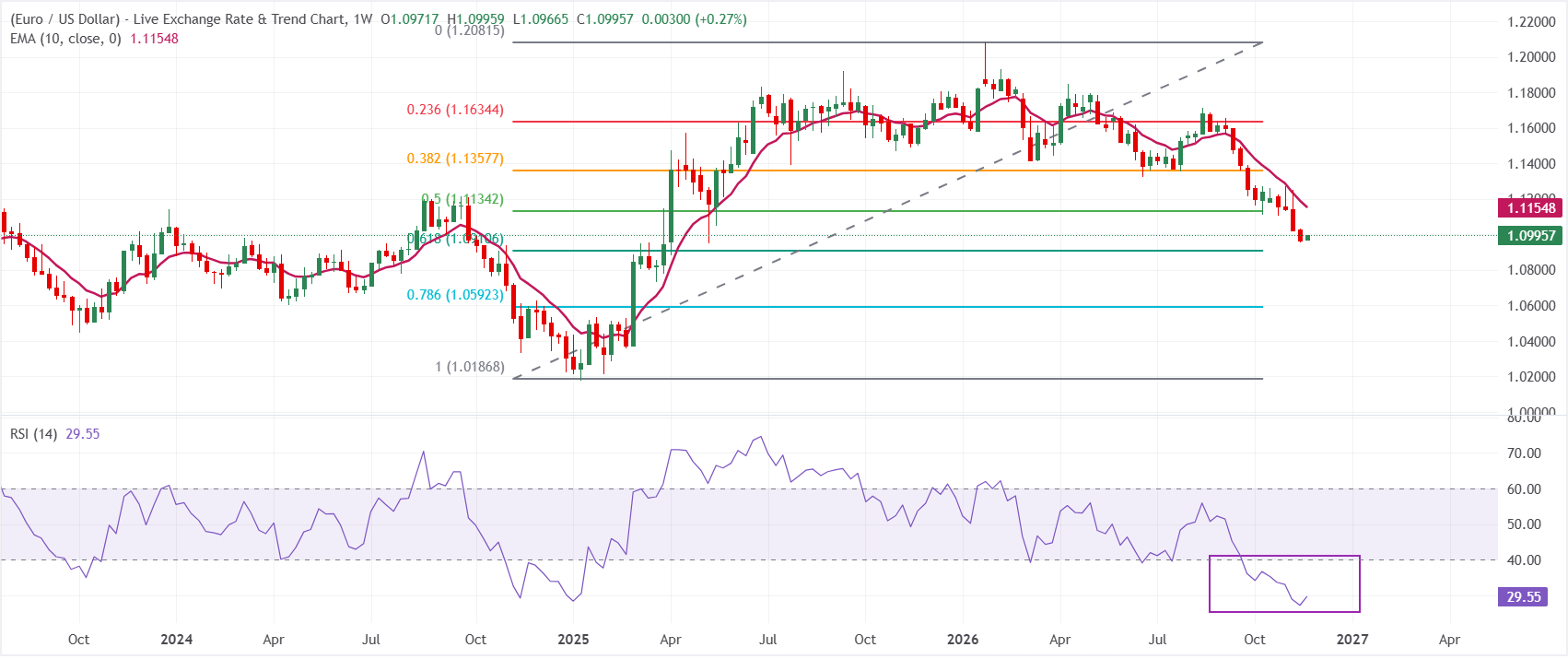
At 1.0996 on the weekly chart, EUR/USD remains below its 10-week exponential moving average (EMA) of 1.1155. This leaves the bearish bias in place and sustains the broader downtrend following the extended retreat from the 1.20 area. Although the weekly Relative Strength Index (RSI), near 29.6 in oversold territory, suggests downside momentum is stretched, the pair's inability to recover the 50.00% Fibonacci retracement at 1.1134 indicates that rallies continue to attract selling.
The 50.00% Fibonacci retracement at 1.1134 presents the first upside hurdle, just below the 10-week EMA at 1.1155. Together, these levels constitute an important supply zone, and a weekly close above it would be required to temper the immediate bearish bias. Beyond that zone, resistance stands at the 38.20% retracement of 1.1358 and the 23.60% level of 1.1634, followed by the cycle-high area near the 0.00% retracement at 1.2082. Initial downside support lies at the 61.80% Fibonacci retracement of 1.0911. Should the decline continue, further support at 1.0592 (78.60%) and 1.0187 (100.00%) could see buyers attempt to limit deeper losses.
(An AI tool assisted in preparing this article's technical analysis. Find out more.)
Responsibility for US monetary policy rests with the Federal Reserve (Fed), whose dual mandate is to maintain price stability and promote full employment. Adjustments to interest rates are its main means of pursuing these objectives. If prices increase too rapidly and inflation exceeds the Fed’s 2% target, the central bank raises interest rates, lifting borrowing costs across the economy. Higher rates make the US a more appealing destination for international investors' funds, strengthening the US Dollar (USD). Conversely, inflation below 2% or an excessively high unemployment rate may prompt the Fed to cut interest rates to stimulate borrowing, putting pressure on the Greenback.
At eight policy meetings each year, the Federal Reserve's (Fed) Federal Open Market Committee (FOMC) reviews the economy and determines monetary policy. Twelve Fed officials participate in the FOMC: the seven members of the Board of Governors, the president of the Federal Reserve Bank of New York and four of the other eleven regional Reserve Bank presidents. The latter serve rotating one-year terms.
When conditions become extreme, the Federal Reserve may turn to Quantitative Easing (QE), a policy that substantially expands the supply of credit within a stalled financial system. This unconventional measure is deployed in crises or when inflation is exceptionally low, and was the Fed's preferred response during the Great Financial Crisis in 2008. Under QE, the Fed prints additional Dollars to purchase high-grade bonds from financial institutions. The US Dollar usually weakens as a result.
Reversing QE, quantitative tightening (QT) sees the Federal Reserve cease bond purchases from financial institutions and refrain from reinvesting the principal repaid on maturing holdings in new bonds. This policy generally supports the US Dollar's value.







Phone: +61 2 8036 8388
Fax: +61 2 8036 8388
Email: support@tmgm.com



The information provided on this website is of a general nature only and does not constitute personal financial advice. Before acting on any information on this website, you should consider the suitability of the information in relation to your objectives, financial situation and needs. Investing in CFDs and FX Margin Contracts carries significant risks and is not suitable for all investors. You may lose more than your initial deposit. You do not own, or have, any interest in the underlying asset. We recommend that you seek independent advice and ensure you fully understand the risks involved before trading. It is important that you read and consider the disclosure document before you acquire any product listed on the website. The information and advertisements offered on this website are not intended for use by any person in any country or jurisdiction where such use would be contrary to local laws and regulations. The Products and Services offered on this website are not intended for residents of the United States, Malaysia and Thailand.
TMGM is authorized and regulated in various jurisdictions.
Trademax Australia Limited, trading as TMGM, is regulated by the Australian Securities and Investments Commission (ASIC), AFSL no. 436416 and is located at Level 28, One International Tower, 100 Barangaroo Avenue, 2000 Sydney, NSW Australia.
Email: support@tmgm.com.au
Trademax Global Limited, trading as TMGM, is authorized and regulated by the Vanuatu Financial Services Commission (VFSC), registration number 40356 and registered at 1276, Kumul Highway, Port Vila, Vanuatu, Republic of Vanuatu.
Email: support@tmgm.com
Trademax Global Markets (SE) Limited, trading as TMGM, is authorized and regulated by the Financial Services Authority (FSA) of Seychelles, with license number SD224. The company is registered at Office No 13, Providence Estate ABIS Centre, Mahe, Seychelles.
Email: support@tmgm.com
Trademax Global Markets (International) Pty Ltd, trading as TMGM, is authorized and regulated by the Financial Services Commission, Mauritius (FSC) with license no. GB22201012, and registered at 33, Edith Cavell Street C/o IQ EQ Fund Services (Mauritius) Ltd Port Louis, 11324 Mauritius.
Email: support@tmgm.com
Copyright © TMGM. All rights reserved


