
News & AnalysisCareer

At around 1.1195, the Euro (EUR) is marginally firmer against the US Dollar (USD) in Tuesday’s European session. Caution ahead of the United States (US) midterm elections later in the day is weighing on the US Dollar, allowing EUR/USD to edge higher.

The US Dollar Index (DXY) stands slightly lower near 101.73 at the time of writing. The index tracks the Greenback against a basket of six major currencies.
This week’s principal event risk for FX is the US midterm elections, according to ING’s Chris Turner. He notes that betting markets now assign the Democrats a “70-72% chance of taking both the House and the Senate.” In his view, “one could make the case that the Dollar should come lower on such an outcome,” since a Democratic clean sweep would likely “lead to gridlock on the debt ceiling, a prolonged government shutdown next year and could encourage President Trump to pursue an even more activist foreign policy agenda.” Turner therefore suggests that investors will balance these political risks against factors that continue to support the Dollar and DXY around the 102.00 area: robust US growth, inflation above target and continued Fed tightening.
September’s JOLTS Job Openings figures are the next focus on the economic calendar, with publication scheduled for 15:00 GMT. Estimates suggest US employers advertised 7.13 million new vacancies, a modest increase from August’s 7.097 million.
Wednesday brings the Eurozone’s preliminary Harmonised Index of Consumer Prices (HICP) figures for October. Investors expect the release to have a substantial influence on expectations for European Central Bank (ECB) monetary policy.
Headline HICP growth is forecast to remain at 3.9% year on year (YoY), above September’s 3.8%. Meanwhile, the core measure, which excludes volatile items such as food, energy, alcohol and tobacco, is expected to hold at 2.5% YoY.
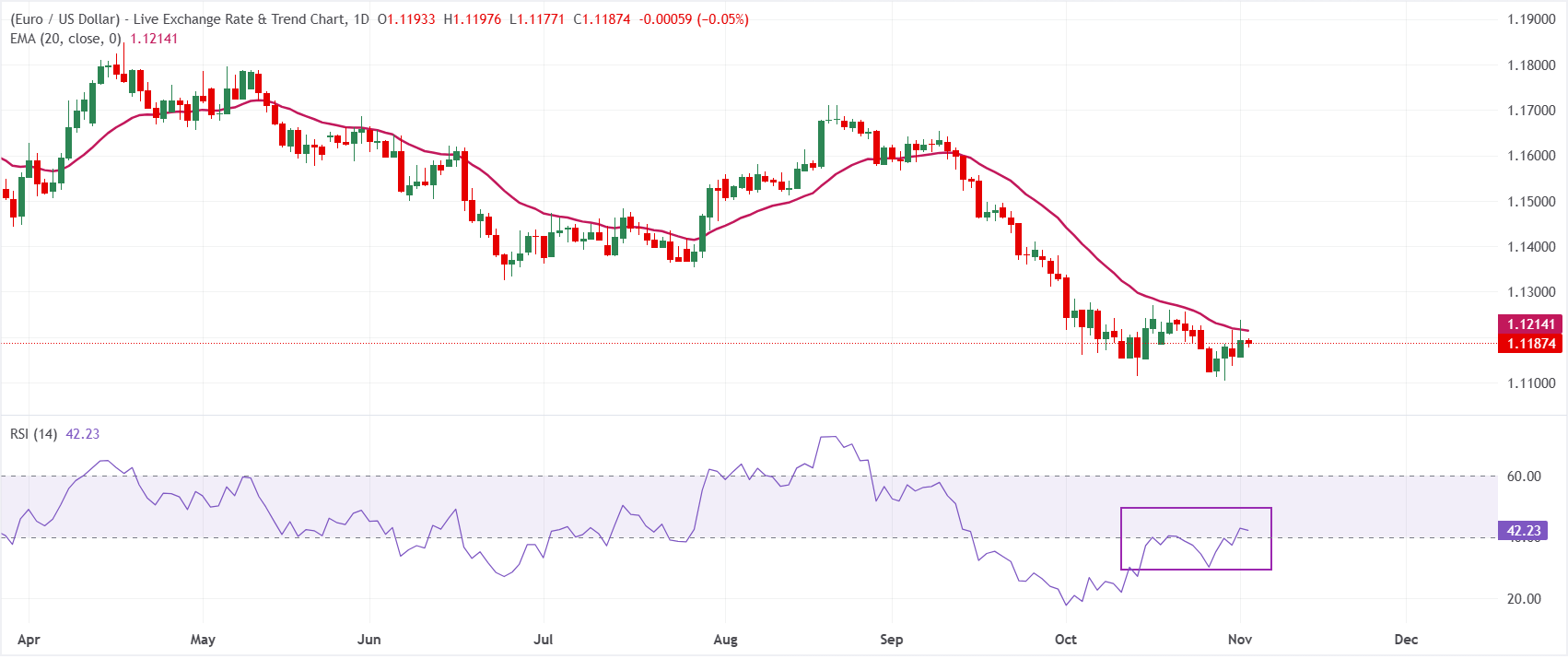
Trading at 1.1187 on the daily chart, EUR/USD retains a bearish short-term bias while the spot price remains below the 20-day exponential moving average (EMA) at 1.1214. Its position beneath this near-term trend indicator suggests that rebounds remain constrained. At around 42, the Relative Strength Index (14) points to easing downward pressure without signalling oversold conditions.
The 20-day EMA at 1.1214 provides the first resistance on the upside. Only a sustained move above it would soften the prevailing bearish tone and make room for a more constructive recovery. As the current dataset offers no clearly defined support levels nearby, traders may turn to price behaviour around recent lows to assess whether selling pressure returns or consolidation takes precedence.
(The technical analysis of this story was written with the help of an AI tool. Know more.)
To measure vacancies, the US Bureau of Labor Statistics conducts the JOLTS Job Openings survey each month. It gathers information from employers across retail, manufacturing and a range of offices.
Find out more.Next publication: Tue 3 November 2026 15:00
Publication frequency: Monthly
Market consensus: 7.13M
Prior reading: 7.079M
Data source: US Bureau of Labor Statistics







Phone: +61 2 8036 8388
Fax: +61 2 8036 8388
Email: support@tmgm.com



The information provided on this website is of a general nature only and does not constitute personal financial advice. Before acting on any information on this website, you should consider the suitability of the information in relation to your objectives, financial situation and needs. Investing in CFDs and FX Margin Contracts carries significant risks and is not suitable for all investors. You may lose more than your initial deposit. You do not own, or have, any interest in the underlying asset. We recommend that you seek independent advice and ensure you fully understand the risks involved before trading. It is important that you read and consider the disclosure document before you acquire any product listed on the website. The information and advertisements offered on this website are not intended for use by any person in any country or jurisdiction where such use would be contrary to local laws and regulations. The Products and Services offered on this website are not intended for residents of the United States, Malaysia and Thailand.
TMGM is authorized and regulated in various jurisdictions.
Trademax Australia Limited, trading as TMGM, is regulated by the Australian Securities and Investments Commission (ASIC), AFSL no. 436416 and is located at Level 28, One International Tower, 100 Barangaroo Avenue, 2000 Sydney, NSW Australia.
Email: support@tmgm.com.au
Trademax Global Limited, trading as TMGM, is authorized and regulated by the Vanuatu Financial Services Commission (VFSC), registration number 40356 and registered at 1276, Kumul Highway, Port Vila, Vanuatu, Republic of Vanuatu.
Email: support@tmgm.com
Trademax Global Markets (SE) Limited, trading as TMGM, is authorized and regulated by the Financial Services Authority (FSA) of Seychelles, with license number SD224. The company is registered at Office No 13, Providence Estate ABIS Centre, Mahe, Seychelles.
Email: support@tmgm.com
Trademax Global Markets (International) Pty Ltd, trading as TMGM, is authorized and regulated by the Financial Services Commission, Mauritius (FSC) with license no. GB22201012, and registered at 33, Edith Cavell Street C/o IQ EQ Fund Services (Mauritius) Ltd Port Louis, 11324 Mauritius.
Email: support@tmgm.com
Copyright © TMGM. All rights reserved


