
News & AnalysisCareer

At around 1.1213, the Euro (EUR) is little changed against the US Dollar (USD) in Tuesday’s European session, having relinquished its earlier gains. A further rise in oil prices has prompted a sharp US Dollar recovery, pulling the major currency pair lower.
From an intraday low of 101.74, the US Dollar Index (DXY) has recovered to around 101.91 during European trading, although it remains 0.13% lower. The index tracks the Greenback against a basket of six major currencies.

A 2.15% rise takes WTI Oil to around $100.20, its highest price in more than a month. The oil risk premium has increased amid continuing conflict in the Middle East and Iran’s threats to extend its blockade to other sea routes.
As higher oil prices unanchor inflation expectations globally, the likelihood of central banks raising interest rates increases.
Over the past week, concerns surrounding Artificial Intelligence (AI)-related optimism have weighed on the US Dollar’s performance.
Strong overseas demand linked to AI optimism has played an important role in US markets, according to analysts at MUFG, who describe them as “a major beneficiary of strong foreign investor demand driven by AI-related optimism.” Their analysis shows that foreign investors bought “USD942 billion of US equities in the twelve months to July, while purchases of US corporate bonds increased sharply to USD452 billion over the same period.” In MUFG’s view, these “sizeable inflows highlight how the USD has become increasingly tied to investors’ search for higher returns in US financial markets, rather than benefiting from its traditional safe-haven status.” The analysts nevertheless warn that “this dynamic also leaves the USD more exposed to a reversal if sentiment towards AI deteriorates.”
The Euro’s appeal has also suffered as France’s fiscal turmoil spills over into other Eurozone countries.
The latest political upheaval in France has reverberated through European markets, Deutsche Bank analysts observe, adding that “those market concerns around French debt cascaded across other countries and asset classes too.” As evidence of the spillover, they note that “the Italian 10yr spread over bunds was also up +4.7bps on the day to 111bps, whilst Spain’s was up +1.2bps to 62bps.”
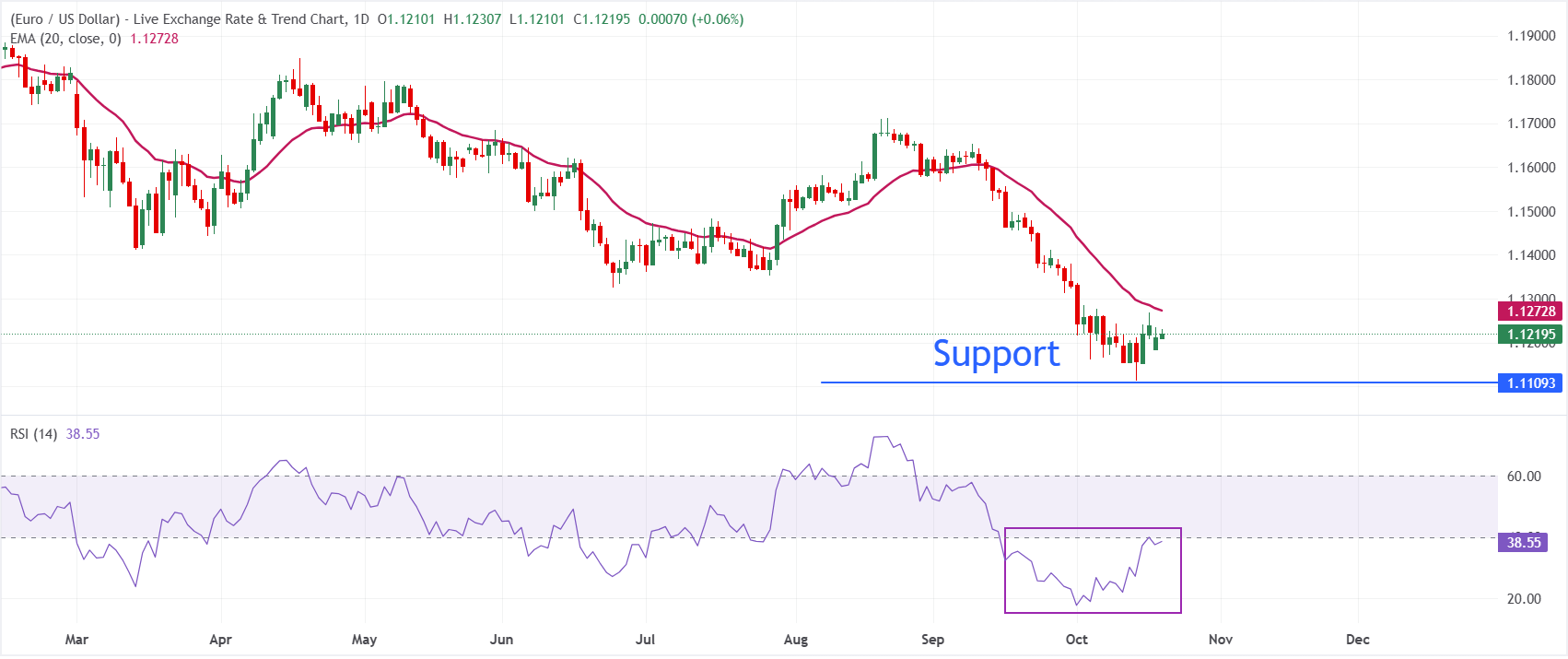
Trading at 1.1219 on the daily chart, EUR/USD retains a bearish short-term bias below the 20-period exponential moving average (EMA) of 1.1273. Failure to recover this short-term EMA indicates that overhead supply continues to limit rallies. Meanwhile, the Relative Strength Index (14) reads 38.5, below the neutral 50 threshold, suggesting persistent downward pressure rather than a clear recovery.
The 20-period EMA at 1.1273 provides the first resistance on the upside. A break above it is needed to temper the prevailing bearish bias and pave the way for a more lasting rebound. Until then, moves towards the EMA are likely to attract fresh selling. With no nearby technical support evident on the chart, the pair risks further declines if sellers reassert control.
(The technical analysis of this story was written with the help of an AI tool. Know more.)
As the official currency of the United States of America, the US Dollar (USD) also serves as the ‘de facto’ currency in a substantial number of other countries, circulating alongside their local banknotes. Data from 2022 put its share of global foreign exchange turnover at over 88%, equivalent to average daily transactions of $6.6 trillion, making it the world’s most traded currency. After the Second World War, the USD replaced the British Pound as the global reserve currency. Gold backed the US Dollar for most of its history, until the Bretton Woods Agreement in 1971 brought the Gold Standard to an end.
Monetary policy set by the Federal Reserve (Fed) is the single most influential factor in the US Dollar’s value. Adjusting interest rates is the Fed’s main means of meeting its dual mandate: maintaining price stability by controlling inflation and promoting full employment. If prices rise too rapidly and inflation exceeds the Fed’s 2% target, it will increase interest rates, supporting the USD. Conversely, inflation below 2% or an excessively high unemployment rate may prompt the Fed to cut rates, putting pressure on the Greenback.
In exceptional circumstances, the Federal Reserve may print additional Dollars and introduce quantitative easing (QE). Through QE, the Fed substantially expands the supply of credit to a financial system that has stalled. This unconventional policy is deployed when credit dries up because banks, fearful of counterparty defaults, are unwilling to lend to one another. It is a last resort when interest rate cuts alone are unlikely to deliver the required outcome. To tackle the credit crunch during the Great Financial Crisis in 2008, the Fed chose this approach. It prints additional Dollars to purchase US government bonds, mainly from financial institutions. The usual effect of QE is a weaker US Dollar.
Usually supportive of the US Dollar, quantitative tightening (QT) reverses this process. The Federal Reserve ceases bond purchases from financial institutions and, as bonds in its portfolio mature, does not reinvest the principal in new purchases.







Phone: +61 2 8036 8388
Fax: +61 2 8036 8388
Email: support@tmgm.com



The information provided on this website is of a general nature only and does not constitute personal financial advice. Before acting on any information on this website, you should consider the suitability of the information in relation to your objectives, financial situation and needs. Investing in CFDs and FX Margin Contracts carries significant risks and is not suitable for all investors. You may lose more than your initial deposit. You do not own, or have, any interest in the underlying asset. We recommend that you seek independent advice and ensure you fully understand the risks involved before trading. It is important that you read and consider the disclosure document before you acquire any product listed on the website. The information and advertisements offered on this website are not intended for use by any person in any country or jurisdiction where such use would be contrary to local laws and regulations. The Products and Services offered on this website are not intended for residents of the United States, Malaysia and Thailand.
TMGM is authorized and regulated in various jurisdictions.
Trademax Australia Limited, trading as TMGM, is regulated by the Australian Securities and Investments Commission (ASIC), AFSL no. 436416 and is located at Level 28, One International Tower, 100 Barangaroo Avenue, 2000 Sydney, NSW Australia.
Email: support@tmgm.com.au
Trademax Global Limited, trading as TMGM, is authorized and regulated by the Vanuatu Financial Services Commission (VFSC), registration number 40356 and registered at 1276, Kumul Highway, Port Vila, Vanuatu, Republic of Vanuatu.
Email: support@tmgm.com
Trademax Global Markets (SE) Limited, trading as TMGM, is authorized and regulated by the Financial Services Authority (FSA) of Seychelles, with license number SD224. The company is registered at Office No 13, Providence Estate ABIS Centre, Mahe, Seychelles.
Email: support@tmgm.com
Trademax Global Markets (International) Pty Ltd, trading as TMGM, is authorized and regulated by the Financial Services Commission, Mauritius (FSC) with license no. GB22201012, and registered at 33, Edith Cavell Street C/o IQ EQ Fund Services (Mauritius) Ltd Port Louis, 11324 Mauritius.
Email: support@tmgm.com
Copyright © TMGM. All rights reserved


