
News & AnalysisCareer

Rates on the Main Refinancing Operations (MRO) and Deposit Facility are widely expected to remain at 2.65% and 2.50%, respectively, when the European Central Bank (ECB) announces its decision at 13:15 GMT on Thursday. The announcement will conclude a two-day monetary policy meeting, following September’s increase of 25 basis points (bps) in both rates.

A Monetary Policy Statement will accompany the decision, but attention will centre on ECB President Christine Lagarde’s press conference at 13:45 GMT. Markets will scrutinise her remarks to journalists for confirmation of their expectations for a third interest rate rise in December.
An unambiguously hawkish message from the ECB on Thursday would probably offer the Euro (EUR) some support, although downside risks remain pronounced. Elevated oil prices and investor unease about France’s public finances are weighing heavily on the single currency. Any attempt by Lagarde to temper expectations of a December increase could therefore deal it a substantial blow.
A pause by the European Central Bank on Thursday is almost entirely priced into markets. Having raised rates by a quarter-point in September after an earlier increase in June, policymakers will want to gauge the effect of their latest action before lifting borrowing costs further. Elevated inflationary pressures, however, leave no room for a dovish gesture.
September’s annual eurozone consumer inflation rate reached 3.8%, a three-year high, compared with 3.2% in August. An almost 19% year-on-year rise in energy prices drove the acceleration. Oil, the principal source of inflation, stands roughly 50% above its July lows, and the uncertain, volatile situation in the Middle East makes a sustained period of high prices likely.
Unchanged core inflation has, by contrast, given the ECB some room for manoeuvre. The bank has also rejected suggestions that there is evidence of strong second-round inflationary effects, reinforcing the argument for holding rates steady. Nevertheless, the sharp rise in headline inflation must have put policymakers on their guard.
Inflation will not be the sole issue before the ECB’s committee on Thursday. A surge in French borrowing costs has alarmed bond markets, widening the spread over the German Bund to levels last seen during the 2009-2011 financial crisis. This has prompted speculation about the ECB’s bond-buying toolkit, specifically its Transmission Protection Instrument (TPI), though activation this week remains a remote prospect.
These competing pressures leave ECB President Christine Lagarde needing to calibrate her language carefully to satisfy all sides. Anchoring inflation remains the bank’s primary objective, obliging her to signal further rate rises over the coming months. Yet recent eurozone figures point to fragile economic growth, while rising bond yields are already tightening financial conditions and reducing the need for an immediate increase in interest rates.
Brown Brothers Harriman analysts note that the ECB’s October survey “showed a further net tightening of credit standards and weaker loan demand in Q3,” adding that this combination “is a headwind to Eurozone economic activity and challenges the nearly 75bps of ECB hikes priced by markets over the next twelve months.”
More than 80% odds of a quarter-point increase in December are embedded in futures prices. The risk, therefore, is that Lagarde strikes an overly dovish tone, potentially eroding speculative support for a euro that is already weak.
Over recent weeks, the euro has weakened against its major counterparts. Investors have retreated from the single currency in October amid worries about the consequences of oil remaining above $100 for an extended period, alongside France’s debt difficulties and the spread of social unrest across the country.
Over the past two months, EUR/USD has shed nearly 5%, reaching 17-month lows just above 1.1100. In that same period, EUR/GBP has fallen by about 2.8%, while EUR/JPY has declined by around 6%.
Such declines underline why a hawkish ECB message on Thursday matters. Expectations for monetary policy alone are unlikely to drive the euro higher, but could relieve some of the selling pressure, particularly alongside an explicit pledge to support France.
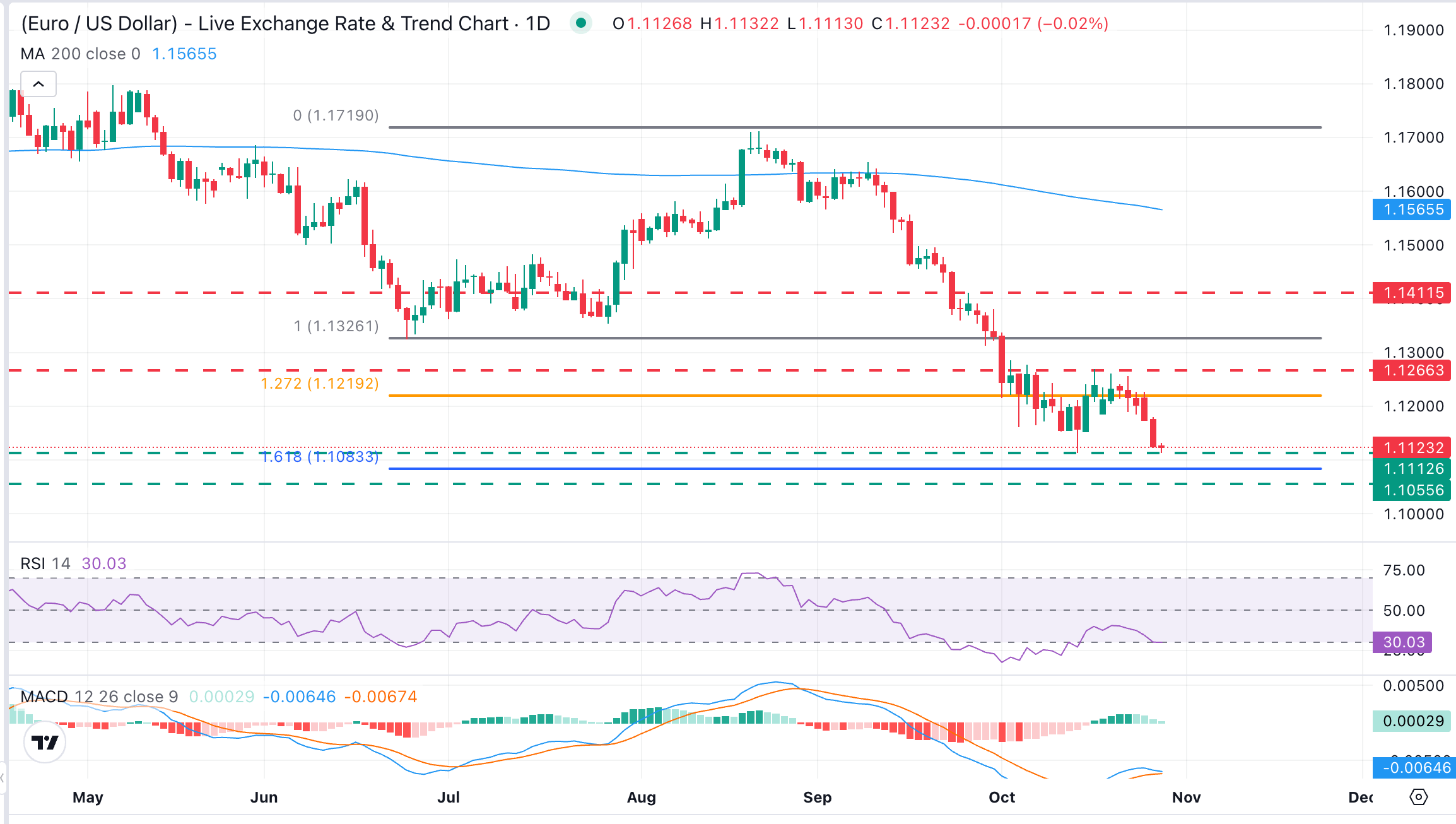
Guillermo Alcalá, FX Analyst at FXStreet, considers the euro’s downward cycle overstretched from a technical standpoint. Even so, he notes that “the EUR/USD pair’s inability to return to the upper range of the 1.1200s keeps the negative trend fully in play.”
Initial indications of fading bearish momentum are visible on the daily chart. Although the Moving Average Convergence Divergence (MACD) histogram has moved above zero, the Relative Strength Index (RSI) is still below 40, pointing to an absence of buyers.
Alcalá sets out the conditions for a reversal: “Bulls should break the resistance area at 1.1255, which has been holding upside attempts in October, and shift the focus to the late-June lows, near 1.1325 to confirm a trend reversal,” he says.
Without that move, the FXStreet expert says pressure would build towards the year-to-date trough of 1.1113, followed by 1.1095, the 61.8% Fibonacci retracement of the June-August advance. Beyond those levels lie the late May 2025 lows at 1.1050.
Borrowers pay interest on loans from financial institutions, while savers and depositors receive interest on their funds. These rates reflect the base lending rates that central banks set in response to economic developments. Maintaining price stability is normally part of a central bank’s mandate, usually expressed as a target for core inflation of around 2%. When inflation is below target, a central bank may lower base lending rates to encourage lending and stimulate the economy. Inflation significantly above 2%, by contrast, normally prompts an increase in base lending rates aimed at bringing price growth down.
By making a country a more attractive destination for global investors’ funds, higher interest rates generally support the value of its currency.
Holding gold rather than an interest-bearing investment or a bank deposit carries a greater opportunity cost when interest rates are higher. As a result, higher rates generally put downward pressure on gold prices. High rates also tend to strengthen the US Dollar (USD). Because gold is denominated in dollars, a stronger dollar has the effect of reducing its price.
US banks lend to one another overnight at the Fed funds rate, the widely cited headline rate established by the Federal Reserve at its FOMC meetings. The rate takes the form of a range, such as 4.75%-5.00%, although the figure normally quoted is the upper bound, or 5.00% in this example. The CME FedWatch tool monitors market expectations for the future Fed funds rate. Those expectations influence the behaviour of many financial markets ahead of subsequent Federal Reserve monetary policy decisions.
Banks receive interest at the deposit facility rate when they place funds with the European Central Bank. This is one of the European Central Bank’s three key interest rates and is announced at each of its eight scheduled meetings a year.
Find out more.Upcoming release: Thu 29 Oct 2026 13:15
Publication frequency: No fixed schedule
Consensus forecast: 2.5%
Prior reading: 2.5%
Data source: European Central Bank







Phone: +61 2 8036 8388
Fax: +61 2 8036 8388
Email: support@tmgm.com



The information provided on this website is of a general nature only and does not constitute personal financial advice. Before acting on any information on this website, you should consider the suitability of the information in relation to your objectives, financial situation and needs. Investing in CFDs and FX Margin Contracts carries significant risks and is not suitable for all investors. You may lose more than your initial deposit. You do not own, or have, any interest in the underlying asset. We recommend that you seek independent advice and ensure you fully understand the risks involved before trading. It is important that you read and consider the disclosure document before you acquire any product listed on the website. The information and advertisements offered on this website are not intended for use by any person in any country or jurisdiction where such use would be contrary to local laws and regulations. The Products and Services offered on this website are not intended for residents of the United States, Malaysia and Thailand.
TMGM is authorized and regulated in various jurisdictions.
Trademax Australia Limited, trading as TMGM, is regulated by the Australian Securities and Investments Commission (ASIC), AFSL no. 436416 and is located at Level 28, One International Tower, 100 Barangaroo Avenue, 2000 Sydney, NSW Australia.
Email: support@tmgm.com.au
Trademax Global Limited, trading as TMGM, is authorized and regulated by the Vanuatu Financial Services Commission (VFSC), registration number 40356 and registered at 1276, Kumul Highway, Port Vila, Vanuatu, Republic of Vanuatu.
Email: support@tmgm.com
Trademax Global Markets (SE) Limited, trading as TMGM, is authorized and regulated by the Financial Services Authority (FSA) of Seychelles, with license number SD224. The company is registered at Office No 13, Providence Estate ABIS Centre, Mahe, Seychelles.
Email: support@tmgm.com
Trademax Global Markets (International) Pty Ltd, trading as TMGM, is authorized and regulated by the Financial Services Commission, Mauritius (FSC) with license no. GB22201012, and registered at 33, Edith Cavell Street C/o IQ EQ Fund Services (Mauritius) Ltd Port Louis, 11324 Mauritius.
Email: support@tmgm.com
Copyright © TMGM. All rights reserved


