
News & AnalysisCareer

With October’s United States (US) Personal Consumption Expenditure (PCE) Price Index due at 13:30 GMT, caution ahead of the release is prompting a US Dollar (USD) recovery. The British Pound (GBP) is trading around 1.3085, down 0.22% against the dollar in Wednesday’s European session. After recovering the previous day, GBP/USD has turned lower as financial markets adopt a more cautious stance.

Today’s percentage moves in the US Dollar (USD) against the major currencies listed are set out below. Its strongest performance was against the Australian Dollar.
| USD | EUR | GBP | JPY | CAD | AUD | NZD | CHF | |
|---|---|---|---|---|---|---|---|---|
| USD | 0.28% | 0.27% | 0.14% | 0.08% | 0.86% | 0.45% | 0.18% | |
| EUR | -0.28% | -0.02% | -0.12% | -0.19% | 0.58% | 0.15% | -0.10% | |
| GBP | -0.27% | 0.02% | -0.10% | -0.16% | 0.61% | 0.18% | -0.09% | |
| JPY | -0.14% | 0.12% | 0.10% | -0.06% | 0.72% | 0.31% | 0.03% | |
| CAD | -0.08% | 0.19% | 0.16% | 0.06% | 0.78% | 0.36% | 0.08% | |
| AUD | -0.86% | -0.58% | -0.61% | -0.72% | -0.78% | -0.41% | -0.68% | |
| NZD | -0.45% | -0.15% | -0.18% | -0.31% | -0.36% | 0.41% | -0.28% | |
| CHF | -0.18% | 0.10% | 0.09% | -0.03% | -0.08% | 0.68% | 0.28% |
Percentage movements between the major currencies are displayed in the heat map. Select the base currency in the left-hand column and the quote currency in the top row. Selecting the US Dollar on the left and following its row across to the Japanese Yen, for instance, gives the percentage change for USD (base)/JPY (quote) in the corresponding cell.
At the time of writing, a 0.18% advance has taken the US Dollar Index (DXY) to around 104.04. The index measures the greenback against a basket of six major currencies.
October’s US PCE Price Index is expected to register 3.8% year-on-year (YoY), up from September’s 3.6%. Core PCE inflation, the Fed’s preferred inflation measure, is likewise forecast to rise, reaching 3.2% YoY compared with the previous reading of 3.1%.
Expectations for a larger interest rate increase from the Federal Reserve (Fed) in December could strengthen if US price pressures show signs of accelerating more quickly than anticipated.
According to the minutes of the Federal Open Market Committee’s (FOMC) October policy meeting, a couple of members cautioned that “a larger rise may be contemplated in December if incoming inflation figures were negative.”
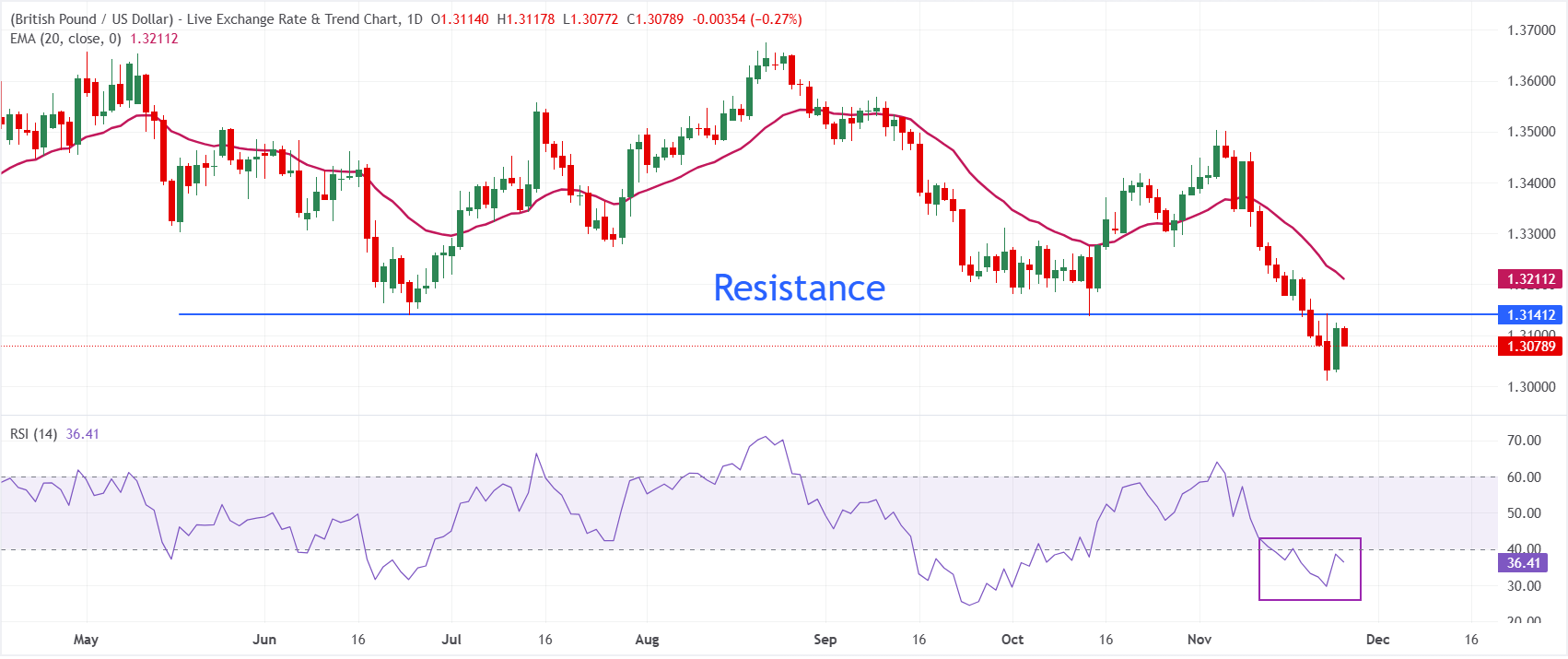
Trading at 1.3079 on the daily chart, GBP/USD retains a bearish short-term outlook below its 20-day exponential moving average (EMA) of 1.3211. The retreat from the mid-1.34s towards the low-1.30s has left this short-term EMA acting as a ceiling. Meanwhile, the Relative Strength Index (14), at around 36, points to persistent downward pressure but has yet to reach extreme oversold levels.
To relieve the immediate selling pressure and allow a corrective rebound, buyers would first need to regain the 20-day EMA at 1.3211, the initial resistance level. Downside risks remain predominant while that hurdle holds, with momentum indicators suggesting sellers could stay in control even during modest recovery attempts.
(The technical analysis of this story was written with the help of an AI tool. Know more.)
Published monthly by the US Bureau of Economic Analysis, the Core Personal Consumption Expenditures (PCE) measure tracks price changes for goods and services bought by consumers in the United States (US). The Federal Reserve (Fed) also uses the PCE Price Index as its preferred inflation gauge. For the YoY figure, goods prices in the reference month are compared with those in the corresponding month a year earlier. By excluding the more volatile food and energy components, the core figure aims to provide a more accurate assessment of price pressures. A high reading is generally supportive of the US Dollar (USD), whereas a low reading tends to weigh on it.
Find out more.Next publication: Wed 25 November 2026 13:30
Release frequency: Every month
Consensus forecast: 3.2%
Previous reading: 3.1%
Data source: US Bureau of Economic Analysis
The annual Core PCE Price Index is FOMC policymakers’ principal measure of inflation and excludes volatile food and energy prices. Following its GDP report, the US Bureau of Economic Analysis publishes the Personal Consumption Expenditures (PCE) Price Index together with monthly changes in Personal Spending and Personal Income. Should the reading exceed expectations, the USD could outperform other currencies, as the figure would suggest a potential hawkish shift in the Fed’s forward guidance. A weaker-than-expected figure could have the opposite effect.







Phone: +61 2 8036 8388
Fax: +61 2 8036 8388
Email: support@tmgm.com



The information provided on this website is of a general nature only and does not constitute personal financial advice. Before acting on any information on this website, you should consider the suitability of the information in relation to your objectives, financial situation and needs. Investing in CFDs and FX Margin Contracts carries significant risks and is not suitable for all investors. You may lose more than your initial deposit. You do not own, or have, any interest in the underlying asset. We recommend that you seek independent advice and ensure you fully understand the risks involved before trading. It is important that you read and consider the disclosure document before you acquire any product listed on the website. The information and advertisements offered on this website are not intended for use by any person in any country or jurisdiction where such use would be contrary to local laws and regulations. The Products and Services offered on this website are not intended for residents of the United States, Malaysia and Thailand.
TMGM is authorized and regulated in various jurisdictions.
Trademax Australia Limited, trading as TMGM, is regulated by the Australian Securities and Investments Commission (ASIC), AFSL no. 436416 and is located at Level 28, One International Tower, 100 Barangaroo Avenue, 2000 Sydney, NSW Australia.
Email: support@tmgm.com.au
Trademax Global Limited, trading as TMGM, is authorized and regulated by the Vanuatu Financial Services Commission (VFSC), registration number 40356 and registered at 1276, Kumul Highway, Port Vila, Vanuatu, Republic of Vanuatu.
Email: support@tmgm.com
Trademax Global Markets (SE) Limited, trading as TMGM, is authorized and regulated by the Financial Services Authority (FSA) of Seychelles, with license number SD224. The company is registered at Office No 13, Providence Estate ABIS Centre, Mahe, Seychelles.
Email: support@tmgm.com
Trademax Global Markets (International) Pty Ltd, trading as TMGM, is authorized and regulated by the Financial Services Commission, Mauritius (FSC) with license no. GB22201012, and registered at 33, Edith Cavell Street C/o IQ EQ Fund Services (Mauritius) Ltd Port Louis, 11324 Mauritius.
Email: support@tmgm.com
Copyright © TMGM. All rights reserved


