
News & AnalysisCareer

At around $4,016 at the time of writing, Gold (XAU/USD) is up 0.50% on Monday, consolidating modest gains after last week’s sharp sell-off took it to $3,975, the lowest since August. Lower Oil prices are lending support as traders respond to diplomatic initiatives aimed at reducing tensions in the Middle East.
Talks between Iranian leaders and officials from Saudi Arabia, Pakistan and Turkey, the three Mecca Pact members, are taking place in Tehran on Monday, Reuters reported. According to Iranian Foreign Ministry spokesman Esmaeil Baghaei, the agenda includes Israel’s expansionist policies, developments in Lebanon and the US war against Iran.
Qatari mediators met Iranian officials in Tehran on Sunday in an earlier round of efforts to reduce regional tensions. Following those talks, Monday’s meeting comes as West Texas Intermediate (WTI) Oil slips to about $100.39 per barrel, down from Friday’s $103.28, its highest since May.
Last week’s loss of around 4% was Gold’s largest weekly fall since June. Rising Oil prices strengthened expectations of further Federal Reserve (Fed) tightening, more than offsetting support from lower US Treasury yields and a weaker US Dollar (USD). Demand for government bonds, fuelled by concerns about AI-related investments, weighed on Treasury yields. Some traders may also have sold Gold to cover losses elsewhere amid the broader equity sell-off.
Gold’s rebound is being constrained as the US Dollar and US Treasury yields stop falling at the start of the week. The benchmark 10-year US Treasury yield is near 4.99%, while the US Dollar Index (DXY), a measure of the Greenback against a basket of six major currencies, stands at around 101.83.
Whether Gold can remain above the psychological $4,000 level or comes under renewed selling pressure could hinge on this week’s Federal Reserve (Fed) monetary policy decision.
An unchanged interest rate range of 3.75%-4.00% is widely anticipated when the Fed’s two-day meeting ends on Wednesday. Gold buyers may nevertheless find little comfort in a pause if policymakers leave open the possibility of another rise in December. According to the CME FedWatch Tool, traders assign around a 79% probability to a hike.
Little fresh guidance is anticipated by TD Securities analysts, who don't expect "much new communication from the FOMC or Chair Warsh." They argue that "a hold in October will make a December hike all the more likely," especially following the "upside surprise in September CPI," which highlights that "inflation risks are still pertinent." Against that backdrop, TD Securities "expect the Fed to hike two more times (December and March)," pointing out that "inflation remains above target while risks are growing." Beyond early next year, incoming price data will be central to the policy outlook, with the analysts adding that "the evolution of inflation data will determine the extent and pace of hikes later in the cycle,".
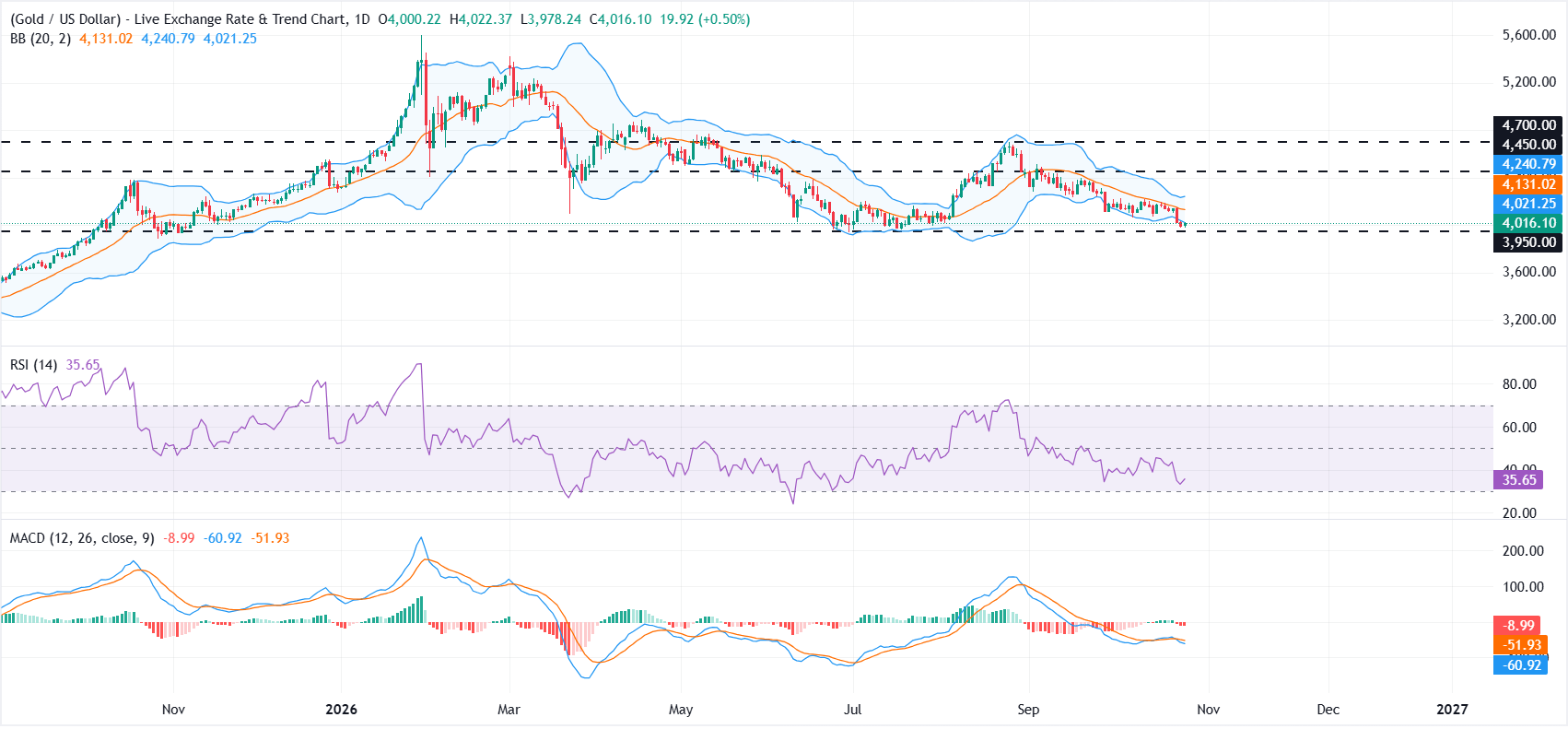
With XAU/USD trading beneath the lower Bollinger Band at $4,020 on the daily chart, the near-term outlook remains bearish. At 35, the Relative Strength Index (RSI) is only just above oversold territory, and the Moving Average Convergence Divergence (MACD) histogram is still negative. Together, the indicators suggest continued downward pressure rather than a clear exhaustion of the recent decline.
The lower Bollinger Band around $4,020 provides the first resistance, ahead of the middle band near $4,131 and the upper band around $4,241. If prices establish a sustained break above these levels, a recovery towards the $4,400-$4,500 area could follow, with $4,700 the next level beyond that.
Initial support is found in the $3,975-$3,950 area. Should prices break decisively below it, the decline could extend to the psychological $3,900 level and then $3,800.
(The technical analysis of this story was written with the help of an AI tool. Know more.)
Throughout human history, Gold has been important as both a store of value and a medium of exchange. Beyond its lustre and use in jewellery, the precious metal is now widely regarded as a safe-haven asset: an investment considered attractive during periods of turbulence. Its independence from any particular issuer or government also underpins its widespread use as a hedge against inflation and currency depreciation.
The largest holders of Gold are central banks. To support their currencies during unsettled periods, they typically diversify reserves and purchase Gold, helping to strengthen perceptions of their economies and currencies. Substantial Gold reserves can bolster confidence in a country’s solvency. World Gold Council data show that central banks increased their reserves by 1,136 tonnes of Gold, worth around $70 billion, in 2022, the largest annual purchase on record. Emerging-economy central banks, including those in China, India and Turkey, are rapidly expanding their Gold holdings.
Both the US Dollar and US Treasuries are major reserve and safe-haven assets, and Gold is inversely correlated with them. Dollar weakness tends to lift Gold, allowing investors and central banks to diversify their holdings during turbulent periods. The metal also has an inverse relationship with risk assets: stock market rallies generally weigh on Gold prices, whereas selling in riskier markets tends to support the precious metal.
Many factors can influence Gold prices. Its safe-haven appeal means geopolitical instability or fears of a severe recession can swiftly send prices higher. Gold pays no yield, so lower interest rates tend to support it, while higher borrowing costs generally weigh on the metal. Nevertheless, because Gold is priced in dollars (XAU/USD), most price movements depend on the performance of the US Dollar (USD). A stronger Dollar typically restrains Gold prices, while a weaker one is likely to lift them.







Phone: +61 2 8036 8388
Fax: +61 2 8036 8388
Email: support@tmgm.com



The information provided on this website is of a general nature only and does not constitute personal financial advice. Before acting on any information on this website, you should consider the suitability of the information in relation to your objectives, financial situation and needs. Investing in CFDs and FX Margin Contracts carries significant risks and is not suitable for all investors. You may lose more than your initial deposit. You do not own, or have, any interest in the underlying asset. We recommend that you seek independent advice and ensure you fully understand the risks involved before trading. It is important that you read and consider the disclosure document before you acquire any product listed on the website. The information and advertisements offered on this website are not intended for use by any person in any country or jurisdiction where such use would be contrary to local laws and regulations. The Products and Services offered on this website are not intended for residents of the United States, Malaysia and Thailand.
TMGM is authorized and regulated in various jurisdictions.
Trademax Australia Limited, trading as TMGM, is regulated by the Australian Securities and Investments Commission (ASIC), AFSL no. 436416 and is located at Level 28, One International Tower, 100 Barangaroo Avenue, 2000 Sydney, NSW Australia.
Email: support@tmgm.com.au
Trademax Global Limited, trading as TMGM, is authorized and regulated by the Vanuatu Financial Services Commission (VFSC), registration number 40356 and registered at 1276, Kumul Highway, Port Vila, Vanuatu, Republic of Vanuatu.
Email: support@tmgm.com
Trademax Global Markets (SE) Limited, trading as TMGM, is authorized and regulated by the Financial Services Authority (FSA) of Seychelles, with license number SD224. The company is registered at Office No 13, Providence Estate ABIS Centre, Mahe, Seychelles.
Email: support@tmgm.com
Trademax Global Markets (International) Pty Ltd, trading as TMGM, is authorized and regulated by the Financial Services Commission, Mauritius (FSC) with license no. GB22201012, and registered at 33, Edith Cavell Street C/o IQ EQ Fund Services (Mauritius) Ltd Port Louis, 11324 Mauritius.
Email: support@tmgm.com
Copyright © TMGM. All rights reserved

