
News & AnalysisCareer

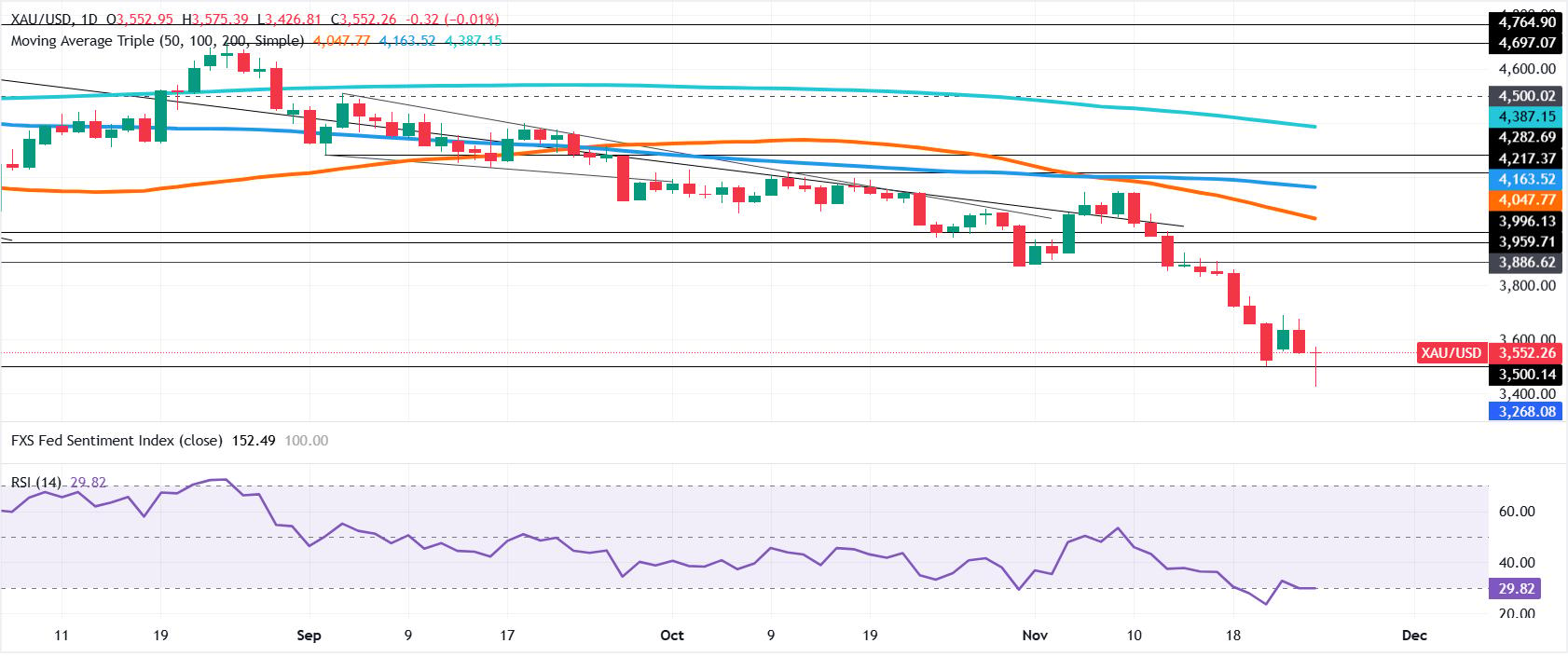
Stronger-than-expected US inflation and Gross Domestic Product (GDP) figures pointing to a resilient economy have left Gold (XAU/USD) down 0.70% on Wednesday. GDP growth comfortably exceeded forecasts. Having touched $3,426, its lowest level since September 2025, XAU/USD is trading at $3,511 at the time of writing.

October’s Core Personal Consumption Expenditures (PCE) Price Index rose by 3.3% year on year, compared with 3.1% previously, according to the US Bureau of Economic Analysis (BEA). The measure is the Federal Reserve’s (Fed) preferred inflation gauge. Headline PCE inflation increased to 3.8% from 3.7%, matching expectations. Meanwhile, the second estimate of Q3 GDP put growth at 4.3%, above the 3.4% forecast.
Expectations of further Fed tightening changed little following the figures. The CME FedWatch Tool continues to indicate a 92% probability of a 25-basis-point rate increase in December, compared with 97% a day earlier.
Elsewhere, growth in Durable Goods Orders eased to 0.2% in October from 2% in September. Initial Jobless Claims dropped to 189K from 202K in the week ending 21 November, substantially below the forecast of 200K.
The US Dollar has softened following the data, with the US Dollar Index (DXY) declining 0.22% to 103.61. The index measures the currency’s performance against a basket of six currencies.
Despite money markets having priced in further rate increases, US Treasury yields have declined. The yield on the benchmark 10-year Treasury note has fallen nearly nine basis points to 4.84%.
In a breaking development, proposals by US President Donald Trump for tariffs on major trading powers, including China, have revived trade tensions, despite his party’s midterm losses.
Thursday brings no scheduled US economic releases, with US markets closed for the Thanksgiving holiday.
A ‘dragonfly doji’ is taking shape in Gold’s price action. After a fresh yearly low, XAU/USD is closing above $3,500 near the session’s highs, signalling that buyers are gathering momentum.
The Relative Strength Index (RSI), however, has flattened close to oversold territory. This indicates that the metal appears overstretched to the downside, as traders take profits while awaiting the next catalyst.
A continuation of the decline requires XAU/USD to break below $3,500, where the swing high of 22 April 2025 now provides support. Below that level, traders would look for further declines towards support at $3,268—the swing low of 30 July 2025—and then $3,000.
To reverse the bearish trend, Gold needs to overcome last week’s high of $3,901 before tackling $4,000. A break above $4,000 would bring the 50-day Simple Moving Average (SMA), at $4,062, into view.
Throughout human history, Gold has served widely as both a store of value and a means of exchange, giving it an important role. Beyond its lustre and use in jewellery, the precious metal is now commonly regarded as a safe-haven asset: an investment considered attractive during periods of turbulence. Because it is not dependent on any particular issuer or government, Gold is also widely viewed as protection against inflation and currency depreciation.
The largest holders of Gold are central banks. To underpin their currencies during unsettled periods, they typically diversify their reserves and purchase Gold, reinforcing perceptions of economic and currency strength. Substantial Gold reserves can bolster confidence in a country’s solvency. Figures from the World Gold Council show that central banks increased their reserves by 1,136 tonnes of Gold in 2022, valued at about $70 billion. That was the largest annual purchase on record. Emerging-market central banks, including those of China, India and Turkey, are rapidly expanding their Gold reserves.
Both the US Dollar and US Treasuries are major reserve and safe-haven assets, and Gold tends to move inversely to them. A weaker Dollar generally supports Gold, allowing investors and central banks to diversify their holdings during turbulent periods. The metal also has an inverse relationship with risk assets: rising equity markets tend to weigh on Gold prices, whereas selling in riskier markets generally benefits the precious metal.
Many different influences can shift Gold prices. Its safe-haven appeal means geopolitical instability or concerns about a severe recession can trigger a rapid rise. Since Gold pays no yield, lower interest rates tend to support it, while higher borrowing costs usually put the metal under pressure. Nevertheless, movements in the US Dollar (USD) drive most price changes because Gold is denominated in dollars (XAU/USD). Dollar strength generally restrains Gold prices; a softer Dollar, by contrast, is likely to lift them.







Phone: +61 2 8036 8388
Fax: +61 2 8036 8388
Email: support@tmgm.com



The information provided on this website is of a general nature only and does not constitute personal financial advice. Before acting on any information on this website, you should consider the suitability of the information in relation to your objectives, financial situation and needs. Investing in CFDs and FX Margin Contracts carries significant risks and is not suitable for all investors. You may lose more than your initial deposit. You do not own, or have, any interest in the underlying asset. We recommend that you seek independent advice and ensure you fully understand the risks involved before trading. It is important that you read and consider the disclosure document before you acquire any product listed on the website. The information and advertisements offered on this website are not intended for use by any person in any country or jurisdiction where such use would be contrary to local laws and regulations. The Products and Services offered on this website are not intended for residents of the United States, Malaysia and Thailand.
TMGM is authorized and regulated in various jurisdictions.
Trademax Australia Limited, trading as TMGM, is regulated by the Australian Securities and Investments Commission (ASIC), AFSL no. 436416 and is located at Level 28, One International Tower, 100 Barangaroo Avenue, 2000 Sydney, NSW Australia.
Email: support@tmgm.com.au
Trademax Global Limited, trading as TMGM, is authorized and regulated by the Vanuatu Financial Services Commission (VFSC), registration number 40356 and registered at 1276, Kumul Highway, Port Vila, Vanuatu, Republic of Vanuatu.
Email: support@tmgm.com
Trademax Global Markets (SE) Limited, trading as TMGM, is authorized and regulated by the Financial Services Authority (FSA) of Seychelles, with license number SD224. The company is registered at Office No 13, Providence Estate ABIS Centre, Mahe, Seychelles.
Email: support@tmgm.com
Trademax Global Markets (International) Pty Ltd, trading as TMGM, is authorized and regulated by the Financial Services Commission, Mauritius (FSC) with license no. GB22201012, and registered at 33, Edith Cavell Street C/o IQ EQ Fund Services (Mauritius) Ltd Port Louis, 11324 Mauritius.
Email: support@tmgm.com
Copyright © TMGM. All rights reserved


