
News & AnalysisCareer

A decline to $3,832 in early Asian trading on Monday, the lowest since October 2025, brings some dip buying into gold (XAU/USD). The metal is little changed at around $3,872 at the time of writing, remaining below the session high of $3,901.

Elevated US Treasury yields and a firm US Dollar (USD), underpinned by a hawkish outlook for the Federal Reserve (Fed), leave the recovery looking vulnerable. Around 103.55, the US Dollar Index (DXY) is at its highest since April 2025. The index measures the dollar against a basket of six major currencies.
Shifting expectations for US monetary policy are supporting the US Dollar, according to analysts at MUFG, who say it “has continued to strengthen at the start of this week building on top of the strong gains recorded last week,” as investors adjust their positions. Explaining the repricing, the analysts note that “market participants have moved to price in a more aggressive Fed tightening cycle following the third consecutive upside surprise in US core CPI in October and a hawkish shift in Fed rhetoric.” As a result, MUFG observes that “the US rates market is now assigning a higher probability to three consecutive hikes in December, January and March, which would lift the effective Fed funds rate towards 4.6%.”
Inflation was heading in the wrong direction and remained “uncomfortably above” the 2% target, Kansas City Fed President Jeff Schmid said on Sunday. As a non-interest-bearing asset, gold becomes less appealing when interest rates rise.
Whether December could bring a larger Fed rate rise is now the focus of debate. Last week, Fed Governor Christopher Waller suggested that a 50-basis-point (bps) increase could be justified by a monthly core Consumer Price Index (CPI) inflation reading of around 0.3% or above. October's figure was 0.3%.
A relatively light schedule of major US economic releases this week puts a series of Fed speeches in focus. New York Fed President John Williams and Fed Chair Kevin Warsh are scheduled to speak later in the US trading session, while the minutes of the Fed's October meeting are set for release on Wednesday.
Among the data releases, Tuesday brings US Retail Sales, followed by weekly Initial Jobless Claims on Thursday. On Friday, attention turns to the University of Michigan's November readings on consumer sentiment and inflation expectations.
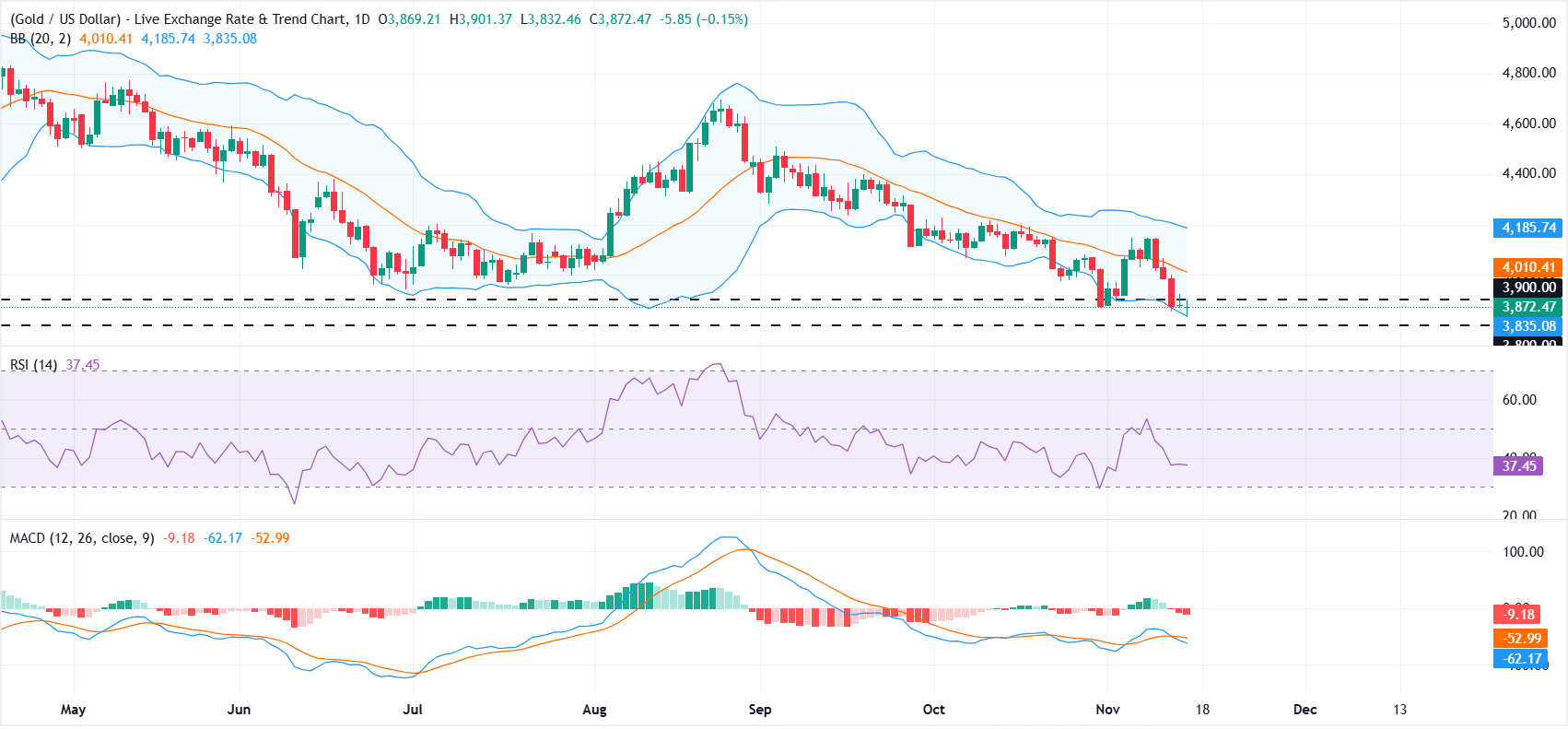
Trading below the Bollinger middle Simple Moving Average (SMA) at $4,010, XAU/USD maintains a bearish short-term outlook on the daily chart. Although the price remains above the lower Bollinger band, a muted Relative Strength Index (RSI) reading of 37 and a negative Moving Average Convergence Divergence (MACD) reinforce the downward pressure. Both indicators suggest that nearby resistance is likely to limit recovery attempts.
The horizontal $3,900 level offers the first resistance on any advance, with the Bollinger middle SMA at $4,010 next, ahead of the upper band near $4,186. Stronger selling interest there could re-establish the broader downtrend. Initial support lies at the lower Bollinger band around $3,834, followed by the horizontal floor at $3,800. A decisive breach of these levels would leave scope for a more pronounced decline.
(The technical analysis of this story was written with the help of an AI tool. Know more.)
Widely used both as a store of value and a means of exchange, gold has held an important place throughout human history. Beyond its lustre and use in jewellery, the precious metal is now broadly regarded as a safe-haven asset, or an attractive investment during periods of turbulence. Its independence from any particular issuer or government also underpins its widespread appeal as a hedge against inflation and currency depreciation.
The largest holders of gold are central banks. Seeking to support their currencies during turbulent periods, they typically diversify their reserves and purchase gold to bolster perceptions of economic and currency strength. Substantial gold reserves can help build confidence in a country's solvency. According to the World Gold Council, central banks increased their reserves by 1,136 tonnes of gold, valued at around $70 billion, in 2022. That marked the largest annual purchase since records began. Emerging-economy central banks, including those in China, India and Turkey, are expanding their gold reserves rapidly.
Both the US Dollar and US Treasuries, major reserve and safe-haven assets, have an inverse correlation with gold. A weaker dollar tends to support gold prices, allowing investors and central banks to diversify their holdings during turbulent periods. The metal also has an inverse relationship with risk assets: stock market gains typically put pressure on gold, whereas selling in riskier markets generally benefits it.
Numerous influences can drive gold prices. Its safe-haven appeal means geopolitical instability or concerns about a deep recession can prompt rapid price increases. Since gold pays no yield, lower interest rates tend to support it, while higher borrowing costs usually weigh on the metal. Nevertheless, movements in the US Dollar (USD) account for most price changes, as gold is quoted in dollars (XAU/USD). Dollar strength generally restrains gold prices, while a weaker dollar is likely to lift them.







Phone: +61 2 8036 8388
Fax: +61 2 8036 8388
Email: support@tmgm.com



The information provided on this website is of a general nature only and does not constitute personal financial advice. Before acting on any information on this website, you should consider the suitability of the information in relation to your objectives, financial situation and needs. Investing in CFDs and FX Margin Contracts carries significant risks and is not suitable for all investors. You may lose more than your initial deposit. You do not own, or have, any interest in the underlying asset. We recommend that you seek independent advice and ensure you fully understand the risks involved before trading. It is important that you read and consider the disclosure document before you acquire any product listed on the website. The information and advertisements offered on this website are not intended for use by any person in any country or jurisdiction where such use would be contrary to local laws and regulations. The Products and Services offered on this website are not intended for residents of the United States, Malaysia and Thailand.
TMGM is authorized and regulated in various jurisdictions.
Trademax Australia Limited, trading as TMGM, is regulated by the Australian Securities and Investments Commission (ASIC), AFSL no. 436416 and is located at Level 28, One International Tower, 100 Barangaroo Avenue, 2000 Sydney, NSW Australia.
Email: support@tmgm.com.au
Trademax Global Limited, trading as TMGM, is authorized and regulated by the Vanuatu Financial Services Commission (VFSC), registration number 40356 and registered at 1276, Kumul Highway, Port Vila, Vanuatu, Republic of Vanuatu.
Email: support@tmgm.com
Trademax Global Markets (SE) Limited, trading as TMGM, is authorized and regulated by the Financial Services Authority (FSA) of Seychelles, with license number SD224. The company is registered at Office No 13, Providence Estate ABIS Centre, Mahe, Seychelles.
Email: support@tmgm.com
Trademax Global Markets (International) Pty Ltd, trading as TMGM, is authorized and regulated by the Financial Services Commission, Mauritius (FSC) with license no. GB22201012, and registered at 33, Edith Cavell Street C/o IQ EQ Fund Services (Mauritius) Ltd Port Louis, 11324 Mauritius.
Email: support@tmgm.com
Copyright © TMGM. All rights reserved


