
News & AnalysisCareer

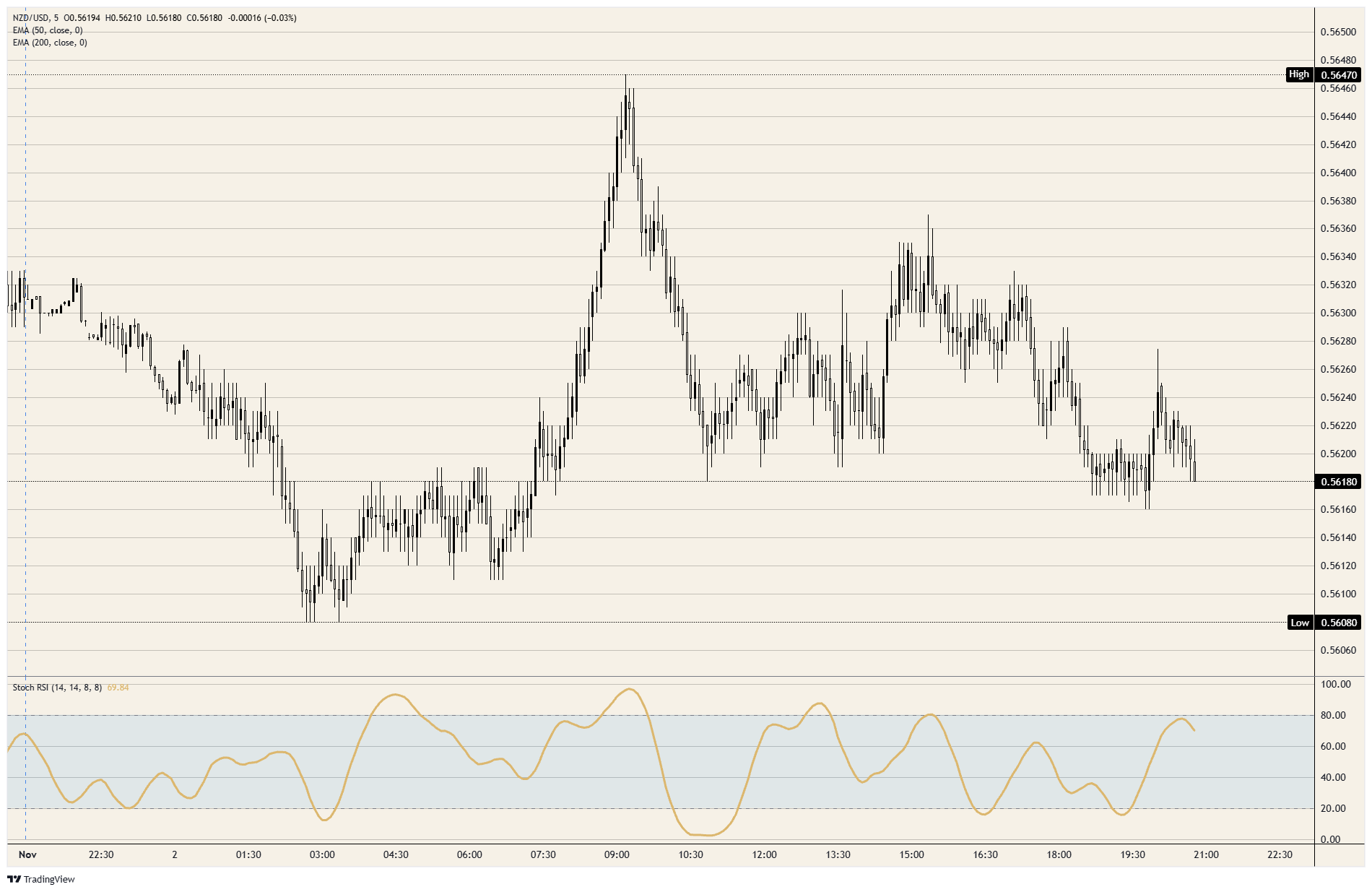
With the Reserve Bank of New Zealand (RBNZ) keeping its policy rate at 2.75%, NZD/USD has surrendered all the gains it made as the Dollar weakened. US-Iran diplomacy had pushed the Dollar and Crude Oil lower, helping the pair recover from a session low just above 0.5600 to just below 0.5650. The pair is now back just above 0.5600, beneath its level at the start of the week.

Westpac described the RBNZ's 28 October decision as a shock to the market: policymakers voted four to three to leave rates unchanged, with Governor Breman supporting the hold. With no further decision due until 9 December and the Fed's rate at 3.75%-4.00%, the interest-rate differential affecting NZD/USD will remain at least 1.00 point until then.
Despite forecasting inflation of 4.4% by year-end, up from September's 3.7%, the RBNZ opted against a rate rise. The New Zealand Dollar has also lost ground to the Australian Dollar as stronger Australian inflation has fuelled expectations of further Reserve Bank of Australia (RBA) rate increases. Against that backdrop, NZD/USD has underperformed the Euro and the Pound against the Dollar.
Unemployment is forecast at 5.5%, against a previous 5.6%, when New Zealand releases its third-quarter labour market figures at 21:45 GMT on Tuesday. Employment growth is expected at 0.4%, following 0.5%. These are the principal New Zealand data ahead of the RBNZ's 9 December decision; the general election takes place on Saturday, 7 November.
US October Nonfarm Payrolls (NFP), due at 13:30 GMT on Friday, are forecast at 65K, while the unemployment rate is expected to remain at 4.2%. Before that, September job openings are scheduled for 15:00 GMT on Tuesday, with a forecast of 7.13 million compared with the previous 7.079 million. Both releases inform the Fed side of the interest-rate differential affecting NZD/USD.
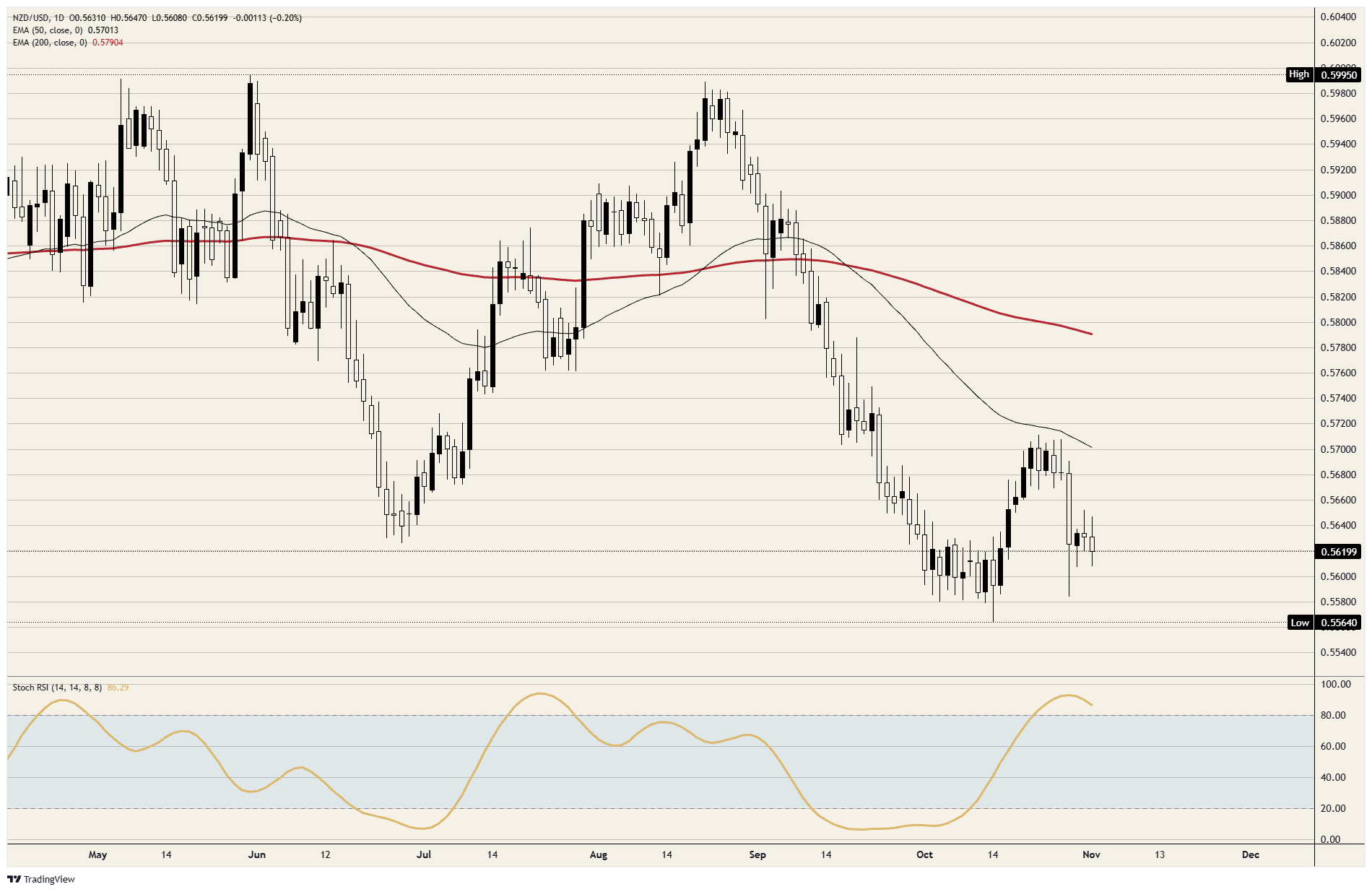
Since 29 October, the day following the RBNZ decision, a half-cent range has contained NZD/USD. The preceding advance from the 14 October low just above 0.5550 had stalled just below the 50-day Exponential Moving Average (EMA). That average now sits near 0.5700, while the 200-day EMA is just below 0.5800.
Known as the Kiwi, the New Zealand Dollar (NZD) is a familiar currency among investors. The strength of New Zealand's economy and its central bank's policy broadly determine its value, although several distinctive factors can also influence its movements. China is New Zealand's largest trading partner, so developments in the Chinese economy tend to affect the Kiwi. Adverse Chinese economic news is likely to imply fewer New Zealand exports to China, weighing on New Zealand's economy and, in turn, its currency. Dairy prices are another influence on NZD, as dairy is the country's principal export industry. Higher dairy prices increase export receipts, supporting both the economy and the NZD.
Keeping inflation within a 1% to 3% range over the medium term, and close to the 2% midpoint, is the Reserve Bank of New Zealand's (RBNZ) objective. The bank sets interest rates at a level appropriate to that aim. If inflation becomes too high, the RBNZ raises rates to slow the economy. Higher rates also lift bond yields, making investment in New Zealand more attractive and thereby supporting NZD. Rate reductions, by contrast, generally weaken the currency. Another important influence on NZD/USD is the interest-rate differential: the gap between New Zealand's rates and those set by the US Federal Reserve, including expectations of how that gap may develop.
Assessing New Zealand's economic health depends heavily on macroeconomic releases, which can also affect the valuation of the New Zealand Dollar (NZD). Strong growth, low unemployment and high confidence underpin a healthy economy and support NZD. Rapid economic expansion draws foreign investment and, where it coincides with elevated inflation, may prompt the Reserve Bank of New Zealand to raise interest rates. Weak economic figures, on the other hand, are likely to lead to NZD depreciation.
During risk-on periods, the New Zealand Dollar (NZD) typically appreciates as investors see limited risks across markets and take an optimistic view of growth. Such conditions tend to improve the outlook for commodities and so-called ‘commodity currencies’ such as the Kiwi. Market turmoil or economic uncertainty usually has the opposite effect: investors tend to dispose of riskier assets in favour of more stable safe havens, weakening NZD.







Phone: +61 2 8036 8388
Fax: +61 2 8036 8388
Email: support@tmgm.com



The information provided on this website is of a general nature only and does not constitute personal financial advice. Before acting on any information on this website, you should consider the suitability of the information in relation to your objectives, financial situation and needs. Investing in CFDs and FX Margin Contracts carries significant risks and is not suitable for all investors. You may lose more than your initial deposit. You do not own, or have, any interest in the underlying asset. We recommend that you seek independent advice and ensure you fully understand the risks involved before trading. It is important that you read and consider the disclosure document before you acquire any product listed on the website. The information and advertisements offered on this website are not intended for use by any person in any country or jurisdiction where such use would be contrary to local laws and regulations. The Products and Services offered on this website are not intended for residents of the United States, Malaysia and Thailand.
TMGM is authorized and regulated in various jurisdictions.
Trademax Australia Limited, trading as TMGM, is regulated by the Australian Securities and Investments Commission (ASIC), AFSL no. 436416 and is located at Level 28, One International Tower, 100 Barangaroo Avenue, 2000 Sydney, NSW Australia.
Email: support@tmgm.com.au
Trademax Global Limited, trading as TMGM, is authorized and regulated by the Vanuatu Financial Services Commission (VFSC), registration number 40356 and registered at 1276, Kumul Highway, Port Vila, Vanuatu, Republic of Vanuatu.
Email: support@tmgm.com
Trademax Global Markets (SE) Limited, trading as TMGM, is authorized and regulated by the Financial Services Authority (FSA) of Seychelles, with license number SD224. The company is registered at Office No 13, Providence Estate ABIS Centre, Mahe, Seychelles.
Email: support@tmgm.com
Trademax Global Markets (International) Pty Ltd, trading as TMGM, is authorized and regulated by the Financial Services Commission, Mauritius (FSC) with license no. GB22201012, and registered at 33, Edith Cavell Street C/o IQ EQ Fund Services (Mauritius) Ltd Port Louis, 11324 Mauritius.
Email: support@tmgm.com
Copyright © TMGM. All rights reserved


