
News & AnalysisCareer

The Reserve Bank of New Zealand’s (RBNZ) surprise decision to keep the Official Cash Rate (OCR) at 2.75% triggered market turmoil on Wednesday, after which the Kiwi pair began to recover. During Friday’s European session, the New Zealand Dollar (NZD) extends that rebound against the US Dollar (USD), approaching 0.5640.

Against expectations of an increase to 3%, the RBNZ kept its OCR unchanged at 2.75%. Nevertheless, citing upside risks to inflation, the central bank signalled that the pause was temporary and that monetary tightening would continue.
Rather than marking the beginning of an easing cycle, the RBNZ’s latest decision represents “more of a pause than a dovish pivot,” according to analysts at Commerzbank. Despite the currency’s recent weakness, they suggest that the anticipated policy trajectory “should limit further NZD downside” and “continue to expect two further hikes, in December and 1Q27,”.
Caution before next week’s United States (US) mid-term elections is meanwhile drawing buyers to the US Dollar. Having recovered all its earlier losses, the US Dollar Index (DXY) stands almost unchanged at around 101.84 at the time of writing. The index measures the Greenback against six major currencies.
A likely split between the White House and Congress leaves the US “heading towards what is known as a ‘divided government’,” according to analysts at Commerzbank. Even if legislative progress loses momentum, much of President Trump’s agenda can still proceed, they suggest, noting that in areas important to him, “such as foreign and trade policy, he has in any case relied primarily on executive orders recently,”.
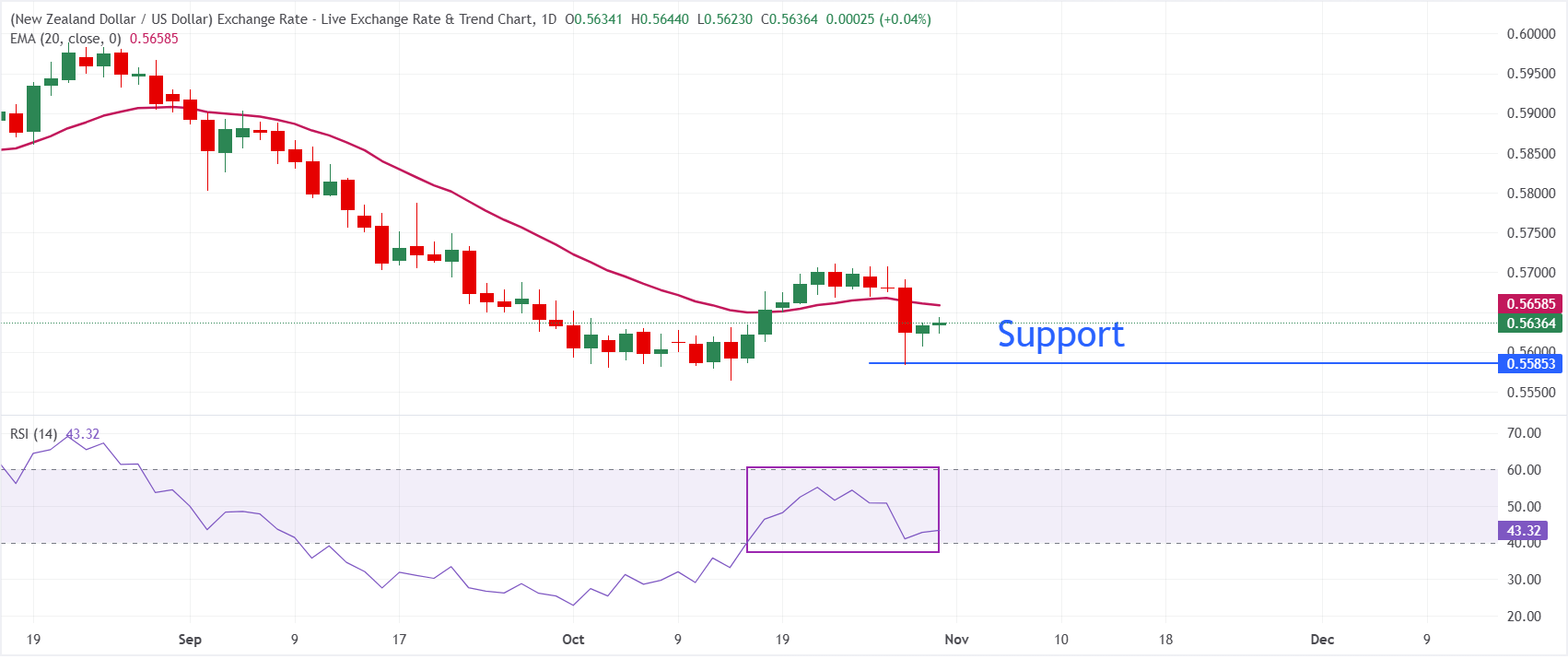
Below the 20-period Exponential Moving Average (EMA) at 0.5658, NZD/USD is trading at 0.5637 on the daily chart, leaving the near-term outlook bearish. Its failure to regain this short-term trend gauge indicates that recent recoveries remain constrained within a wider decline. Meanwhile, the Relative Strength Index (RSI) reading of 43.4 remains below neutral, pointing to only limited recovery momentum.
The 28 October low of 0.5584 provides the main support on the downside. Above the market, the first resistance lies at the 20-day EMA near 0.5658, where sellers are likely to seek to preserve the prevailing downtrend.
(The technical analysis of this story was written with the help of an AI tool. Know more.)
Following each of its seven scheduled policy meetings a year, the Reserve Bank of New Zealand (RBNZ) announces its interest rate decision. A hawkish RBNZ that judges inflationary pressures to be increasing raises the Official Cash Rate (OCR) to curb inflation. Higher rates draw in more capital, supporting the New Zealand Dollar (NZD). Conversely, when the central bank considers inflation too low, it cuts the OCR, which generally puts downward pressure on NZD.
Read further.Latest release: Wed 28 October 2026 01:00
Release frequency: Irregular
Reported: 2.75%
Consensus forecast: 3%
Prior reading: 2.75%
Data source: Reserve Bank of New Zealand
At seven monetary policy meetings each year, the Reserve Bank of New Zealand (RBNZ) announces its interest rate decision alongside the economic assessments underpinning it. These announcements provide signals about the economic outlook and the likely direction of policy, both key considerations for the NZD's valuation. If economic conditions improve and the outlook is favourable, the RBNZ could raise interest rates to tighten monetary policy, a move that tends to support the NZD. A press conference by interim Governor Christian Hawkesby usually follows the policy announcements.







Phone: +61 2 8036 8388
Fax: +61 2 8036 8388
Email: support@tmgm.com



The information provided on this website is of a general nature only and does not constitute personal financial advice. Before acting on any information on this website, you should consider the suitability of the information in relation to your objectives, financial situation and needs. Investing in CFDs and FX Margin Contracts carries significant risks and is not suitable for all investors. You may lose more than your initial deposit. You do not own, or have, any interest in the underlying asset. We recommend that you seek independent advice and ensure you fully understand the risks involved before trading. It is important that you read and consider the disclosure document before you acquire any product listed on the website. The information and advertisements offered on this website are not intended for use by any person in any country or jurisdiction where such use would be contrary to local laws and regulations. The Products and Services offered on this website are not intended for residents of the United States, Malaysia and Thailand.
TMGM is authorized and regulated in various jurisdictions.
Trademax Australia Limited, trading as TMGM, is regulated by the Australian Securities and Investments Commission (ASIC), AFSL no. 436416 and is located at Level 28, One International Tower, 100 Barangaroo Avenue, 2000 Sydney, NSW Australia.
Email: support@tmgm.com.au
Trademax Global Limited, trading as TMGM, is authorized and regulated by the Vanuatu Financial Services Commission (VFSC), registration number 40356 and registered at 1276, Kumul Highway, Port Vila, Vanuatu, Republic of Vanuatu.
Email: support@tmgm.com
Trademax Global Markets (SE) Limited, trading as TMGM, is authorized and regulated by the Financial Services Authority (FSA) of Seychelles, with license number SD224. The company is registered at Office No 13, Providence Estate ABIS Centre, Mahe, Seychelles.
Email: support@tmgm.com
Trademax Global Markets (International) Pty Ltd, trading as TMGM, is authorized and regulated by the Financial Services Commission, Mauritius (FSC) with license no. GB22201012, and registered at 33, Edith Cavell Street C/o IQ EQ Fund Services (Mauritius) Ltd Port Louis, 11324 Mauritius.
Email: support@tmgm.com
Copyright © TMGM. All rights reserved


