
News & AnalysisCareer

With October’s United States (US) Personal Consumption Expenditure (PCE) Price Index figures approaching, Silver (XAG/USD) has opened the week with a strong recovery. The white metal has ended a three-day run of losses, gaining almost 3.85% to trade at around $42.55 during the European session.

Behind Silver’s rebound is a shift in financial market pricing, which no longer allows for a large interest rate increase by the Federal Reserve (Fed) at its December policy meeting.
A week earlier, the CME FedWatch tool had indicated a small chance of a 50 basis points (bps) increase in Fed interest rates at the December meeting.
Despite the recovery, Silver’s outlook is expected to stay bearish, with financial markets remaining confident that the Fed will raise interest rates at successive meetings in the near term.
TD Securities expects “a third hike in March.” That would follow December and January, when, according to the bank, “most officials would support consecutive 25bp hikes in December and January,”. Explaining their assessment, its economists say “inflation remains above target and is moving in the wrong direction.” They also observe that “data last week and our expectations for data this week are in line with recent trends,” while noting that “the labor market has stabilized, with some signs of strengthening, and activity data has been robust.” Their conclusion is that “the economy can handle more restriction, and the Fed is likely to provide it,” although “the extent and pace of hikes later in the cycle.” will depend on “the evolution of inflation data”.
Wednesday’s release of October US PCE inflation figures will be a focus for investors this week.
Persistent price pressures are likely to be evident in the figures, according to Commerzbank, which reminds clients that the PCE deflator is the Fed’s preferred price index. The bank argues that the inflation environment is unlikely to make the Fed’s near-term dilemma any easier, forecasting that “the inflation rate… expected to rise to 3.8% in October, and even without food and energy prices, the inflation rate is expected to be too high at 3.2%.”
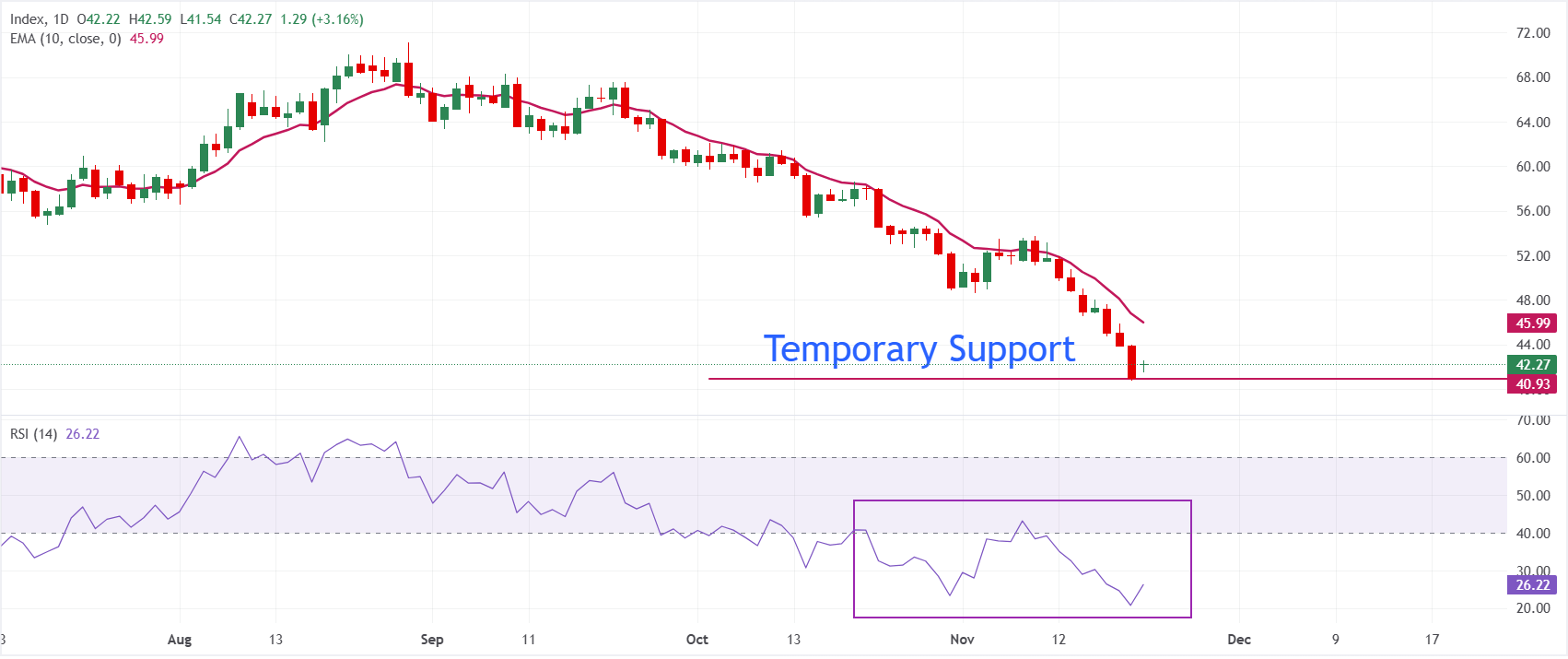
Below the 10-period exponential moving average (EMA) of $45.99, XAG/USD is trading at $42.27 on the daily chart, maintaining its near-term bearish bias. Rallies remain vulnerable while spot stays beneath this short-term trend measure. Meanwhile, the Relative Strength Index (RSI), at around 26, remains in oversold territory, suggesting that a rebound would probably be corrective against a backdrop of continued pressure.
A daily close above the 10-day EMA at $45.99, the first resistance level, would be required to relieve immediate downside pressure and indicate the start of a more sustained recovery. On the downside, the previous week’s low of $40.78 provides the nearest support zone. A breach would leave Silver exposed to $40.00.
(The technical analysis of this story was written with the help of an AI tool. Know more.)
Historically a store of value and a means of exchange, Silver remains a widely traded precious metal among investors. While it attracts less interest than Gold, traders may choose Silver for its intrinsic value, to diversify their portfolios or as a possible hedge against high inflation. Exposure can come through physical holdings of coins or bars, or through instruments such as exchange-traded funds that follow its price in international markets.
Interest rates, currency movements and a broad range of other influences can drive Silver prices. Its safe-haven status means geopolitical turmoil or concerns about a severe recession can lift prices, though the effect is generally less pronounced than for Gold. Because Silver pays no yield, lower interest rates tend to support it. The US Dollar (USD) also matters, since Silver is priced in dollars (XAG/USD): Dollar strength tends to restrain prices, while a weaker currency is likely to push them higher. Investment demand, recycling rates and mining supply can affect pricing too, with Silver far more abundant than Gold.
Among metals, Silver has one of the highest levels of electrical conductivity, exceeding both Copper and Gold, which makes it widely used in industries such as electronics and solar energy. Rising demand can lift prices, whereas weaker demand tends to depress them. Economic developments in the US, China and India can therefore influence price fluctuations. Large industrial sectors in the US and, especially, China consume Silver in a range of processes, while Indian consumers’ demand for Silver jewellery is also an important influence on prices.
Given their similar safe-haven characteristics, Silver generally moves in line with Gold and typically rises when Gold gains. Investors may use the Gold/Silver ratio to assess the metals’ relative valuations. This ratio measures how many ounces of Silver equal the value of one ounce of Gold. A high reading may be interpreted by some investors as a sign that Silver is undervalued or Gold overvalued; a low reading, by contrast, could indicate that Gold is undervalued relative to Silver.







Phone: +61 2 8036 8388
Fax: +61 2 8036 8388
Email: support@tmgm.com



The information provided on this website is of a general nature only and does not constitute personal financial advice. Before acting on any information on this website, you should consider the suitability of the information in relation to your objectives, financial situation and needs. Investing in CFDs and FX Margin Contracts carries significant risks and is not suitable for all investors. You may lose more than your initial deposit. You do not own, or have, any interest in the underlying asset. We recommend that you seek independent advice and ensure you fully understand the risks involved before trading. It is important that you read and consider the disclosure document before you acquire any product listed on the website. The information and advertisements offered on this website are not intended for use by any person in any country or jurisdiction where such use would be contrary to local laws and regulations. The Products and Services offered on this website are not intended for residents of the United States, Malaysia and Thailand.
TMGM is authorized and regulated in various jurisdictions.
Trademax Australia Limited, trading as TMGM, is regulated by the Australian Securities and Investments Commission (ASIC), AFSL no. 436416 and is located at Level 28, One International Tower, 100 Barangaroo Avenue, 2000 Sydney, NSW Australia.
Email: support@tmgm.com.au
Trademax Global Limited, trading as TMGM, is authorized and regulated by the Vanuatu Financial Services Commission (VFSC), registration number 40356 and registered at 1276, Kumul Highway, Port Vila, Vanuatu, Republic of Vanuatu.
Email: support@tmgm.com
Trademax Global Markets (SE) Limited, trading as TMGM, is authorized and regulated by the Financial Services Authority (FSA) of Seychelles, with license number SD224. The company is registered at Office No 13, Providence Estate ABIS Centre, Mahe, Seychelles.
Email: support@tmgm.com
Trademax Global Markets (International) Pty Ltd, trading as TMGM, is authorized and regulated by the Financial Services Commission, Mauritius (FSC) with license no. GB22201012, and registered at 33, Edith Cavell Street C/o IQ EQ Fund Services (Mauritius) Ltd Port Louis, 11324 Mauritius.
Email: support@tmgm.com
Copyright © TMGM. All rights reserved


