
News & AnalysisCareer

A fresh 18-month high of 103.08 for the US Dollar Index (DXY) on Thursday has not prevented the Japanese Yen (JPY) from edging higher against the US Dollar (USD). The Asia-Pacific currency is outperforming its major counterparts during the session.
Today’s percentage movements in the Japanese Yen (JPY) against the major currencies listed are set out below. Its largest gain was against the Australian Dollar.
| USD | EUR | GBP | JPY | CAD | AUD | NZD | CHF | |
|---|---|---|---|---|---|---|---|---|
| USD | 0.07% | 0.11% | -0.10% | 0.04% | 0.22% | 0.20% | -0.07% | |
| EUR | -0.07% | 0.04% | -0.16% | -0.04% | 0.15% | 0.12% | -0.14% | |
| GBP | -0.11% | -0.04% | -0.19% | -0.08% | 0.11% | 0.08% | -0.18% | |
| JPY | 0.10% | 0.16% | 0.19% | 0.13% | 0.31% | 0.27% | 0.02% | |
| CAD | -0.04% | 0.04% | 0.08% | -0.13% | 0.18% | 0.15% | -0.10% | |
| AUD | -0.22% | -0.15% | -0.11% | -0.31% | -0.18% | -0.02% | -0.29% | |
| NZD | -0.20% | -0.12% | -0.08% | -0.27% | -0.15% | 0.02% | -0.23% | |
| CHF | 0.07% | 0.14% | 0.18% | -0.02% | 0.10% | 0.29% | 0.23% |
Percentage movements between the major currencies are displayed in the heat map. Select the base currency in the left-hand column and the quote currency in the top row. Selecting the Japanese Yen on the left and following that row across to the US Dollar, for instance, gives the percentage change for JPY (base)/USD (quote) in the corresponding cell.

At the time of writing, a slight decline has taken USD/JPY towards 159.65. The pair nevertheless remains near Wednesday’s high of 159.94, its strongest level in over two months.
Stronger-than-forecast October Producer Price Index (PPI) figures are supporting the Japanese currency, as the data is expected to bolster hopes of further near-term interest rate rises from the Bank of Japan (BoJ).
Headline PPI rose by 0.7% month on month, exceeding the 0.3% forecast and following a 0.2% fall in producer prices in September. The annualised increase unexpectedly accelerated to 7.1% from the previous reading of 6.8%, rather than moderating to 6.5% as anticipated.
For its part, the US Dollar is outperforming as concerns grow over aggressive monetary tightening by the Federal Reserve (Fed) in the period ahead.
The reaction to recent hawkish statements by Fed officials goes beyond a change in interest rate expectations, according to analysts at Rabobank. They cite comments “including those from Waller that put the risk of a 50-bps rate hike on the table,” noting that the market is now “fully priced for a December rate hike,”. Crucially, they say, the remarks were received “with no real speculation that the Fed would be pressured by political forces not to raise rates.”
Concerns over the Fed’s credibility have receded, Rabobank observes, noting that “since Fed Chair Warsh surprised the market with a hawkish position at Jackson Hole in August, fears about diminished Fed credibility have dissipated.” The analysts also believe that “the results of last week’s mid-term elections suggest less reason to expect pressure from the White House,” supporting the view that the central bank can tighten policy without substantial political interference.
Rabobank sums up its assessment: “In short,” it concludes, “markets have inferred that last week’s mid-term election result suggests that the issue of Fed credibility is likely to be diminished over the remainder of Trump’s term.” This development, the analysts argue, “should remove a significant potential hurdle from the outlook for the USD.”
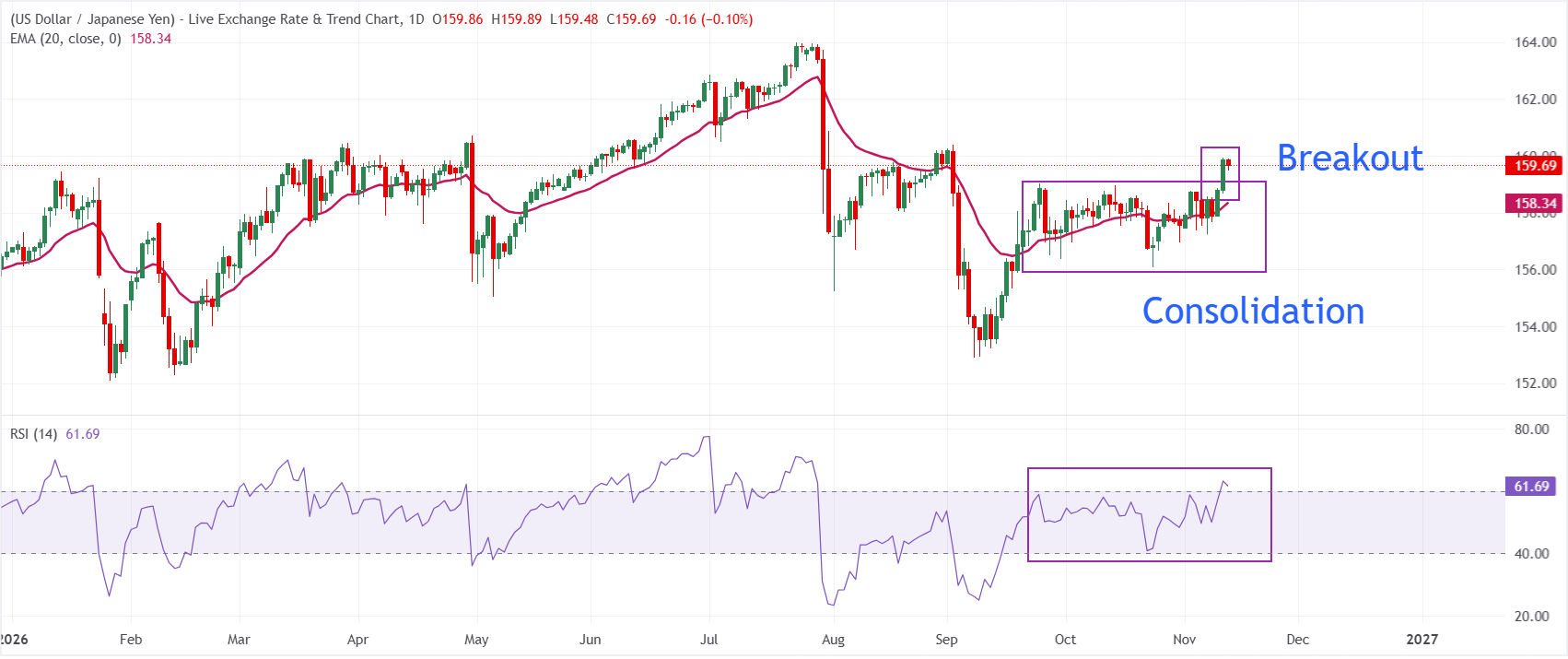
Trading at 159.69 on the daily chart, USD/JPY retains a bullish short-term bias while the spot price remains above its 20-day exponential moving average (EMA) of 158.34. Gains are extending from last week’s pullback, with the EMA positioned beneath the price suggesting that underlying demand is still firm. At 61.66, the Relative Strength Index (14) remains in positive territory without reaching overbought levels. This points to favourable upward momentum that does not yet look overstretched.
The 20-day EMA at 158.34 provides the first support on a decline, with buyers likely to defend the recent breakout area if a corrective dip occurs. Further gains would remain favoured while USD/JPY stays above this average. A daily close beneath it, however, would indicate that bullish control is weakening and leave scope for a deeper retracement.
(The technical analysis of this story was written with the help of an AI tool. Know more.)
Published by the Bank of Japan, the Producer Price Index tracks the prices of goods bought by domestic companies in Japan. Its correlation with the Consumer Price Index (CPI) makes the PPI a measure of changes in Japanese manufacturing costs and inflation. A high reading is regarded as pointing towards an interest rate rise and is therefore positive, or bullish, for the JPY. A low reading, by contrast, is considered negative, or bearish.
Find out more.Latest release: Wed 11 Nov 2026 23:50
Release frequency: Every month
Reported figure: 0.7%
Consensus forecast: 0.3%
Previous reading: -0.3%
Data source: Statistics Bureau of Japan







Phone: +61 2 8036 8388
Fax: +61 2 8036 8388
Email: support@tmgm.com



The information provided on this website is of a general nature only and does not constitute personal financial advice. Before acting on any information on this website, you should consider the suitability of the information in relation to your objectives, financial situation and needs. Investing in CFDs and FX Margin Contracts carries significant risks and is not suitable for all investors. You may lose more than your initial deposit. You do not own, or have, any interest in the underlying asset. We recommend that you seek independent advice and ensure you fully understand the risks involved before trading. It is important that you read and consider the disclosure document before you acquire any product listed on the website. The information and advertisements offered on this website are not intended for use by any person in any country or jurisdiction where such use would be contrary to local laws and regulations. The Products and Services offered on this website are not intended for residents of the United States, Malaysia and Thailand.
TMGM is authorized and regulated in various jurisdictions.
Trademax Australia Limited, trading as TMGM, is regulated by the Australian Securities and Investments Commission (ASIC), AFSL no. 436416 and is located at Level 28, One International Tower, 100 Barangaroo Avenue, 2000 Sydney, NSW Australia.
Email: support@tmgm.com.au
Trademax Global Limited, trading as TMGM, is authorized and regulated by the Vanuatu Financial Services Commission (VFSC), registration number 40356 and registered at 1276, Kumul Highway, Port Vila, Vanuatu, Republic of Vanuatu.
Email: support@tmgm.com
Trademax Global Markets (SE) Limited, trading as TMGM, is authorized and regulated by the Financial Services Authority (FSA) of Seychelles, with license number SD224. The company is registered at Office No 13, Providence Estate ABIS Centre, Mahe, Seychelles.
Email: support@tmgm.com
Trademax Global Markets (International) Pty Ltd, trading as TMGM, is authorized and regulated by the Financial Services Commission, Mauritius (FSC) with license no. GB22201012, and registered at 33, Edith Cavell Street C/o IQ EQ Fund Services (Mauritius) Ltd Port Louis, 11324 Mauritius.
Email: support@tmgm.com
Copyright © TMGM. All rights reserved


