




The British Pound's growth beat came from a dead ceasefire
- GBP/USD trades just under 1.3500 after a session range barely 40 pips wide.
- June growth 0.3% against a flat consensus, manufacturing output down 0.5%.
- September Fed hike odds 34.8%, down from a coin flip on August 10.
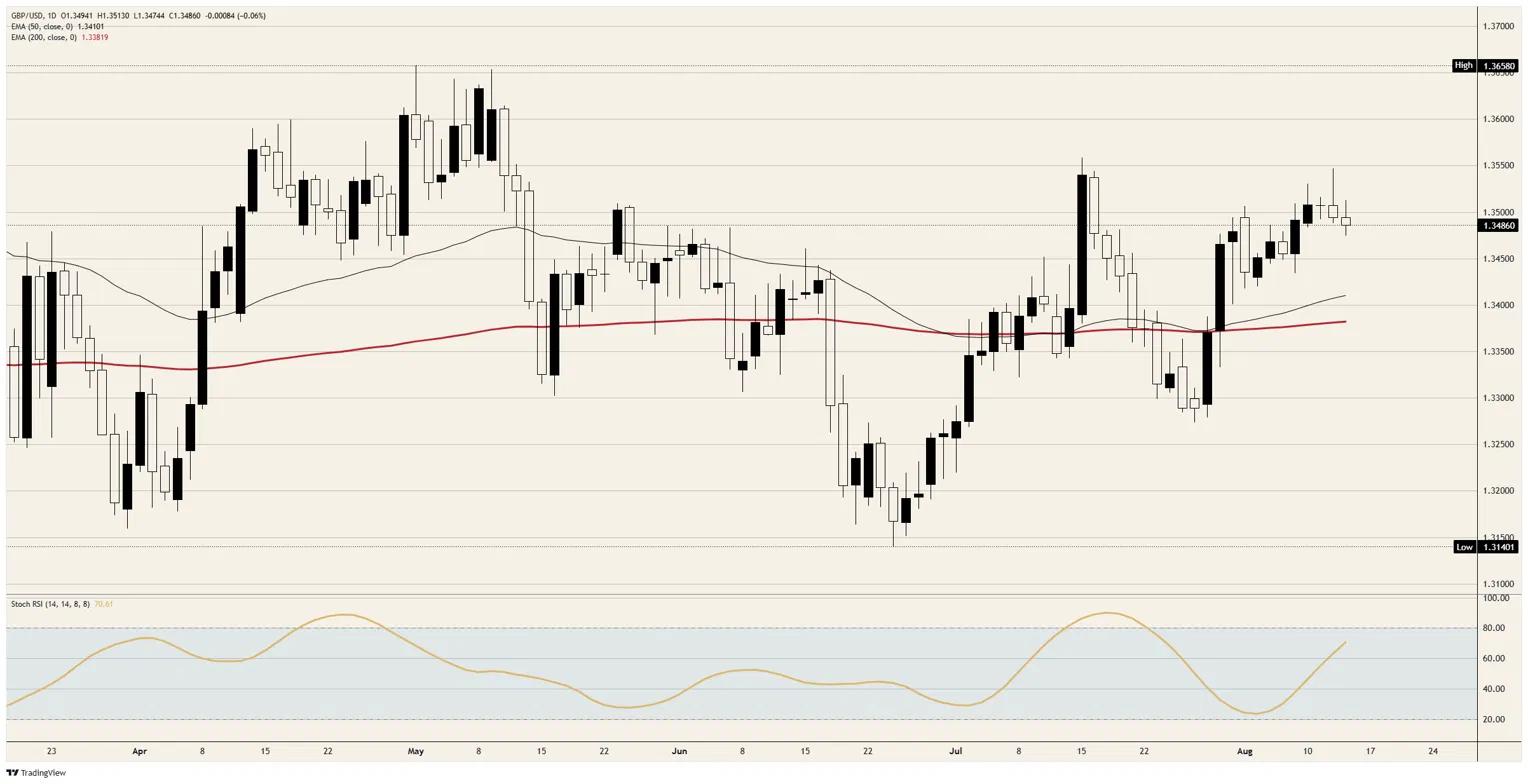
The Pound holds just under 1.3500 on Thursday inside a session range barely 40 pips wide, which is a thin response to a morning that handed Britain a growth beat and an afternoon that handed the Dollar a soft inflation print. Sterling reached fractionally above 1.3500 and was turned back just short of 1.3550 on Wednesday, the same area that capped the pair in mid-July.
Both legs of the exchange rate moved in the Pound's favour and the price did nothing with either. The pair has still climbed roughly two cents since the start of August, enough to reclaim the converged 50-day and 200-day Exponential Moving Average (EMA) band near 1.3400 that had capped it since early July.
The quarter's best month was bought in the Gulf
Monthly Gross Domestic Product (GDP) rose 0.3% in June against a consensus of no growth at all, and the second-quarter YoY rate came in at 1.2% against 1.1% expected. The quarterly rate itself matched consensus at 0.4% and slowed from 0.6%, so the entire upside surprise sits inside one month.
What sat inside that month matters more than the headline number. Services carried the June advance, and the detail credits the temporary Gulf ceasefire, the start of the World Cup and favourable weather. Two of those are calendar events that do not repeat. The third no longer exists.
Talks on reopening the Strait of Hormuz are deadlocked, with Tehran attaching six conditions to any agreement and Washington insisting the waterway is already under its control. Transits ran eight vessels on Tuesday against a 10-day average near 12 and roughly 130 before the war. A growth print whose strongest component was underwritten by a truce that broke in July describes a quarter that has already gone.
The factory side of the release went the other way entirely. Industrial production fell 0.2% MoM in June against expectations of a small rise, and manufacturing output fell 0.5% against a 0.2% decline expected. Britain grew in June because households bought services in the one month the Gulf was quiet, which is a poor foundation to hand a currency.
The Dollar is running this pair
The July Producer Price Index (PPI) landed flat MoM against 0.2% expected, with the YoY rate down to 4.7% from 5.5% and the core measure up 0.2% against 0.3%. Initial jobless claims came in at 209K against 202K expected and 200K previously. Both readings argue the same way, and the front end has been moving on them for three sessions.
Rate futures now put a September 16 hold at 65.2%, leaving a hike tail of 34.8% at a meeting that was a coin flip on August 10. October 28 has drifted to an even split, and December 9 gives the current range a 34.1% chance of surviving the year. The cut column is empty at every 2026 meeting, so this is a downgrade of the hike case rather than the start of an easing case.
Two policymakers spoke either side of that data and both read hawkish against their own recent averages, one of them among the three reserve bank presidents who dissented for a quarter point in July. Neither speech arrested the repricing.
None of that repricing has anything to do with Britain, and the cross rates say so plainly. The Pound sits near the top of its 30-day range against the Dollar while losing ground over the same month to the Yen, the Australian Dollar, the Canadian Dollar and the New Zealand Dollar. A currency that rises against one counterpart and falls against four others is not being bought. It is being measured against something that is being sold.
The first genuinely British week of the summer
Friday brings US retail sales for July at 12:30 GMT, with the headline expected at 0.1% against 0.2% previously. The preliminary University of Michigan sentiment index follows at 14:00 GMT, expected at 54.5 against 55.2, with its inflation expectations components carrying more weight than the headline.
Next week hands the initiative back to the domestic data. Labour market figures land on August 18, carrying the claimant count, employment change and an unemployment rate that last printed at 4.9%, and July inflation follows on August 19 against a 2.6% headline and a 2.6% core. Retail sales and the preliminary August Purchasing Managers Index (PMI) surveys arrive on August 21.
Those releases are the last major domestic readings before the September 17 Bank of England decision, where three of nine members already prefer a higher rate. The Federal Open Market Committee (FOMC) minutes on August 19 sit in the same window, which makes the middle of next week the first two-sided test this rally has faced.
Levels
Resistance: The 1.3550 area is the line that matters, having capped the pair in mid-July and turned it back again on Wednesday. A daily close above it opens the early-May peak in the 1.3650 area.
Support: The reclaimed EMA band near 1.3400 is the first floor, roughly 75 pips beneath spot and the level that held this pair down through most of July. Below that sits 1.3300, then the summer base in the 1.3150 area.
Bias: Bullish while 1.3400 holds, with 1.3550 the objective and a break there opening 1.3650. Invalidation on a daily close back beneath 1.3400, which would hand the pair straight back to the band it just escaped. Daily momentum is stretched into resistance, with the Stochastic Relative Strength Index (Stoch RSI) near 70 and rising.
GBP/USD daily chart
Pound Sterling FAQs
The Pound Sterling (GBP) is the oldest currency in the world (886 AD) and the official currency of the United Kingdom. It is the fourth most traded unit for foreign exchange (FX) in the world, accounting for 12% of all transactions, averaging $630 billion a day, according to 2022 data. Its key trading pairs are GBP/USD, also known as ‘Cable’, which accounts for 11% of FX, GBP/JPY, or the ‘Dragon’ as it is known by traders (3%), and EUR/GBP (2%). The Pound Sterling is issued by the Bank of England (BoE).
The single most important factor influencing the value of the Pound Sterling is monetary policy decided by the Bank of England. The BoE bases its decisions on whether it has achieved its primary goal of “price stability” – a steady inflation rate of around 2%. Its primary tool for achieving this is the adjustment of interest rates. When inflation is too high, the BoE will try to rein it in by raising interest rates, making it more expensive for people and businesses to access credit. This is generally positive for GBP, as higher interest rates make the UK a more attractive place for global investors to park their money. When inflation falls too low it is a sign economic growth is slowing. In this scenario, the BoE will consider lowering interest rates to cheapen credit so businesses will borrow more to invest in growth-generating projects.
Data releases gauge the health of the economy and can impact the value of the Pound Sterling. Indicators such as GDP, Manufacturing and Services PMIs, and employment can all influence the direction of the GBP. A strong economy is good for Sterling. Not only does it attract more foreign investment but it may encourage the BoE to put up interest rates, which will directly strengthen GBP. Otherwise, if economic data is weak, the Pound Sterling is likely to fall.
Another significant data release for the Pound Sterling is the Trade Balance. This indicator measures the difference between what a country earns from its exports and what it spends on imports over a given period. If a country produces highly sought-after exports, its currency will benefit purely from the extra demand created from foreign buyers seeking to purchase these goods. Therefore, a positive net Trade Balance strengthens a currency and vice versa for a negative balance.













