

Сауда
Бәсекеге қабілетті бағалар, жоғары өтімділік және озық сауда құралдары арқылы нарықтардың кең ауқымын зерттеңіз.
Толығырақ 
Платформа
TMGM-нің жылдамдыққа, дәлдікке және жоғары деңгейлі сауда тәжірибесіне арналған қуатты платформасымен сауданы кедергісіз жүргізіңіз.
Толығырақ Сауда платформасы
Академия
Бастауыштарға арналған нұсқаулықтар, вебинарлар және нарық талдаулары сияқты ресурстар арқылы сауданың негіздерін үйреніңіз.
Толығырақ TMGM Академиясы
Жаңалықтар және талдау
Сауда мүмкіндіктерінен алда болу үшін нақты уақыттағы нарық жаңартулары мен сараптамалық талдауды алыңыз
Толығырақ Жаңалықтар және талдау
Туралы
TMGM-ді ерекшелендіретін жайттарды біліңіз — біздің жаһандық ауқымымыз, реттеушілік беріктігіміз және трейдингтегі инновацияларға деген адалдығымыз.
Толығырақ Неліктен TMGM-ді таңдау керек
Indian Rupee falls to two-week low as higher oil prices continue to weigh
- The Indian Rupee weakens further against the US Dollar due to elevated oil prices.
- The US and Iran are preparing for a joint military operation against Iran after elections.
- On Wednesday, the Fed left interest rates steady in the 3.75%-4.00% range.
The Indian Rupee (INR) revisits a two-week low against the US Dollar (USD) on Thursday as elevated oil prices continue to keep the South Asian currency under pressure. In the opening session, the USD/INR pair trades slightly higher to near 95.30.

As of writing, the MCX Crude Oil contract expiring on November 19 is down 1.5% to near Rs. 9,650. Still, the oil price is close to its recent highs of Rs. 9,828.
Currencies from economies, such as India, which rely heavily on oil imports to meet their energy needs, tend to underperform in a high-oil-price environment.
What is supporting oil prices?
Oil prices have remained elevated due to growing fears of further escalation in energy supply risks, as reports suggest that Israel and the United States (US) are preparing for fresh attacks on Iran after their respective elections.
Strategists at Deutsche Bank point out that oil prices remain broadly higher after the Wall Street Journal (WSJ) reported that the United States (US) President Donald Trump’s administration warned Gulf states to be prepared for a new operation against Iran after the midterms. Adding to the geopolitical bid, Danske Bank’s research team highlights that, in his post-election speech, Israeli Prime Minister (PM) Benjamin Netanyahu raised the prospect of “renewed joint action with President Trump against Iran”.
Meanwhile, ongoing tensions between Iran-aligned Houthis and Saudi Arabia are also fuelling energy supply concerns. On Tuesday, a military spokesperson from Yemen's Iran-aligned Houthis said that they launched a ballistic missile toward the Ras Tanura oil refinery in eastern Saudi Arabia, the kingdom’s largest refinery, Reuters reported.
US Dollar regains ground after Fed’s policy announcement
The slight recovery move in the US Dollar in the aftermath of the Federal Reserve’s (Fed) monetary policy announcement is also lending strength to the USD/INR pair. As of writing, the US Dollar Index (DXY), which gauges the Greenback’s value against six major currencies, trades marginally higher to near 102.20.
The USD Index failed to extend its three-day winning streak on Wednesday and corrected to near 102.00, following the Fed’s monetary policy decision.
At the policy meeting, the Fed left interest rates unchanged in the 3.75%-4.00% range, as expected, and reiterated its commitment to achieve price stability. Fed Chairman Kevin Warsh said there would be only six monetary policy decisions starting in 2028.
USD/INR Technical Analysis
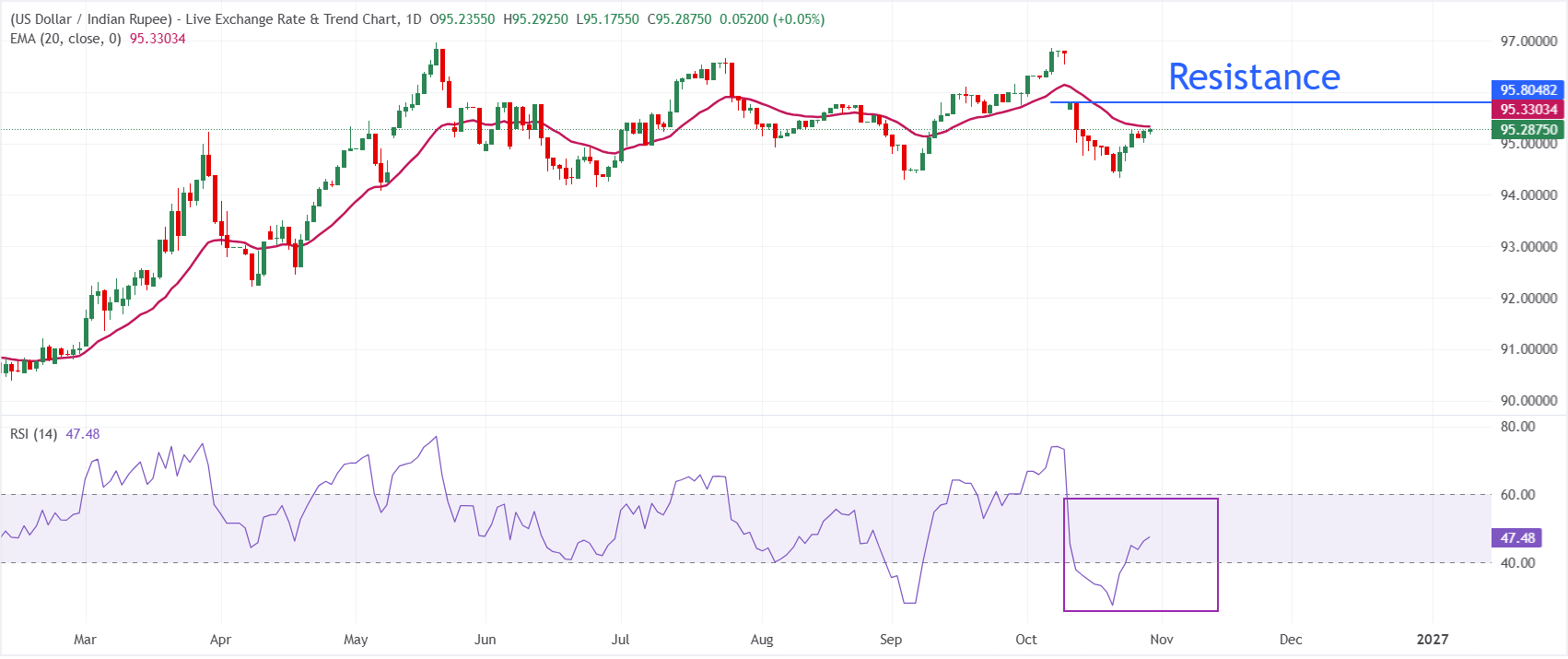
In the daily chart, USD/INR trades at 95.2875, retaining a mildly bearish near-term bias as spot holds beneath the 20-day Exponential Moving Average (EMA) at 95.3303. The pair’s inability to reclaim this short-term EMA suggests that rallies are still being capped by nearby dynamic resistance, while the Relative Strength Index (RSI) around 47 points to neutral-to-soft momentum rather than an oversold condition, limiting scope for an aggressive rebound.
On the topside, immediate resistance is located at the 20-day EMA at 95.3303, which acts as the first hurdle for any recovery attempt; a sustained break above this level would ease downside pressure and open the door for a broader consolidation phase. With no clear structural support levels derived from the current dataset, traders may instead monitor the recent closing low zone just under 95.10 as an indicative area where demand could re-emerge if selling resumes.
(The technical analysis of this story was written with the help of an AI tool. Know more.)
Indian Rupee FAQs
The Indian Rupee (INR) is one of the most sensitive currencies to external factors. The price of Crude Oil (the country is highly dependent on imported Oil), the value of the US Dollar – most trade is conducted in USD – and the level of foreign investment, are all influential. Direct intervention by the Reserve Bank of India (RBI) in FX markets to keep the exchange rate stable, as well as the level of interest rates set by the RBI, are further major influencing factors on the Rupee.
The Reserve Bank of India (RBI) actively intervenes in forex markets to maintain a stable exchange rate, to help facilitate trade. In addition, the RBI tries to maintain the inflation rate at its 4% target by adjusting interest rates. Higher interest rates usually strengthen the Rupee. This is due to the role of the ‘carry trade’ in which investors borrow in countries with lower interest rates so as to place their money in countries’ offering relatively higher interest rates and profit from the difference.
Macroeconomic factors that influence the value of the Rupee include inflation, interest rates, the economic growth rate (GDP), the balance of trade, and inflows from foreign investment. A higher growth rate can lead to more overseas investment, pushing up demand for the Rupee. A less negative balance of trade will eventually lead to a stronger Rupee. Higher interest rates, especially real rates (interest rates less inflation) are also positive for the Rupee. A risk-on environment can lead to greater inflows of Foreign Direct and Indirect Investment (FDI and FII), which also benefit the Rupee.
Higher inflation, particularly, if it is comparatively higher than India’s peers, is generally negative for the currency as it reflects devaluation through oversupply. Inflation also increases the cost of exports, leading to more Rupees being sold to purchase foreign imports, which is Rupee-negative. At the same time, higher inflation usually leads to the Reserve Bank of India (RBI) raising interest rates and this can be positive for the Rupee, due to increased demand from international investors. The opposite effect is true of lower inflation.
Үздік мақалалар
1New Zealand Dollar: Downside limited after RBNZ surprise – OCBC2Why Bitwise thinks Bitcoin could reach $1.6M by 2036?3AUD/USD Price Forecast: Tests consolidation breakout near 0.70404US Dollar Index Price Forecast: Holds gains above 102.00, bullish bias remains intact5US Dollar: Fed meeting keeps Dollar steady – Commerzbank6Euro: Downside risk hinges on 1.1110 against US Dollar – UOB7Japanese Yen flattens against US Dollar, BoJ policy takes centre stage8Pi Network Price Forecast: PI risks another lower leg as the broader crypto market slips9Indian Rupee falls to two-week low as higher oil prices continue to weigh


Бастау!
Тіркеліп, 3 минуттан аз уақытта жаһандық нарықтарға қол жеткізіңіз

Бізбен байланысыңыз









Байланыстар
Телефон: +61 2 8036 8388
Факс: +61 2 8036 8388
Эл. пошта: support@tmgm.com



Осы веб-сайтта берілген ақпарат тек жалпы сипатта ғана ұсынылады және жеке қаржылық кеңес болып табылмайды. Осы веб-сайттағы кез келген ақпаратқа сүйенбес бұрын, оның сіздің мақсаттарыңызға, қаржылық жағдайыңызға және қажеттіліктеріңізге сәйкестігін бағалауыңыз керек. CFD және FX Margin Contracts-қа инвестиция салу елеулі тәуекелдермен байланысты және барлық инвесторлар үшін қолайлы емес. Сіз бастапқы салымыңыздан артық қаражат жоғалтуыңыз мүмкін. Сіз базалық активке ешқандай меншік құқығына немесе үлеске ие болмайсыз. Сауда жасамас бұрын тәуелсіз кеңес алуды және тәуекелдерді толық түсінуді ұсынамыз. Веб-сайтта көрсетілген кез келген өнімді сатып алмас бұрын, ақпараттық құжатты оқып, оны мұқият қарастыру маңызды. Осы веб-сайтта ұсынылған ақпарат пен жарнамалар жергілікті заңдар мен ережелерге қайшы келетін кез келген елде немесе юрисдикцияда тұратын адамдардың пайдалануына арналмаған. Осы веб-сайтта ұсынылатын Өнімдер мен Қызметтер Америка Құрама Штаттары, Малайзия және Таиланд тұрғындарына арналмаған.
TMGM әртүрлі юрисдикцияларда уәкілетті және реттеледі.
Trademax Australia Limited, TMGM атауымен жұмыс істейді, Австралияның Бағалы қағаздар және инвестициялар жөніндегі комиссиясымен (ASIC) реттеледі, AFSL № 436416 және мына мекенжайда орналасқан: Level 28, One International Tower, 100 Barangaroo Avenue, 2000 Sydney, NSW Australia.
Электрондық пошта: support@tmgm.com.au
Trademax Global Limited, TMGM атауымен жұмыс істейді, Вануату Қаржылық қызметтер комиссиясымен (VFSC) уәкілетті және реттеледі, тіркеу нөмірі 40356, тіркелген мекенжайы: 1276, Kumul Highway, Port Vila, Vanuatu, Republic of Vanuatu.
Электрондық пошта: support@tmgm.com
Trademax Global Markets (SE) Limited, TMGM атауымен жұмыс істейді, Сейшел аралдарының Қаржылық қызметтер басқармасы (FSA) тарапынан уәкілетті және реттеледі, лицензия нөмірі SD224. Компания мына мекенжайда тіркелген: Office No 13, Providence Estate ABIS Centre, Mahe, Seychelles.
Электрондық пошта: support@tmgm.com
Trademax Global Markets (International) Pty Ltd, TMGM атауымен жұмыс істейді, Mauritius Қаржылық қызметтер комиссиясымен (FSC) № GB22201012 лицензиясы бойынша уәкілетті және реттеледі, тіркелген мекенжайы: 33, Edith Cavell Street C/o IQ EQ Fund Services (Mauritius) Ltd Port Louis, 11324 Mauritius.
Электрондық пошта: support@tmgm.com
Авторлық құқық © TMGM. Барлық құқықтар қорғалған