




Australian Dollar hits a seven-week high on nothing Australian
- AUD/USD trades just above 0.7050, its highest level since mid-June.
- All four major Australian banks now forecast a hold at 4.35% on 11 August.
- China's July services PMI fell to 50.4 against 53.7 expected, from 54.1.
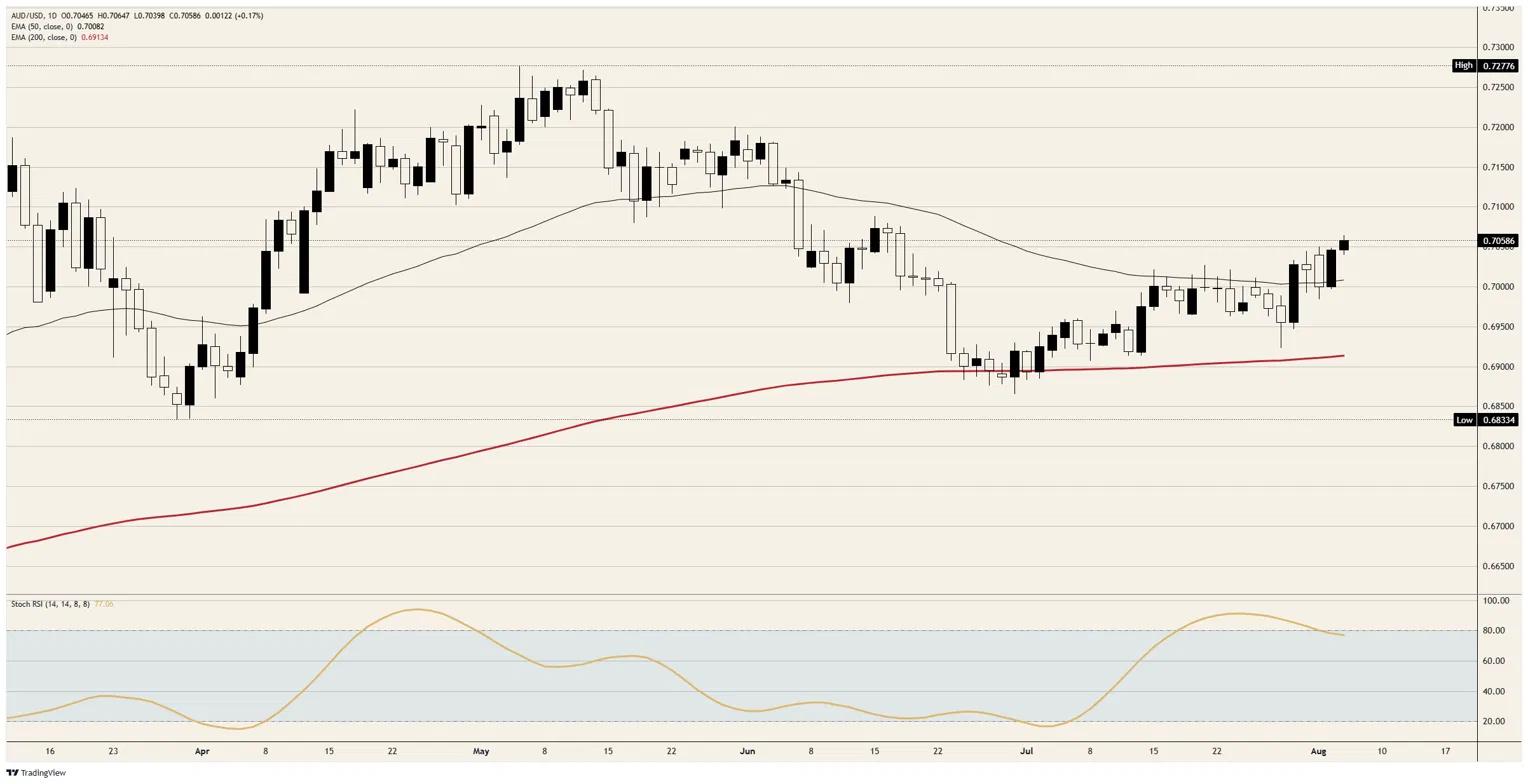
The Aussie is trading just above 0.7050 after a gain of not quite two tenths of a percent, its best level in seven weeks and the first time since mid-June that price has held clear of the 50-day Exponential Moving Average (EMA) near 0.7000. The 200-day EMA near 0.6900 continues to rise underneath, and the structure now reads as a base rather than a downtrend.

The way the move has been built is the problem. Today's range covers 25 pips, the daily Stochastic Relative Strength Index (Stoch RSI) has rolled over from the high eighties to the mid seventies, and the entire advance has come in a week when Australia's own interest rate case was dismantled. This is a rally in the Australian Dollar that has nothing to do with Australia.
The hike that got priced out
Three increases in February, March and May took the cash rate from 3.60% to 4.35%, and the June hold explicitly kept a fourth on the table. Ahead of the June-quarter inflation release, a majority of surveyed economists expected at least one further increase in 2026, with August the most nominated meeting. That was the Aussie's entire yield story.
The release at the end of July removed it. Headline inflation printed 3.8% with the trimmed mean at 3.6%, both softer than expected, and all four major domestic banks have since converged on a hold when the board announces at 04:30 GMT on 11 August. The quarterly Statement on Monetary Policy and a press conference follow, so the forecast profile and the tone of the guidance carry the meeting rather than the rate.
The domestic data is the strongest since January and it buys nothing
Australian activity is not the weak leg here. The July composite Purchasing Managers Index (PMI) was revised up to 53.2, the best reading since January, with services at a six-month high and manufacturing back in expansion. Household spending beat as well, and the local equity market has printed a record high on the same Middle East optimism lifting risk assets everywhere.
None of it has a transmission channel any more. Once the market decides the tightening cycle is over, strong activity data stops being a rates input and becomes a growth story that the currency prices only through risk appetite. That is precisely how the Aussie is trading: as a high-beta expression of a falling Greenback, not as a claim on Australian yields.
The oddity is that the carry is finally there. A 4.35% cash rate against an American upper bound of 3.75% leaves the Australian Dollar with a positive policy spread over the Greenback for the first time in years, and the currency still sits more than two cents beneath its May peak. Yield gaps only pay when the market believes they will widen, and this one is now expected to close from the other side.
The China leg is deteriorating in plain sight
China's July services gauge landed at 50.4 against a 53.7 consensus, down from 54.1 and barely above the line separating expansion from contraction. The manufacturing equivalent had already eased to 50.9 from 51.7 earlier in the week. Australia's largest customer is losing momentum in both halves of its economy at once.
Australia's own trade position tells a matching story. The June balance due Thursday at 01:30 GMT is forecast at a deficit near 1.1 billion Australian Dollars after roughly 3 billion prior, with June exports last recorded 6.9% lower on the month. A resource exporter running consecutive monthly deficits while its currency makes seven-week highs is not a currency being bought for its fundamentals.
What lands before the Reserve Bank
Chinese trade data arrives Friday at 03:00 GMT, with exports seen at 22.7% YoY from 27% and imports at 28.6% from 36%, both decelerating sharply. The Dollar side runs first: American private payrolls came in at 44K against 70K today, the services employment index dropped to 47.4, and Friday's 12:30 GMT payrolls report carries an 80K consensus after 57K.
The sequencing matters for anyone holding this into next week. A soft American labour print on Friday extends the Greenback's decline and drags the Aussie higher into a meeting where no policy change is expected, which sets up the classic trap: a currency at the top of its range on foreign flows, walking into domestic guidance that has every reason to sound relaxed about inflation.
Levels and bias
Resistance: 0.7100 is the first genuine test, with 0.7150 above it and the mid-June shelf just under that. Beyond, the May peak short of 0.7300 marks the year's ceiling and is not in play this week.
Support: The 50-day EMA near 0.7000 is the line that decides whether this reclaim is real, with 0.6950 beneath it and the rising 200-day EMA near 0.6900 as the base of the summer range.
Bias: Bullish while the 0.7000 handle holds, targeting 0.7100 and capped near 0.7150 by a Stoch RSI already turning down from overbought. A daily close back beneath 0.7000 puts price under the 50-day again and reopens 0.6950. The 11 August guidance is the binary, and the risk sits with a board that no longer needs to sound hawkish.
AUD/USD daily chart
Australian Dollar FAQs
One of the most significant factors for the Australian Dollar (AUD) is the level of interest rates set by the Reserve Bank of Australia (RBA). Because Australia is a resource-rich country another key driver is the price of its biggest export, Iron Ore. The health of the Chinese economy, its largest trading partner, is a factor, as well as inflation in Australia, its growth rate and Trade Balance. Market sentiment – whether investors are taking on more risky assets (risk-on) or seeking safe-havens (risk-off) – is also a factor, with risk-on positive for AUD.
The Reserve Bank of Australia (RBA) influences the Australian Dollar (AUD) by setting the level of interest rates that Australian banks can lend to each other. This influences the level of interest rates in the economy as a whole. The main goal of the RBA is to maintain a stable inflation rate of 2-3% by adjusting interest rates up or down. Relatively high interest rates compared to other major central banks support the AUD, and the opposite for relatively low. The RBA can also use quantitative easing and tightening to influence credit conditions, with the former AUD-negative and the latter AUD-positive.
China is Australia’s largest trading partner so the health of the Chinese economy is a major influence on the value of the Australian Dollar (AUD). When the Chinese economy is doing well it purchases more raw materials, goods and services from Australia, lifting demand for the AUD, and pushing up its value. The opposite is the case when the Chinese economy is not growing as fast as expected. Positive or negative surprises in Chinese growth data, therefore, often have a direct impact on the Australian Dollar and its pairs.
Iron Ore is Australia’s largest export, accounting for $118 billion a year according to data from 2021, with China as its primary destination. The price of Iron Ore, therefore, can be a driver of the Australian Dollar. Generally, if the price of Iron Ore rises, AUD also goes up, as aggregate demand for the currency increases. The opposite is the case if the price of Iron Ore falls. Higher Iron Ore prices also tend to result in a greater likelihood of a positive Trade Balance for Australia, which is also positive of the AUD.
The Trade Balance, which is the difference between what a country earns from its exports versus what it pays for its imports, is another factor that can influence the value of the Australian Dollar. If Australia produces highly sought after exports, then its currency will gain in value purely from the surplus demand created from foreign buyers seeking to purchase its exports versus what it spends to purchase imports. Therefore, a positive net Trade Balance strengthens the AUD, with the opposite effect if the Trade Balance is negative.













