

Торговля
Изучите широкий спектр рынков с конкурентными ценами, высокой ликвидностью и передовыми торговыми инструментами.
Узнать больше 
Платформа
Торгуйте без сбоев на мощной платформе TMGM, созданной для скорости, точности и превосходного торгового опыта.
Узнать больше Торговая платформа
Торговые инструменты
Академия
Изучите основы торговли с помощью материалов для начинающих, включая руководства, вебинары и аналитические обзоры рынка.
Узнать больше Новости и аналитика
Получайте актуальные рыночные обновления и экспертную аналитику, чтобы быть на шаг впереди торговых возможностей
Узнать больше Новости и аналитика
О нас
Узнайте, что отличает TMGM — наше глобальное присутствие, надежное регулирование и приверженность инновациям в трейдинге.
Узнать больше Почему выбирают TMGM
Спонсорство
Gold rebounds toward $4,000 as Iran peace hopes sink Oil, US Dollar
- Gold rallies over 2% to $3,954 as US Dollar weakness accelerates.
- US 10-year Treasury yields drop nearly six basis points to 4.871%.
- December Fed hike odds hold near 75% amid stronger US manufacturing.
Gold (XAU/USD) rebounds and gains over 2% on Monday as crude prices drift lower, dragging the US Dollar (USD) lower due to its positive correlation, as elevated energy prices exert pressure on inflation. XAU/USD trades at $3,954 at the time of writing.
XAU/USD surges as falling energy prices and Treasury yields revive bullion demand

Oil prices are collapsing amid growing speculation for a diplomatic exit from the US-Iran conflict. Reports say that Iran’s supreme leader granted “certain authorities” regarding peace talks to President Masoud Pezeshkian. News that US President Donald Trump wants a peaceful resolution improved risk appetite, a headwind for the Greenback, which usually fares well amid high interest-rate scenarios and on its safe-haven appeal.
The US Dollar Index (DXY), which measures the buck’s performance against six currencies, is down 0.27% at 101.68. US Treasury yields also edged lower, with the 10-year yield losing nearly 6 basis points to 4.871%.
In the US, the Institute for Supply Management (ISM) Purchasing Managers’ Index (PMI) improved from 54.5 to 55.5 in October, exceeding forecasts of 54.6. The report showed that the Prices Paid sub-component fell from 77.9 to 75.2, while an employment measure cooled during the month.
Even though business activity reached its second-highest reading in more than four years, an indication that the economy is expanding solidly, traders trimmed hawkish bets from a week ago. Money markets see a 75% chance of a rate hike in December, down from 80% a week ago, according to the CME FedWatch Tool.
What is on the US calendar
Traders' focus is on Tuesday’s US midterm elections, Factory Orders, the Job Openings and Labor Turnover Survey (JOLTS) and speeches by Federal Reserve officials.
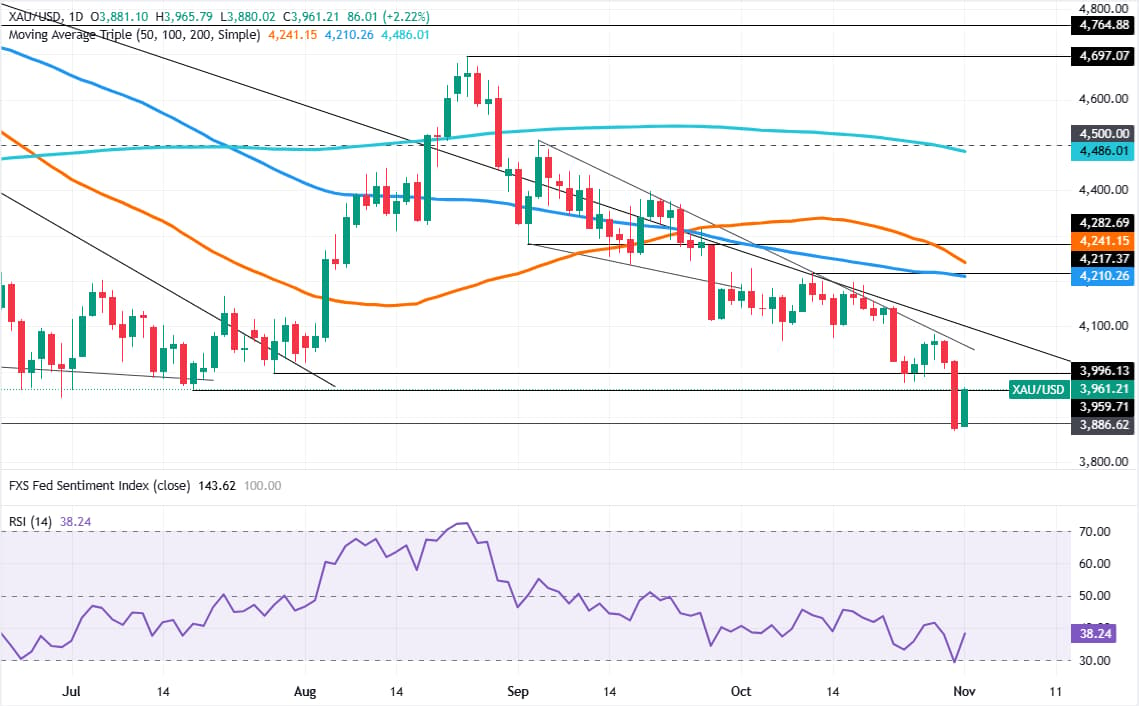
XAU/USD technical outlook: Recovery incomplete, but reclaims $3,900
Despite bouncing off yearly lows, Gold’s trend remains up, even though the Relative Strength Index (RSI) shows buyers are gaining momentum. The XAU/USD pair bounced from below $3,900 to current spot prices, but it remains below the latest cycle low at $3,975, the October 23 low of the day (LOD), which has turned into resistance.
To complete a bullish reversal, buyers must surpass the October 23 LOD followed by the $4,000 psychological level. A breach of the latter will see Gold face a key resistance trendline near $4,050-$4,070, ahead of $4,100.
For a bearish continuation, Gold needs to fall below $3,900. This will expose the October 30 yearly low of $3,870, followed by the April 22, 2025, daily high, turned into support at $3,500.
Gold FAQs
Gold has played a key role in human’s history as it has been widely used as a store of value and medium of exchange. Currently, apart from its shine and usage for jewelry, the precious metal is widely seen as a safe-haven asset, meaning that it is considered a good investment during turbulent times. Gold is also widely seen as a hedge against inflation and against depreciating currencies as it doesn’t rely on any specific issuer or government.
Central banks are the biggest Gold holders. In their aim to support their currencies in turbulent times, central banks tend to diversify their reserves and buy Gold to improve the perceived strength of the economy and the currency. High Gold reserves can be a source of trust for a country’s solvency. Central banks added 1,136 tonnes of Gold worth around $70 billion to their reserves in 2022, according to data from the World Gold Council. This is the highest yearly purchase since records began. Central banks from emerging economies such as China, India and Turkey are quickly increasing their Gold reserves.
Gold has an inverse correlation with the US Dollar and US Treasuries, which are both major reserve and safe-haven assets. When the Dollar depreciates, Gold tends to rise, enabling investors and central banks to diversify their assets in turbulent times. Gold is also inversely correlated with risk assets. A rally in the stock market tends to weaken Gold price, while sell-offs in riskier markets tend to favor the precious metal.
The price can move due to a wide range of factors. Geopolitical instability or fears of a deep recession can quickly make Gold price escalate due to its safe-haven status. As a yield-less asset, Gold tends to rise with lower interest rates, while higher cost of money usually weighs down on the yellow metal. Still, most moves depend on how the US Dollar (USD) behaves as the asset is priced in dollars (XAU/USD). A strong Dollar tends to keep the price of Gold controlled, whereas a weaker Dollar is likely to push Gold prices up.
Лучшие статьи
1Indonesian Rupiah: External headwinds and MSCI risks – OCBC2Mexican Peso roars back as Mexico's GDP surprise pushes USD/MXN lower3Strategy resumes Bitcoin purchases with $65.5M acquisition after brief pause4Taiwan Dollar: Strong fundamentals but near-term pressure – Commerzbank5Gold rebounds toward $4,000 as Iran peace hopes sink Oil, US Dollar6Chinese Yuan: Constructive appreciation bias into 2027 – OCBC7Canadian Dollar gains stall as positive US-Iran headlines send Oil lower8Singapore Dollar: Range-bound trading outlook against US Dollar – UOB9South Korean Won: Moderate appreciation with two-way risks – OCBC


Начать!
Зарегистрируйтесь и получите доступ к глобальным рынкам менее чем за 3 минуты

Свяжитесь с нами









Контакты
Телефон: +61 2 8036 8388
Факс: +61 2 8036 8388
Эл. почта: support@tmgm.com
Веб-сайт: https://www.tmgmasia.com



Информация, представленная на этом веб-сайте, носит исключительно общий характер и не является персональной финансовой консультацией. Прежде чем действовать на основании любой информации на этом веб-сайте, вам следует оценить ее уместность с учетом ваших целей, финансового положения и потребностей. Инвестирование в CFD и маржинальные контракты на FX сопряжено со значительными рисками и подходит не всем инвесторам. Вы можете потерять больше, чем ваш первоначальный депозит. Вы не владеете базовым активом и не имеете в нем какой-либо доли. Мы рекомендуем вам обратиться за независимой консультацией и убедиться, что вы полностью понимаете связанные с этим риски, прежде чем начинать торговлю. Важно прочитать и принять во внимание документ с раскрытием информации, прежде чем приобретать любой продукт, указанный на веб-сайте. Информация и рекламные материалы, предлагаемые на этом веб-сайте, не предназначены для использования любым лицом в любой стране или юрисдикции, где такое использование противоречило бы местным законам и нормативным актам. Продукты и услуги, предлагаемые на этом веб-сайте, не предназначены для резидентов США, Малайзии и Таиланда.
TMGM уполномочена и регулируется в различных юрисдикциях.
Trademax Australia Limited, работающая под брендом TMGM, регулируется Australian Securities and Investments Commission (ASIC), AFSL № 436416 и находится по адресу: Level 28, One International Tower, 100 Barangaroo Avenue, 2000 Sydney, NSW Australia.
Email: support@tmgm.com.au
Trademax Global Limited, работающая под брендом TMGM, уполномочена и регулируется Vanuatu Financial Services Commission (VFSC), регистрационный номер 40356, и зарегистрирована по адресу: 1276, Kumul Highway, Port Vila, Vanuatu, Republic of Vanuatu.
Email: support@tmgm.com
Trademax Global Markets (SE) Limited, работающая под брендом TMGM, уполномочена и регулируется Financial Services Authority (FSA) Сейшельских Островов, номер лицензии SD224. Компания зарегистрирована по адресу: Office No 13, Providence Estate ABIS Centre, Mahe, Seychelles.
Email: support@tmgm.com
Trademax Global Markets (International) Pty Ltd, работающая под брендом TMGM, уполномочена и регулируется Financial Services Commission, Mauritius (FSC), лицензия № GB22201012, и зарегистрирована по адресу: 33, Edith Cavell Street C/o IQ EQ Fund Services (Mauritius) Ltd Port Louis, 11324 Mauritius.
Email: support@tmgm.com
Авторское право © TMGM. Все права защищены