

Trading
Tuklasin ang malawak na hanay ng mga merkado na may competitive na presyo, malalim na liquidity, at advanced na trading tools.
Matuto Pa 
Platform
Mag-trade nang walang sagabal gamit ang malakas na platform ng TMGM, na ginawa para sa bilis, katumpakan, at superior na trading experience.
Matuto Pa Trading Platform
Mga Trading Tools
Academy
Matuto ng mga pangunahing kaalaman sa trading gamit ang mga beginner-friendly na resources, kasama ang mga gabay, webinars, at market insights.
Matuto Pa TMGM Academy
Balita at Analysis
Makakuha ng real-time na mga update sa merkado at expert analysis upang manatiling nangunguna sa mga trading opportunities
Matuto Pa Balita at Analysis
Tungkol
Alamin kung ano ang nagpapangiiba sa TMGM — ang aming global presence, regulatory strength, at commitment sa innovation sa trading.
Matuto Pa Bakit Piliin ang TMGM
Sponsorship
WTI set for monthly gain amid US-Iran stalemate
- WTI rebounds as uncertainty around US-Iran talks keeps supply risks in focus.
- Saudi pipeline flows and higher Gulf exports ease some concerns over Middle East supply.
- WTI holds above key daily SMAs, though momentum indicators remain mixed.
West Texas Intermediate (WTI) Oil rebounds on Wednesday and remains on track for a monthly gain of around 5.5%. The lack of progress in US-Iran negotiations to reopen the Strait of Hormuz keeps geopolitical risks elevated, even as Middle East supply conditions improve. At the time of writing, WTI trades around $90, recovering part of the previous day’s losses.
The US benchmark fell over 4% on Tuesday, slipping to its lowest level since September 4, as easing supply concerns weighed on prices. Reuters reported that Saudi Arabia resumed tanker loadings at Yanbu after restarting its East-West pipeline, which provides an alternative route around Hormuz. Goldman Sachs estimated that Gulf Oil exports recovered to around 23.3 million barrels per day last week, broadly matching their 2025 average. The US also announced that it would offer up to 40 million barrels from its Strategic Petroleum Reserve.
Meanwhile, data released by the US Energy Information Administration (EIA) on Wednesday showed that crude inventories increased by 922,000 barrels last week. The reading was above market expectations for a decline of around 300,000 barrels but considerably smaller than the previous week’s 2.969 million-barrel build.
On the Middle East front, Iran confirmed that it had received Washington’s response to Tehran’s seven-day proposal aimed at reopening the Strait of Hormuz. The initial plan was rejected by US President Donald Trump, while Tehran has signalled that it will not soften its demands, which include lifting the naval blockade of Iranian ports and releasing frozen Iranian assets. Iranian Foreign Minister Abbas Araqchi is expected to review Washington’s response with officials in Tehran.
A deal between Washington and Tehran could remove some of the geopolitical premium from Oil prices. In contrast, a prolonged stalemate could support further gains in WTI.
Technical analysis
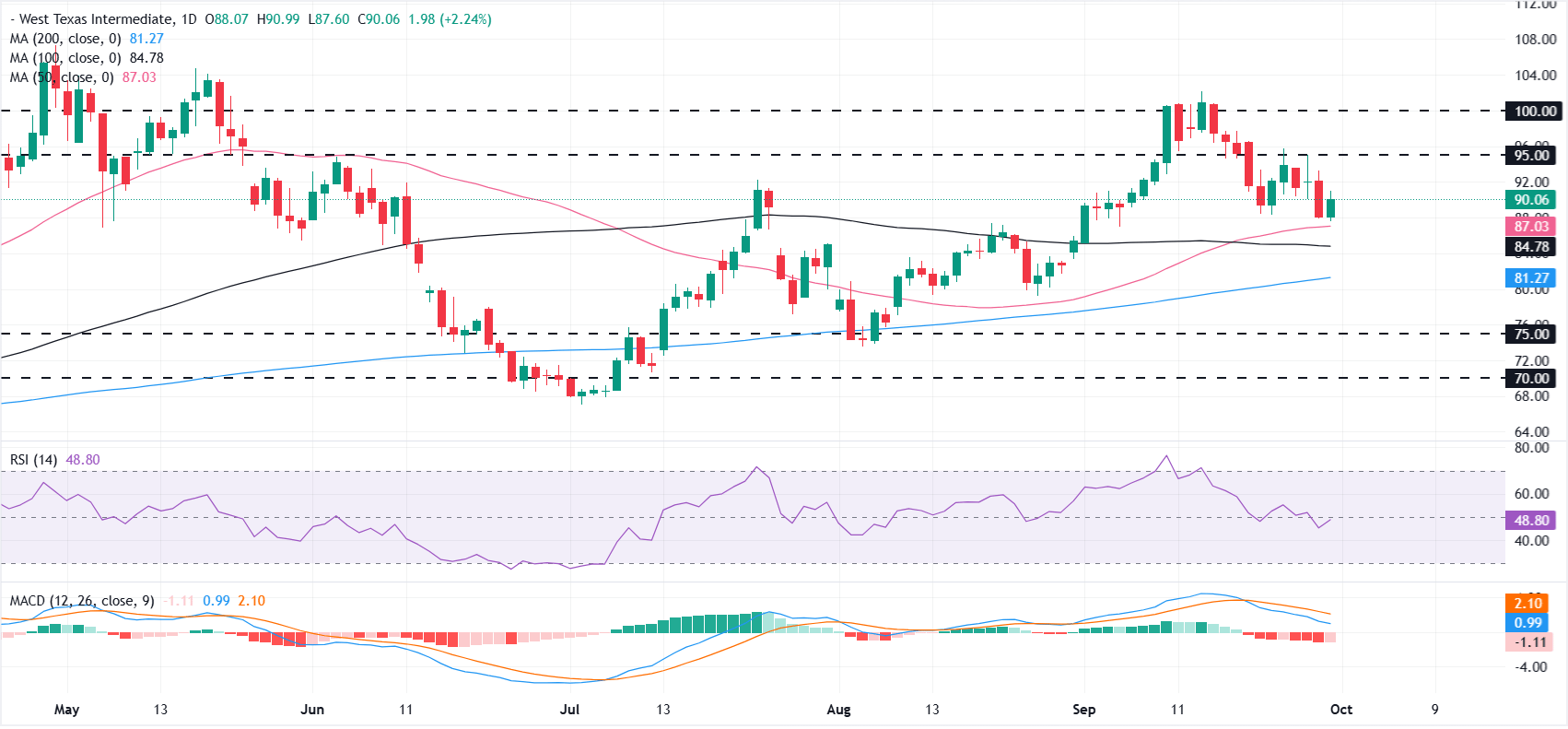
On the daily chart, WTI US Oil holds above the 50-day, 100-day and 200-day Simple Moving Averages (SMAs), which together suggest a still constructive underlying trend even after retreating from a brief move above $100 earlier this month.
Momentum is more cautious, with the Relative Strength Index (RSI) hovering near a neutral 48 and the Moving Average Convergence Divergence (MACD) in negative territory, hinting that bullish pressure is losing steam even as price remains supported by the key medium- and long-term averages.
On the topside, initial resistance is seen at the horizontal barrier near $95, followed by a stronger cap at $100. On the downside, immediate support is aligned with the $89.95 area and the 50-day SMA at $87.03, ahead of the 100-day SMA at $84.78 and the 200-day SMA at $81.27. Below these, deeper structural floors emerge at $75 and $70, which would come into play only if selling extends significantly.
(The technical analysis of this story was written with the help of an AI tool. Know more.)
WTI Oil FAQs
WTI Oil is a type of Crude Oil sold on international markets. The WTI stands for West Texas Intermediate, one of three major types including Brent and Dubai Crude. WTI is also referred to as “light” and “sweet” because of its relatively low gravity and sulfur content respectively. It is considered a high quality Oil that is easily refined. It is sourced in the United States and distributed via the Cushing hub, which is considered “The Pipeline Crossroads of the World”. It is a benchmark for the Oil market and WTI price is frequently quoted in the media.
Like all assets, supply and demand are the key drivers of WTI Oil price. As such, global growth can be a driver of increased demand and vice versa for weak global growth. Political instability, wars, and sanctions can disrupt supply and impact prices. The decisions of OPEC, a group of major Oil-producing countries, is another key driver of price. The value of the US Dollar influences the price of WTI Crude Oil, since Oil is predominantly traded in US Dollars, thus a weaker US Dollar can make Oil more affordable and vice versa.
The weekly Oil inventory reports published by the American Petroleum Institute (API) and the Energy Information Agency (EIA) impact the price of WTI Oil. Changes in inventories reflect fluctuating supply and demand. If the data shows a drop in inventories it can indicate increased demand, pushing up Oil price. Higher inventories can reflect increased supply, pushing down prices. API’s report is published every Tuesday and EIA’s the day after. Their results are usually similar, falling within 1% of each other 75% of the time. The EIA data is considered more reliable, since it is a government agency.
OPEC (Organization of the Petroleum Exporting Countries) is a group of 12 Oil-producing nations who collectively decide production quotas for member countries at twice-yearly meetings. Their decisions often impact WTI Oil prices. When OPEC decides to lower quotas, it can tighten supply, pushing up Oil prices. When OPEC increases production, it has the opposite effect. OPEC+ refers to an expanded group that includes ten extra non-OPEC members, the most notable of which is Russia.
Sikat na Artikulo
1Forex Today: Fedspeak, Claims and the ISM data steal the show2EUR/USD Price Forecast: Monthly outlook mixed, daily chart remains bearish3Gold can’t catch a PCE break as long US yields keep climbing4WTI set for monthly gain amid US-Iran stalemate5Bitcoin and Gold Outlook: BTC recovers $84K, XAU slips amid softer US PCE6ECB’s Lagarde warns France needs a credible path to rein in debt7ECB’s Schnabel says yield surge could cool inflation pressures8Australian Dollar reverses post-PCE rebound as US Dollar recovers9Bitcoin’s 4-year cycle looks self-fulfilling, but RWA may define what's next – ARK Invest


Magsimula!
Mag-sign up at ma-access ang Global Markets sa loob ng 3 minuto

Makipag-ugnayan sa Amin









Mga Kontak
Telepono: +61 2 8036 8388
Fax: +61 2 8036 8388
Email: support@tmgm.com



Ang impormasyong ibinigay sa website na ito ay pangkalahatang impormasyon lamang at hindi bumubuo ng personal na payong pinansyal. Bago kumilos batay sa anumang impormasyon sa website na ito, dapat mong isaalang-alang ang pagiging angkop ng impormasyon kaugnay ng iyong mga layunin, kalagayang pinansyal, at mga pangangailangan. Ang pag-iinvest sa CFDs at FX Margin Contracts ay may kaakibat na malalaking panganib at hindi angkop para sa lahat ng mamumuhunan. Maaari kang mawalan ng higit pa sa iyong paunang deposito. Wala kang pagmamay-ari o anumang interes sa pinagbabatayang asset. Inirerekomenda namin na humingi ka ng independiyenteng payo at tiyaking lubos mong nauunawaan ang mga panganib na kasangkot bago makipagkalakalan. Mahalaga na basahin at isaalang-alang mo ang dokumento ng pagsisiwalat bago ka kumuha ng anumang produktong nakalista sa website. Ang impormasyon at mga patalastas na inaalok sa website na ito ay hindi nilalayong gamitin ng sinumang tao sa alinmang bansa o hurisdiksyon kung saan ang ganitong paggamit ay labag sa mga lokal na batas at regulasyon. Ang mga Produkto at Serbisyong inaalok sa website na ito ay hindi nilalayong para sa mga residente ng United States, Malaysia, at Thailand.
Ang TMGM ay awtorisado at pinangangasiwaan sa iba't ibang hurisdiksyon.
Ang Trademax Australia Limited, na nag-trading bilang TMGM, ay pinangangasiwaan ng Australian Securities and Investments Commission (ASIC), AFSL no. 436416 at matatagpuan sa Level 28, One International Tower, 100 Barangaroo Avenue, 2000 Sydney, NSW Australia.
Email: support@tmgm.com.au
Ang Trademax Global Limited, na nag-trading bilang TMGM, ay awtorisado at pinangangasiwaan ng Vanuatu Financial Services Commission (VFSC), registration number 40356 at nakarehistro sa 1276, Kumul Highway, Port Vila, Vanuatu, Republic of Vanuatu.
Email: support@tmgm.com
Ang Trademax Global Markets (SE) Limited, na kilala bilang TMGM, ay awtorisado at nire-regulahan ng Financial Services Authority (FSA) ng Seychelles, na may lisensya bilang SD224. Ang kumpanya ay nakarehistro sa Office Blg. 13, Providence Estate ABIS Centre, Mahe, Seychelles.
Email: support@tmgm.com
Ang Trademax Global Markets (International) Pty Ltd, na nag-trading bilang TMGM, ay awtorisado at pinangangasiwaan ng Financial Services Commission, Mauritius (FSC) na may license no. GB22201012, at nakarehistro sa 33, Edith Cavell Street C/o IQ EQ Fund Services (Mauritius) Ltd Port Louis, 11324 Mauritius.
Email: support@tmgm.com
Copyright © TMGM. Lahat ng karapatan ay nakalaan