

Savdo
Raqobatbardosh narxlar, chuqur likvidlik va ilg‘or savdo vositalari bilan keng turdagi bozorlarni kashf eting.
Batafsil ma’lumot 
Platforma
TMGM’ning tezlik, aniqlik va yuqori savdo tajribasi uchun yaratilgan kuchli platformasi bilan uzluksiz savdo qiling.
Batafsil ma’lumot Savdo platformasi
Savdo vositalari
Akademiya
Boshlovchilar uchun qulay resurslar, jumladan qo‘llanmalar, vebinarlar va bozor tahlillari orqali savdoning asoslarini o‘rganing.
Batafsil ma’lumot Yangiliklar va tahlil
Savdo imkoniyatlaridan oldinda bo‘lish uchun bozor yangilanishlari va ekspert tahlillarini real vaqt rejimida oling
Batafsil ma’lumot Yangiliklar va tahlil
Haqida
TMGMni boshqalardan ajratib turadigan jihatlarni bilib oling — bizning global mavjudligimiz, tartibga solishdagi mustahkamligimiz va savdoda innovatsiyalarga sodiqligimiz.
Batafsil ma’lumot Nega TMGMni tanlash kerak
Silver Price Forecast: XAG/USD recovers strongly as oil prices hit hardly
- Silver price rebounds strongly to near $50.35 as oil prices corrects further.
- Investors shift their focus to US mid-term elections and key US economic data.
- According to expectations, the probability of the Democrats taking the Senate at 72.0%.
Silver price (XAG/USD) is up 2.45% to near $50.35 in the European trade on Monday. The white metal bounces back strongly after hitting a fresh almost a year low of $48.86 on Friday, as oil prices have extended their correction.
As of writing, the WTI Oil price has corrected slightly below $100 from its five-month high of $104.03 posted on Friday.
Lower oil prices ease fears of acceleration in global inflationary pressures, a scenario that might diminish expectations of prolonged monetary tightening by central banks. Such a case bodes well for non-yielding assets, like Silver.
Oil prices come under pressure after signals from the United States (US) that it would prefer pursuing a diplomatic resolution with Iran than resuming military attacks.
Meanwhile, investors await US mid-term elections, and key US economic data, notably Nonfarm Payrolls (NFP), that could shape expectations for the Federal Reserve’s (Fed) monetary policy outlook.
US midterms set to reshape fiscal outlook as markets eye tight race for Congress
Strategists at Deutsche Bank note that, looking in more depth at the week ahead, “tomorrow’s midterms will determine control of Congress for the final two years of President Trump’s term.” They highlight that current polling “suggests Democrats are favoured to gain the three seats needed for a House majority, while the Senate remains a much closer contest,” with the final outcome in either chamber potentially taking “several days to become clear if the margins are tight.”
In terms of market-implied probabilities, Deutsche Bank point out that “Polymarket currently put the probability of the Democrats taking the Senate at 72.0%. Well renowned pollster Nate Silver currently suggests a 75% probability.”
From a near-term fiscal perspective, Deutsche Bank’s economists caution that “the lame-duck session after the election could prove at least as consequential as the composition of the new Congress,” with “government funding expiring on December 11 and Republicans likely to seek a reconciliation bill that could include additional defence spending and potentially address the debt limit.”
Silver Technical Analysis
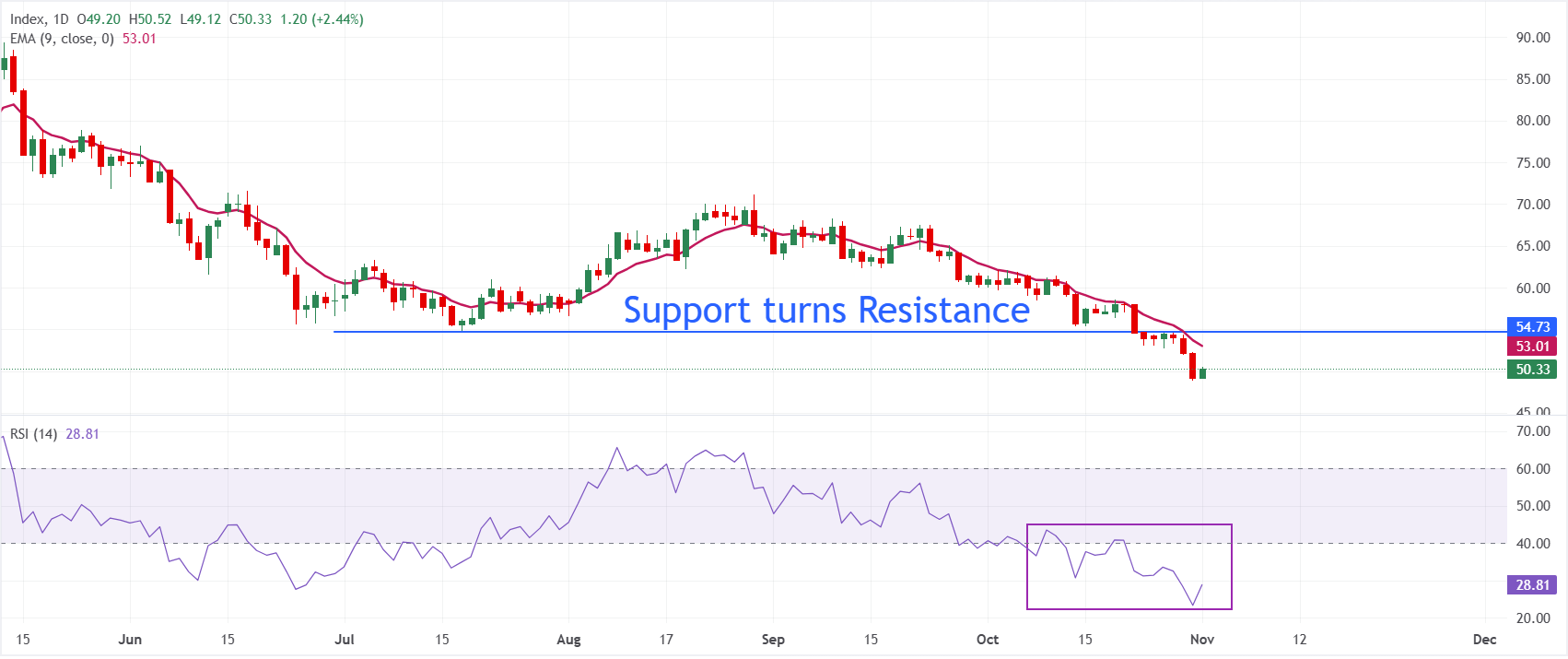
In the daily chart, XAG/USD trades at $50.35, extending a bearish near-term bias as price holds clearly beneath the 9-day Exponential Moving Average (EMA) at $53.02. The metal remains pressured by this overhead dynamic barrier, while the Relative Strength Index (RSI) at 28.90 sits in oversold territory, hinting that downside momentum is stretched but not yet decisively reversing.
On the topside, initial resistance is located at the 9-day EMA around $53.02, and a sustained break above this level would be needed to ease the current bearish tone. On the downside, while there is no nearby structural price floor in the dataset, the oversold RSI reading near 28.90 suggests that sellers could begin to lose conviction on further dips, potentially slowing the slide rather than establishing a clear support zone.
(The technical analysis of this story was written with the help of an AI tool. Know more.)
Silver FAQs
Silver is a precious metal highly traded among investors. It has been historically used as a store of value and a medium of exchange. Although less popular than Gold, traders may turn to Silver to diversify their investment portfolio, for its intrinsic value or as a potential hedge during high-inflation periods. Investors can buy physical Silver, in coins or in bars, or trade it through vehicles such as Exchange Traded Funds, which track its price on international markets.
Silver prices can move due to a wide range of factors. Geopolitical instability or fears of a deep recession can make Silver price escalate due to its safe-haven status, although to a lesser extent than Gold's. As a yieldless asset, Silver tends to rise with lower interest rates. Its moves also depend on how the US Dollar (USD) behaves as the asset is priced in dollars (XAG/USD). A strong Dollar tends to keep the price of Silver at bay, whereas a weaker Dollar is likely to propel prices up. Other factors such as investment demand, mining supply – Silver is much more abundant than Gold – and recycling rates can also affect prices.
Silver is widely used in industry, particularly in sectors such as electronics or solar energy, as it has one of the highest electric conductivity of all metals – more than Copper and Gold. A surge in demand can increase prices, while a decline tends to lower them. Dynamics in the US, Chinese and Indian economies can also contribute to price swings: for the US and particularly China, their big industrial sectors use Silver in various processes; in India, consumers’ demand for the precious metal for jewellery also plays a key role in setting prices.
Silver prices tend to follow Gold's moves. When Gold prices rise, Silver typically follows suit, as their status as safe-haven assets is similar. The Gold/Silver ratio, which shows the number of ounces of Silver needed to equal the value of one ounce of Gold, may help to determine the relative valuation between both metals. Some investors may consider a high ratio as an indicator that Silver is undervalued, or Gold is overvalued. On the contrary, a low ratio might suggest that Gold is undervalued relative to Silver.
Eng yaxshi maqolalar
1Dow Jones futures advance as risk appetite rebounds ahead of busy week2Norwegian Krone: Supported by energy and tight gas market – Danske Bank3Canadian Dollar sits near September 16 highs as weaker USD offsets declining oil prices4British Pound trades positive at the start of the BoE’s policy week5Swiss Franc remains stronger following SVME PMI data6CEE FX: Dovish stance and energy shock pressure currencies – ING7Australian Dollar dips further amid mixed data with RBA decision in focus8Polish Zloty: Inflation dip seen delaying tightening – Commerzbank9Silver Price Forecast: XAG/USD recovers strongly as oil prices hit hardly

Boshlang!
Ro‘yxatdan o‘ting va 3 daqiqadan kamroq vaqt ichida Global bozorlariga kirish imkoniga ega bo‘ling

Biz bilan bog‘laning









Kontaktlar
Telefon: +61 2 8036 8388
Faks: +61 2 8036 8388
Email: support@tmgm.com



Ushbu veb-saytda taqdim etilgan ma’lumotlar faqat umumiy xususiyatga ega bo‘lib, shaxsiy moliyaviy maslahat hisoblanmaydi. Ushbu veb-saytdagi har qanday ma’lumot asosida harakat qilishdan oldin, ma’lumotning sizning maqsadlaringiz, moliyaviy ahvolingiz va ehtiyojlaringizga mosligini ko‘rib chiqishingiz kerak. CFD va FX Margin shartnomalariga sarmoya kiritish sezilarli xavflarni o‘z ichiga oladi va barcha investorlar uchun mos emas. Siz boshlang‘ich depozitingizdan ko‘proq yo‘qotishingiz mumkin. Siz asosiy aktivga egalik qilmaysiz va unda hech qanday manfaatga ega emassiz. Savdo qilishdan oldin mustaqil maslahat olishni va ishtirok etuvchi xavflarni to‘liq tushunishingizni tavsiya qilamiz. Veb-saytda keltirilgan har qanday mahsulotni xarid qilishdan oldin oshkor qilish hujjatini o‘qib chiqishingiz va ko‘rib chiqishingiz muhimdir. Ushbu veb-saytda taklif etilgan ma’lumotlar va reklama materiallari bunday foydalanish mahalliy qonunlar va qoidalarga zid bo‘ladigan har qanday mamlakat yoki yurisdiksiyadagi shaxslar tomonidan foydalanish uchun mo‘ljallanmagan. Ushbu veb-saytda taklif etilgan Mahsulotlar va Xizmatlar AQSh, Malayziya va Tailand rezidentlari uchun mo‘ljallanmagan.
TMGM turli yurisdiksiyalarda vakolatli va tartibga solinadi.
Trademax Australia Limited, TMGM nomi ostida faoliyat yuritadi, Avstraliya Qimmatli qog‘ozlar va investitsiyalar komissiyasi (ASIC) tomonidan tartibga solinadi, AFSL raqami 436416 va manzili: Level 28, One International Tower, 100 Barangaroo Avenue, 2000 Sydney, NSW Australia.
Email: support@tmgm.com.au
Trademax Global Limited, TMGM nomi ostida faoliyat yuritadi, Vanuatu Moliyaviy Xizmatlar Komissiyasi (VFSC) tomonidan vakolatli va tartibga solinadi, ro‘yxatga olish raqami 40356 va ro‘yxatdan o‘tgan manzili: 1276, Kumul Highway, Port Vila, Vanuatu, Vanuatu Respublikasi.
Email: support@tmgm.com
Trademax Global Markets (SE) Limited, TMGM nomi ostida faoliyat yuritadi, Seyshel orollari Moliyaviy Xizmatlar Boshqarmasi (FSA) tomonidan 224-sonli SD litsenziyasi bilan vakolatli va tartibga solinadi. Kompaniya Office No 13, Providence Estate ABIS Centre, Mahe, Seychelles manzilida ro‘yxatdan o‘tgan.
Email: support@tmgm.com
Trademax Global Markets (International) Pty Ltd, TMGM nomi ostida faoliyat yuritadi, Mauritius Moliyaviy Xizmatlar Komissiyasi (FSC) tomonidan GB22201012 litsenziya raqami bilan vakolatli va tartibga solinadi hamda 33, Edith Cavell Street C/o IQ EQ Fund Services (Mauritius) Ltd Port Louis, 11324 Mauritius manzilida ro‘yxatdan o‘tgan.
Email: support@tmgm.com
Mualliflik huquqi © TMGM. Barcha huquqlar himoyalangan