

Trading
Explore a wide range of markets with competitive pricing, deep liquidity, and advanced trading tools.
Learn More 
Platform
Trade seamlessly with TMGM's powerful platform, built for speed, precision, and a superior trading experience.
Learn More Trading Platform
Academy
Learn the fundamentals of trading with beginner-friendly resources, including guides, webinars, and market insights.
Learn More News & Analysis
Get real-time market updates and expert analysis to stay ahead of trading opportunities
Learn More News & Analysis
About
Learn what sets TMGM apart — our global presence, regulatory strength, and commitment to innovation in trading.
Learn More Why Choose TMGM
Sponsorship
19-month high: Dollar Index pulls back after retail sales surge
- 19-month high for DXY after retail sales proves short-lived as gains fully unwind.
- With a December Fed rate increase fully priced in, softer factory figures reversed the rise in yields.
- Wednesday's minutes from the Fed's October meeting are the next focus for rate-hike expectations.
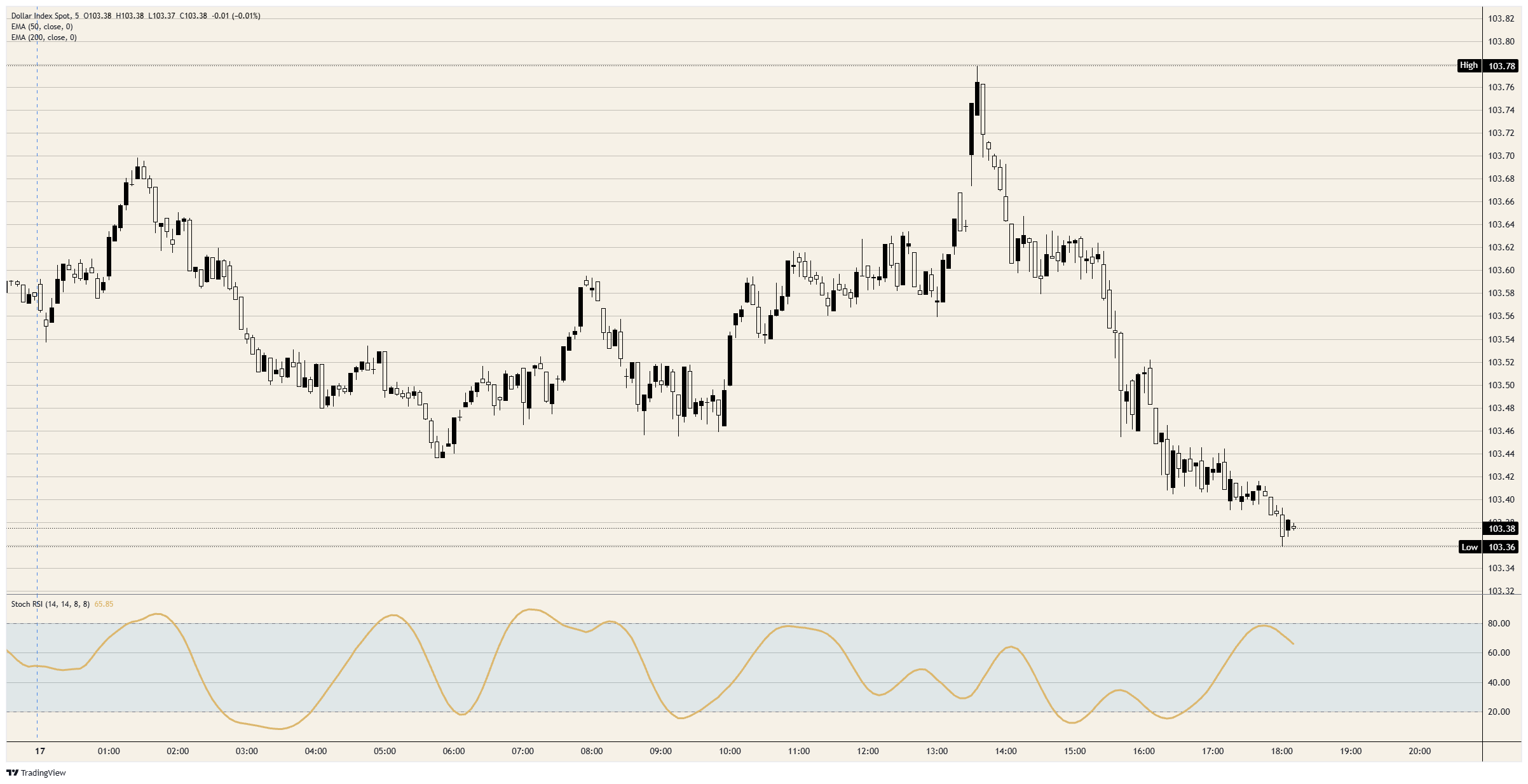
Just below 103.80 marked a fresh 19-month high for the Dollar Index. October retail sales drove it to its strongest level since April 2025, but that entire surge had unwound before the subsequent industrial production release. A further decline has brought the index to around 103.40, leaving it set to end a five-session run of gains.

October retail sales increased 0.2%, while the control group advanced 0.6% and its September increase was upgraded to 0.5%. A 1.1% rise in import prices matched the previous month's increase. With a December Fed rate increase already fully discounted, including a near 91% probability of a quarter-point move on CME FedWatch, the stronger figures offered limited additional support for the Dollar.
A 0.4% contraction in October industrial production followed a 0.7% increase, while homebuilder sentiment fell from 29 to 25. The session's gains in Treasury yields were erased, leaving the 10-year yield near 5.13%. The homebuilder reading triggered the Dollar's second leg lower. That decline persisted after Cleveland Fed President Hammack said inflation was heading in the wrong direction.
19:00 GMT Wednesday: Fed minutes in focus
At 19:00 GMT on Wednesday, the Fed will release minutes of its October 27-28 meeting, at which rates were left at 3.75%-4.00%. New York Fed President Williams is also due to speak that day. Thursday brings remarks from Cleveland Fed President Hammack, Chicago Fed President Goolsbee and Philadelphia Fed President Paulson. Markets have fully discounted a December 9 rate increase, leaving scope for these events to shift expectations of a half-point move, currently near 9% on CME FedWatch.
Tuesday's calendar includes Nvidia (NVDA) results at 21:20 GMT. According to analysts at ING, losses in US technology shares have extended across enough other equity markets to support the Dollar's safe-haven appeal. Thursday's weekly jobless claims release is scheduled for 13:30 GMT.
103.00: DXY remains above October peak
Less than a fifth of the advance from the November 10 low near 101.50 has been retraced, putting the index back within Monday's trading range. It remains above the October 14 high just below 103.00, a level it broke through on November 12. The 50-day Exponential Moving Average (EMA) stands near 101.70, versus around 100.40 for the 200-day EMA.
5-minute chart: DXY
US Dollar: frequently asked questions
As the official currency of the United States of America, the US Dollar (USD) also circulates alongside domestic banknotes in a significant number of other countries as their ‘de facto’ currency. No other currency is traded more heavily: 2022 data show that it accounts for over 88% of global foreign exchange turnover, equivalent to average daily transactions of $6.6 trillion. The USD replaced the British Pound as the world's reserve currency after the Second World War. Gold backed the US Dollar for most of its history, until the Bretton Woods Agreement in 1971 brought the Gold Standard to an end.
Monetary policy, set by the Federal Reserve (Fed), is the single biggest influence on the US Dollar's value. To fulfil its dual mandate of price stability (controlling inflation) and full employment, the Fed relies primarily on interest-rate adjustments. If prices increase too rapidly and inflation exceeds its 2% target, the Fed will increase rates, supporting the USD. Conversely, inflation below 2% or an excessively high Unemployment Rate may prompt the Fed to cut rates, putting pressure on the Greenback.
When conditions become extreme, the Federal Reserve can print additional Dollars and introduce quantitative easing (QE). This process substantially expands the supply of credit through a financial system that has seized up. As an unconventional policy tool, QE addresses a credit shortage caused by banks refusing to lend to one another for fear of counterparty default. It is a last resort when interest-rate cuts alone are unlikely to deliver the required outcome. During the Great Financial Crisis in 2008, the Fed used QE as its preferred response to the credit crunch. Under this policy, newly printed Dollars fund purchases of US government bonds, mainly from financial institutions. The US Dollar typically weakens as a result of QE.
By contrast, quantitative tightening (QT) reverses that process. The Federal Reserve halts bond purchases from financial institutions and refrains from reinvesting principal repaid on maturing bond holdings in further purchases. This generally supports the US Dollar.
POPULAR ARTICLES
1Producer Prices Fall Short of Forecasts as New Zealand Dollar Hovers Near Its Low210-month low: Australian Dollar stabilises after RBA minutes show split3160.00 holds as Tokyo’s warnings support third session of yen gains4Five-session slide ends for Pound on UK jobs data and softer Dollar51.10: Euro inches back from 19-month low as Dollar softens651% of Bitcoin supply underwater as sell-off intensifies7Dow Jones Industrial Average Falls on NSA Outage Before Nvidia Beats Expectations8US natural gas demand decline brings limited relief to Europe - Commerzbank9UOB: Chinese Yuan likely to extend gains against US Dollar


Get Started!
Sign up and access the Global Markets in less than 3 minutes

Connect With Us









Contacts
Phone: +61 2 8036 8388
Fax: +61 2 8036 8388
Email: support@tmgm.com



The information provided on this website is of a general nature only and does not constitute personal financial advice. Before acting on any information on this website, you should consider the suitability of the information in relation to your objectives, financial situation and needs. Investing in CFDs and FX Margin Contracts carries significant risks and is not suitable for all investors. You may lose more than your initial deposit. You do not own, or have, any interest in the underlying asset. We recommend that you seek independent advice and ensure you fully understand the risks involved before trading. It is important that you read and consider the disclosure document before you acquire any product listed on the website. The information and advertisements offered on this website are not intended for use by any person in any country or jurisdiction where such use would be contrary to local laws and regulations. The Products and Services offered on this website are not intended for residents of the United States, Malaysia and Thailand.
TMGM is authorized and regulated in various jurisdictions.
Trademax Australia Limited, trading as TMGM, is regulated by the Australian Securities and Investments Commission (ASIC), AFSL no. 436416 and is located at Level 28, One International Tower, 100 Barangaroo Avenue, 2000 Sydney, NSW Australia.
Email: support@tmgm.com.au
Trademax Global Limited, trading as TMGM, is authorized and regulated by the Vanuatu Financial Services Commission (VFSC), registration number 40356 and registered at 1276, Kumul Highway, Port Vila, Vanuatu, Republic of Vanuatu.
Email: support@tmgm.com
Trademax Global Markets (SE) Limited, trading as TMGM, is authorized and regulated by the Financial Services Authority (FSA) of Seychelles, with license number SD224. The company is registered at Office No 13, Providence Estate ABIS Centre, Mahe, Seychelles.
Email: support@tmgm.com
Trademax Global Markets (International) Pty Ltd, trading as TMGM, is authorized and regulated by the Financial Services Commission, Mauritius (FSC) with license no. GB22201012, and registered at 33, Edith Cavell Street C/o IQ EQ Fund Services (Mauritius) Ltd Port Louis, 11324 Mauritius.
Email: support@tmgm.com
Copyright © TMGM. All rights reserved