

Trading
Explore a wide range of markets with competitive pricing, deep liquidity, and advanced trading tools.
Learn More 
Platform
Trade seamlessly with TMGM's powerful platform, built for speed, precision, and a superior trading experience.
Learn More Trading Platform
Academy
Learn the fundamentals of trading with beginner-friendly resources, including guides, webinars, and market insights.
Learn More News & Analysis
Get real-time market updates and expert analysis to stay ahead of trading opportunities
Learn More News & Analysis
About
Learn what sets TMGM apart — our global presence, regulatory strength, and commitment to innovation in trading.
Learn More Why Choose TMGM
Sponsorship
$4,000 in Focus: Gold Consolidates Near This Level as Recovery Stays Fragile Ahead of Fed Decision
- $4,000 is back within Gold’s reach and has been reclaimed. Middle East diplomacy has prompted Oil prices to retreat.
- Wednesday’s Fed monetary policy decision is the next focus for traders.
- A near-oversold RSI and negative MACD keep the technical picture bearish.
$4,016 is Gold’s approximate price at the time of writing. XAU/USD is up 0.50% on Monday, consolidating modest gains after last week’s steep sell-off took it to $3,975, the lowest since August. Lower Oil prices are providing support as traders assess diplomatic moves aimed at reducing Middle East tensions.

Talks with Iranian leaders are taking place in Tehran on Monday, Reuters reported, involving officials from Saudi Arabia, Pakistan and Turkey, the three Mecca Pact members. According to Iranian Foreign Ministry spokesman Esmaeil Baghaei, the agenda includes Israel’s expansionist policies, developments in Lebanon and the US war against Iran.
Qatari mediators met Iranian officials in Tehran on Sunday in an effort to reduce regional tensions, ahead of Monday’s meeting. West Texas Intermediate (WTI) Oil has slipped to about $100.39 per barrel, having touched $103.28 on Friday, its highest since May.
Around 4% was wiped off Gold’s value last week, marking its largest weekly fall since June. Higher Oil prices strengthened expectations of additional Federal Reserve (Fed) tightening. That pressure outweighed the support from lower US Treasury yields and a weaker US Dollar (USD). Demand for government bonds, driven by concerns about AI-related investments, pushed Treasury yields lower. Some traders may also have sold Gold to offset losses elsewhere during the broader equity sell-off.
Gold’s rebound is being constrained as the US Dollar and US Treasury yields stabilise at the start of the week following their declines. The US Dollar Index (DXY) is trading at roughly 101.83. It measures the Greenback against a basket of six major currencies. Meanwhile, the benchmark 10-year US Treasury yield is close to 4.99%.
Whether Gold can remain above the psychological $4,000 level or comes under renewed selling pressure could hinge on this week’s Federal Reserve (Fed) monetary policy announcement.
An unchanged interest-rate range of 3.75%-4.00% is widely anticipated when the Fed’s two-day meeting ends on Wednesday. Yet a hold may do little to reassure Gold buyers if policymakers leave another December increase on the table. The CME FedWatch Tool shows traders assigning around a 79% probability to a hike.
79% December hike probability: Fed hold expected as inflation exceeds target
Little fresh guidance is anticipated by TD Securities analysts, who don't expect "much new communication from the FOMC or Chair Warsh." They argue that "a hold in October will make a December hike all the more likely," especially following the "upside surprise in September CPI," which highlights that "inflation risks are still pertinent." On that basis, TD Securities "expect the Fed to hike two more times (December and March)," observing that "inflation remains above target while risks are growing." Beyond early next year, incoming price data will be central to the policy outlook: the analysts add that "the evolution of inflation data will determine the extent and pace of hikes later in the cycle."
$4,020 resistance: Lower Bollinger Band limits Gold’s upside
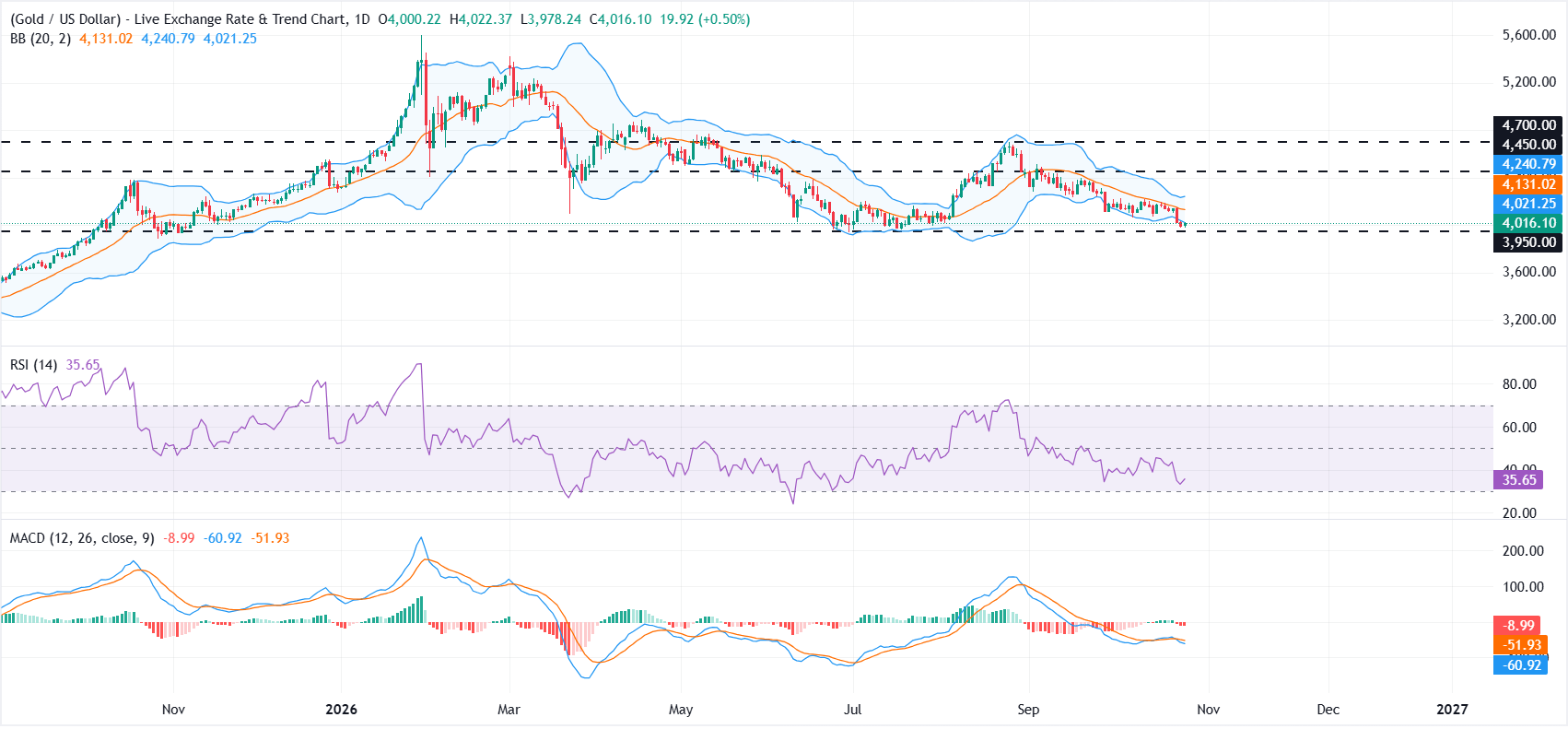
Below the lower Bollinger Band at $4,020, XAU/USD retains a bearish short-term outlook on the daily chart. At 35, the Relative Strength Index (RSI) remains just above oversold territory, while the Moving Average Convergence Divergence (MACD) histogram is still negative. Together, these signals point to continued downward pressure rather than clear evidence that the recent decline has run its course.
The lower Bollinger Band around $4,020 provides the first resistance level. Above it, the middle band near $4,131 and upper band around $4,241 are the next hurdles. Clearing these levels on a sustained basis could allow a recovery towards $4,400-$4,500, with $4,700 beyond that zone.
The $3,975-$3,950 area offers immediate support. If prices break decisively below it, the decline could extend to the psychological $3,900 level and then $3,800.
(The technical analysis of this story was written with the help of an AI tool. Know more.)
Gold: Key questions answered
Widely used as both a store of value and a means of exchange, Gold has held an important place throughout human history. Today, its appeal extends beyond its lustre and use in jewellery. The metal is widely regarded as a safe-haven asset, or an investment considered attractive during periods of turmoil. Because it does not depend on a particular issuer or government, Gold is also commonly viewed as a hedge against inflation and currency depreciation.
The largest holders of Gold are central banks. To support their currencies during unsettled periods, they typically diversify reserves and purchase Gold to strengthen perceptions of their economies and currencies. Substantial Gold reserves can reinforce confidence in a country’s solvency. World Gold Council data show that central banks increased their reserves by 1,136 tonnes in 2022, worth around $70 billion. That was the largest annual purchase on record. Emerging-economy central banks, including those in China, India and Turkey, are expanding their Gold reserves rapidly.
The US Dollar and US Treasuries, both leading reserve and safe-haven assets, have an inverse correlation with Gold. A weaker Dollar typically accompanies a rise in Gold, allowing investors and central banks to diversify their holdings during turbulent periods. Risk assets also tend to move in the opposite direction to Gold. Stock-market gains generally put pressure on the metal’s price, whereas selling in riskier markets tends to support it.
Many factors can influence Gold prices. Its safe-haven role means geopolitical instability or concern about a deep recession can trigger rapid gains. Since Gold pays no yield, lower interest rates tend to support it, while a higher cost of money usually weighs on the metal. Nevertheless, the US Dollar (USD) drives most price movements because Gold is quoted in dollars (XAU/USD). Dollar strength generally restrains Gold prices; a weaker Dollar is more likely to lift them.
POPULAR ARTICLES
1Euro: Defined range keeps trading sideways against US Dollar – UOB2$80,000 Area: Bitcoin Price Forecast as BTC Stalls Amid Geopolitical Tensions and Weaker Risk Appetite3October rate hike now expected from Reserve Bank of New Zealand – TD Securities4$54.00 Area: XAG/USD holds steady as bears retain control – Silver Price Forecast5Bank of Canada: Rabobank expects policy rate to remain unchanged6Australian Dollar: Yield advantage set to strengthen on inflation data – BBH7British Pound outperforms Japanese Yen as UK Budget and BoJ decision approach8Brazilian Real: Losses against US Dollar deepen on election shock - SocGen9Above 1.4000: USD/CAD price forecast as Dollar gains and Oil prices weigh on CAD
LIVE QUOTES


ALL ABOUT GOLD & PRECIOUS METALS
Get Started!
Sign up and access the Global Markets in less than 3 minutes

Connect With Us









Contacts
Phone: +61 2 8036 8388
Fax: +61 2 8036 8388
Email: support@tmgm.com



The information provided on this website is of a general nature only and does not constitute personal financial advice. Before acting on any information on this website, you should consider the suitability of the information in relation to your objectives, financial situation and needs. Investing in CFDs and FX Margin Contracts carries significant risks and is not suitable for all investors. You may lose more than your initial deposit. You do not own, or have, any interest in the underlying asset. We recommend that you seek independent advice and ensure you fully understand the risks involved before trading. It is important that you read and consider the disclosure document before you acquire any product listed on the website. The information and advertisements offered on this website are not intended for use by any person in any country or jurisdiction where such use would be contrary to local laws and regulations. The Products and Services offered on this website are not intended for residents of the United States, Malaysia and Thailand.
TMGM is authorized and regulated in various jurisdictions.
Trademax Australia Limited, trading as TMGM, is regulated by the Australian Securities and Investments Commission (ASIC), AFSL no. 436416 and is located at Level 28, One International Tower, 100 Barangaroo Avenue, 2000 Sydney, NSW Australia.
Email: support@tmgm.com.au
Trademax Global Limited, trading as TMGM, is authorized and regulated by the Vanuatu Financial Services Commission (VFSC), registration number 40356 and registered at 1276, Kumul Highway, Port Vila, Vanuatu, Republic of Vanuatu.
Email: support@tmgm.com
Trademax Global Markets (SE) Limited, trading as TMGM, is authorized and regulated by the Financial Services Authority (FSA) of Seychelles, with license number SD224. The company is registered at Office No 13, Providence Estate ABIS Centre, Mahe, Seychelles.
Email: support@tmgm.com
Trademax Global Markets (International) Pty Ltd, trading as TMGM, is authorized and regulated by the Financial Services Commission, Mauritius (FSC) with license no. GB22201012, and registered at 33, Edith Cavell Street C/o IQ EQ Fund Services (Mauritius) Ltd Port Louis, 11324 Mauritius.
Email: support@tmgm.com
Copyright © TMGM. All rights reserved