

Trading
Explore a wide range of markets with competitive pricing, deep liquidity, and advanced trading tools.
Learn More 
Platform
Trade seamlessly with TMGM's powerful platform, built for speed, precision, and a superior trading experience.
Learn More Trading Platform
Academy
Learn the fundamentals of trading with beginner-friendly resources, including guides, webinars, and market insights.
Learn More News & Analysis
Get real-time market updates and expert analysis to stay ahead of trading opportunities
Learn More News & Analysis
About
Learn what sets TMGM apart — our global presence, regulatory strength, and commitment to innovation in trading.
Learn More Why Choose TMGM
Sponsorship
Near $3,900: Gold struggles as traders weigh Middle East developments and US election risks
- Oil’s rebound and hawkish Fed expectations limit Gold’s recovery.
- US midterm elections and employment releases are in focus as traders seek fresh market direction.
- $3,870 yearly low remains at risk of a retest as bearish momentum weighs on Gold.
Gold (XAU/USD) trades around $3,900 at the time of writing. The metal is down 1% on the day, losing momentum on Tuesday as Oil prices recover. The rebound followed a Wall Street Journal (WSJ) report of a US strike on Iran’s Qeshm Island. That report weakened optimism surrounding diplomatic efforts, which had driven energy prices sharply lower the previous day.

West Texas Intermediate (WTI) is trading around $97, gaining 2.23% after a decline of nearly 7% on Monday. Oil remains volatile as traders respond to changing headlines.
Since the war started in late February, the relationship between Oil prices and interest rate expectations has been a central influence on Gold. Rising energy costs intensify inflationary pressures. This encourages central banks, especially the Federal Reserve (Fed), to maintain elevated interest rates or tighten policy further. By raising the opportunity cost of owning a non-yielding asset, higher borrowing costs typically put pressure on the precious metal.
A 25 basis points (bps) interest rate increase in September was followed by a Fed pause in October. The central bank nevertheless reiterated its commitment to restoring price stability, keeping further increases on the table. The CME FedWatch Tool puts the probability of a December rate rise at 75%.
The US Dollar Index (DXY) stands around 101.81, measuring the currency against six major peers. Although the US Dollar (USD) has eased modestly from recent highs, demand remains supported by Middle East uncertainty, higher Oil prices and hawkish expectations for the Fed. This creates an additional obstacle for Gold.
A sustained fall in Oil prices would be needed to give Gold greater room to recover in this environment. With US-Iran negotiations still clouded by uncertainty, such a fall remains far from assured in the near term. Further liquidation is another risk for the metal. Concerns about AI spending are weighing on technology shares, prompting some investors to sell Gold to offset losses and meet margin calls.
Tuesday’s JOLTS Job Openings begin a busy week of US labour market releases, culminating in Friday’s Nonfarm Payrolls (NFP). Traders are also watching Tuesday’s US midterm elections, whose outcome could shape the US Dollar’s direction.
US midterms and Iran risk shape Dollar outlook
For Commerzbank’s Norman Liebke, an outcome in which “the Republicans lose their majorities in both chambers” could mean the Dollar would “come under greater pressure, as the Trump administration would have less political backing overall.” His assessment is that, even if “only the House of Representatives changes hands, the Dollar would likely face some headwinds as well, albeit to a lesser extent,” while the alternative is that “if the Republicans retain control of both chambers, this should instead provide support for the Dollar.”
The immediate aftermath matters too, according to Liebke, who says “what happens immediately after the midterms is also likely to be relevant for the Dollar.” He highlights the risk that “if Trump were indeed to escalate the conflict with Iran again and launch another attack on the country, this would initially point to further increases in energy prices and rising risk aversion.” Under those risk-off conditions, he says, “the Dollar could benefit from its role as a safe haven, as it did at the beginning of the Iran war.”
Technical analysis: Further downside remains possible as momentum weakens
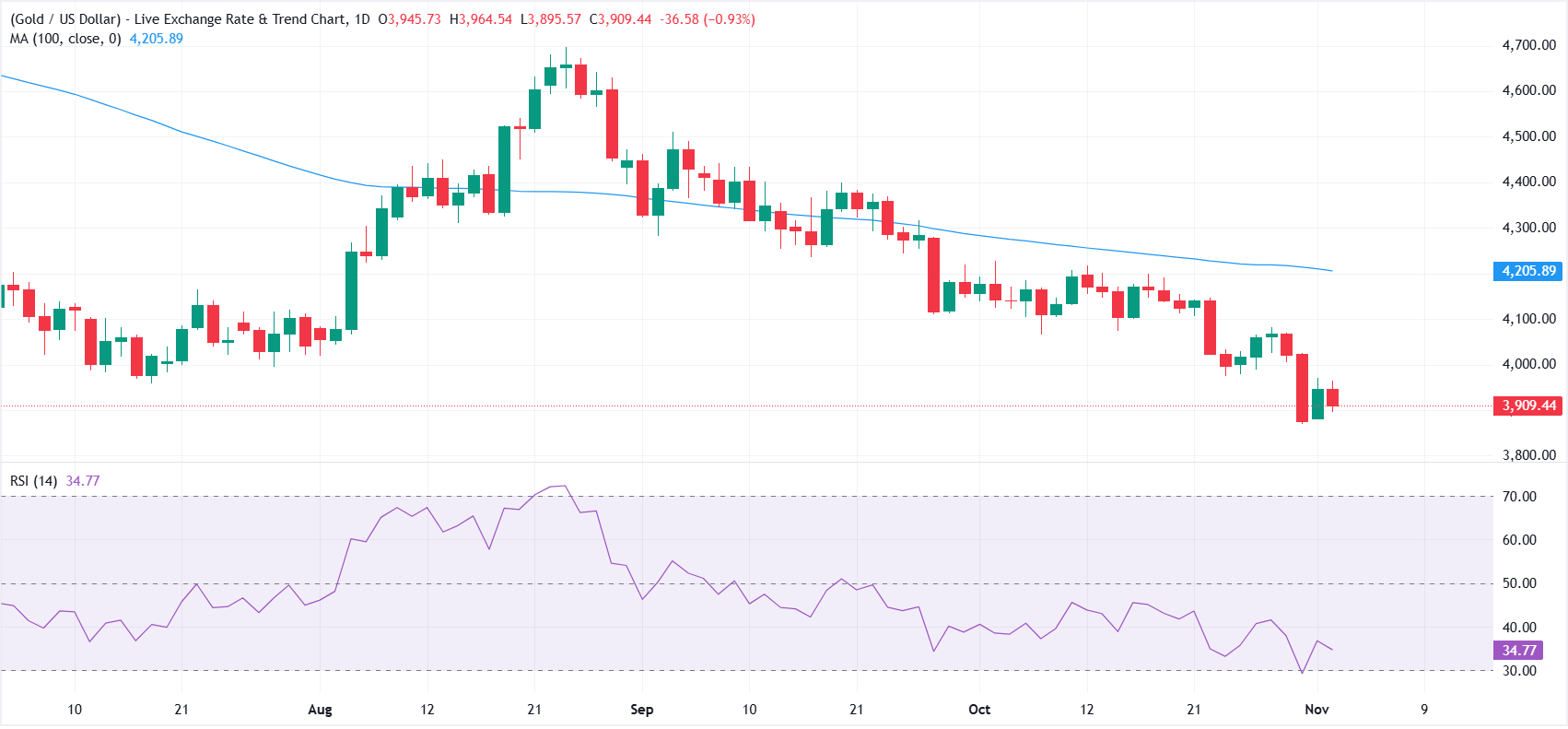
Trading beneath its 21-day, 100-day and 200-day Simple Moving Averages (SMAs), XAU/USD retains a bearish bias on the daily chart.
At 34, the Relative Strength Index (RSI) sits just above oversold territory. The Moving Average Convergence Divergence (MACD) is also negative, remaining below zero. Taken together, the indicators suggest sellers still control momentum, even as the sell-off becomes stretched.
The $3,950-$4,000 band provides the first resistance on a recovery, ahead of the 21-day SMA at $4,092. Further up, the 100-day SMA at $4,210 combines with a horizontal barrier near $4,400 to create a wider supply zone. Beyond that, the 200-day SMA at $4,485 represents a more distant structural ceiling.
Friday’s yearly low of $3,870 is the immediate support to watch, with Gold still exposed to additional losses. A breach could open the way to a further decline.
(The technical analysis of this story was written with the help of an AI tool. Know more.)
Gold: Key Questions
Widely used as both a store of value and a means of exchange, Gold has held an important place throughout human history. Its appeal today extends beyond its lustre and use in jewellery. The precious metal is broadly regarded as a safe haven, making it a favoured investment during periods of turmoil. Because it does not depend on a particular issuer or government, Gold is also widely viewed as a hedge against inflation and currency depreciation.
The largest holders of Gold are central banks. To support their currencies during unsettled periods, they typically diversify reserves and purchase Gold, reinforcing perceptions of economic and currency strength. Substantial Gold reserves can bolster confidence in a country’s solvency. World Gold Council data show that central banks increased their reserves by 1,136 tonnes in 2022, worth around $70 billion. That marked the largest annual purchase on record. Emerging-economy central banks, including those in China, India and Turkey, are expanding their Gold reserves rapidly.
Both the US Dollar and US Treasuries are major reserve and safe-haven assets, and Gold is inversely correlated with them. Dollar weakness typically supports Gold, allowing investors and central banks to diversify holdings in turbulent periods. The metal also has an inverse relationship with risk assets. Rising equity markets generally put pressure on Gold prices, whereas selling in riskier markets tends to support the precious metal.
A broad set of influences can move Gold prices. Its safe-haven appeal means geopolitical instability or fears of a severe recession can trigger a rapid rise. As Gold pays no yield, lower interest rates generally support it, while higher borrowing costs usually weigh on the metal. Most price moves nevertheless hinge on the performance of the US Dollar (USD), since Gold is quoted in dollars (XAU/USD). Dollar strength tends to restrain Gold prices; a weaker Dollar is more likely to lift them.
POPULAR ARTICLES
1Oil: Supply-demand balance and inventories look fragile – TD Securities2US Dollar Index gains modestly within range as midterm elections take centre stage32026: One further Federal Reserve hike before outlook becomes less clear – BNY4US Midterm Elections in focus as Japanese Yen slips against US Dollar5United States: Trump expected to face constraints from Democratic gains, says Deutsche Bank6$1.25 support: Ripple price forecast as XRP holds on and Binance reserves reach five-year low7Gold: Limited follow-through as downside bias persists – UOB8US Dollar: ING sees limited downside from midterms9Near $3,900: Gold struggles as traders weigh Middle East developments and US election risks


Get Started!
Sign up and access the Global Markets in less than 3 minutes

Connect With Us









Contacts
Phone: +61 2 8036 8388
Fax: +61 2 8036 8388
Email: support@tmgm.com



The information provided on this website is of a general nature only and does not constitute personal financial advice. Before acting on any information on this website, you should consider the suitability of the information in relation to your objectives, financial situation and needs. Investing in CFDs and FX Margin Contracts carries significant risks and is not suitable for all investors. You may lose more than your initial deposit. You do not own, or have, any interest in the underlying asset. We recommend that you seek independent advice and ensure you fully understand the risks involved before trading. It is important that you read and consider the disclosure document before you acquire any product listed on the website. The information and advertisements offered on this website are not intended for use by any person in any country or jurisdiction where such use would be contrary to local laws and regulations. The Products and Services offered on this website are not intended for residents of the United States, Malaysia and Thailand.
TMGM is authorized and regulated in various jurisdictions.
Trademax Australia Limited, trading as TMGM, is regulated by the Australian Securities and Investments Commission (ASIC), AFSL no. 436416 and is located at Level 28, One International Tower, 100 Barangaroo Avenue, 2000 Sydney, NSW Australia.
Email: support@tmgm.com.au
Trademax Global Limited, trading as TMGM, is authorized and regulated by the Vanuatu Financial Services Commission (VFSC), registration number 40356 and registered at 1276, Kumul Highway, Port Vila, Vanuatu, Republic of Vanuatu.
Email: support@tmgm.com
Trademax Global Markets (SE) Limited, trading as TMGM, is authorized and regulated by the Financial Services Authority (FSA) of Seychelles, with license number SD224. The company is registered at Office No 13, Providence Estate ABIS Centre, Mahe, Seychelles.
Email: support@tmgm.com
Trademax Global Markets (International) Pty Ltd, trading as TMGM, is authorized and regulated by the Financial Services Commission, Mauritius (FSC) with license no. GB22201012, and registered at 33, Edith Cavell Street C/o IQ EQ Fund Services (Mauritius) Ltd Port Louis, 11324 Mauritius.
Email: support@tmgm.com
Copyright © TMGM. All rights reserved