

Trading
Explore a wide range of markets with competitive pricing, deep liquidity, and advanced trading tools.
Learn More 
Platform
Trade seamlessly with TMGM's powerful platform, built for speed, precision, and a superior trading experience.
Learn More Trading Platform
Academy
Learn the fundamentals of trading with beginner-friendly resources, including guides, webinars, and market insights.
Learn More News & Analysis
Get real-time market updates and expert analysis to stay ahead of trading opportunities
Learn More News & Analysis
About
Learn what sets TMGM apart — our global presence, regulatory strength, and commitment to innovation in trading.
Learn More Why Choose TMGM
Sponsorship
Renewed AI momentum puts New Zealand Dollar at fresh risk of losses against US Dollar
- 0.5434 in focus as NZD/USD faces further downside on renewed global AI momentum.
- A broad AI rebound has drawn support from Jensen Huang’s return as Nvidia CEO.
- Further interest rate increases retain the backing of Fed policymakers.
0.5434 is the level below which NZD/USD risks further losses. During Tuesday’s European session, the New Zealand Dollar (NZD) remains under pressure against the US Dollar (USD). Renewed momentum in the global Artificial Intelligence (AI) trade has strengthened demand for the US Dollar, weighing on the Kiwi pair.

Gains in the US Dollar Index (DXY) remain intact at the time of writing, with the index near its 20-month high of 104.57. DXY measures the Greenback against six major currencies.
Nvidia leadership change lifts equities and bolsters Dollar
Jensen Huang’s reinstatement as Nvidia CEO has provided a major market catalyst, according to analysts at Danske Bank. They cite “Jensen Huang's return as the CEO of Nvidia” as helping to “rally equity markets and lift front end US Treasury yields in a flattener,” while a “broad USD continued to rally.” In the bank’s assessment, momentum linked to AI has eclipsed conventional macroeconomic drivers. Investors’ rotation into US assets and Dollar exposure has left the Euro among the weakest G10 currencies, with Scandinavian FX also lagging.
Hawkish expectations for the Federal Reserve (Fed) provide another source of US Dollar support alongside the revival in the global AI trade. Policymakers’ persistent backing for additional tightening has compelled traders to price in consecutive interest rate rises.
2% inflation target: Williams signals further work ahead
A 6.2/10 reading on the FXS Speechtracker, equal to its historical average, places Fed official Williams’ speech broadly in line with the established baseline. It indicates a consistently hawkish tone, rather than an intensification. Williams’ emphasis that the US central bank “still has work to do” to restore inflation to the 2% target points to a lengthy period of restrictive policy. That message is reinforced by projections for inflation of 3.5% at end-2026 and a return to 2% only by 2028, even as growth and a stable labour market indicate economic resilience. Williams observes that inflation pressures are not broadening significantly. Nevertheless, his assessment that inflation remains too high, with risks tilted upwards, preserves a policy bias towards further action if required.
A rise of 0.35 points took the FXS Fed Sentiment Index to 152.49, far above the neutral threshold of 100 and consistent with firmly hawkish Fed communication. Together with the unchanged FXS Speechtracker reading of 6.2/10, the small increase indicates a steady but clearly hawkish environment. Expectations that policy restraint will persist should therefore continue to support the Dollar.
0.5453: NZD/USD technical outlook remains bearish
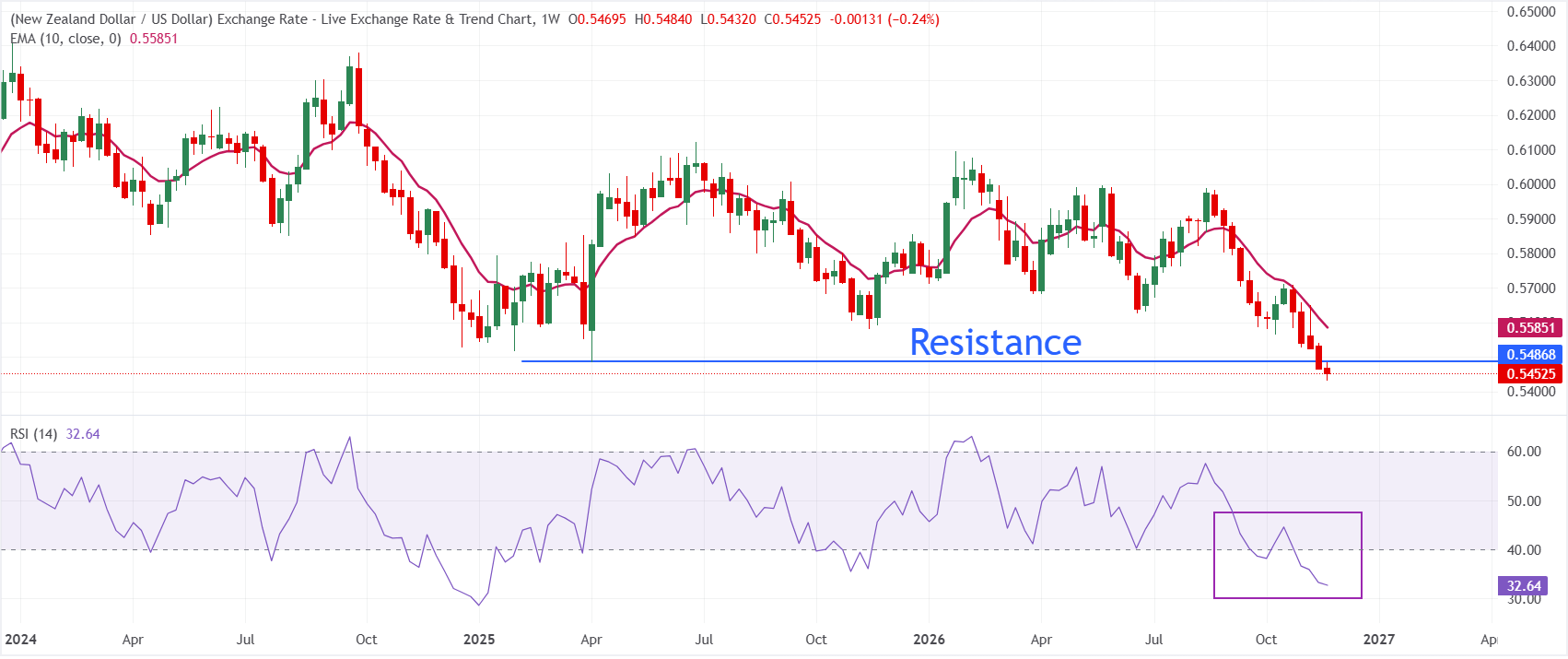
At 0.5453 on the weekly chart, NZD/USD remains below its 10-week exponential moving average (EMA) of 0.5585, preserving a bearish near-term outlook. Recent rebounds have failed to hold, leaving the pair to edge lower. Trading beneath the short-term EMA indicates that sellers remain in control despite intermittent corrective recoveries.
The 10-week EMA at 0.5585 provides the first upside resistance and continues to constrain recovery attempts while price stays below it. Downward momentum is also evident in the 14-week Relative Strength Index (RSI), which sits near 33 and is approaching oversold territory. Although the trend remains under pressure, hesitation among sellers at lower levels could leave the pair exposed to short-covering.
(The technical analysis of this story was written with the help of an AI tool. Know more.)
AI stocks: key questions answered
As an academic discipline, artificial intelligence aims to reproduce human cognitive functions in machines, including logical understanding, perception and pattern recognition. Usually shortened to AI, the field encompasses artificial neural networks, machine learning or predictive analytics, symbolic reasoning, deep learning, natural language processing, speech recognition, image recognition and expert systems. Its ultimate objective is artificial general intelligence, or AGI: a machine capable of solving arbitrary problems without having been trained to solve them.
Applications of artificial intelligence span many different activities. Among the most familiar are generative AI platforms trained on large language models (LLMs) to respond to text-based questions, including ChatGPT and Google’s Bard platform. User-written text can also be turned into original images by the program Midjourney. Elsewhere, probabilistic techniques allow AI to assess an entity’s characteristics or how it is perceived. Upstart’s lending platform, for example, employs an AI-enhanced credit rating system to assess applicants’ creditworthiness, searching the internet for information on their careers, wealth profiles and relationships. Scientific research databases provide other AI systems with material to propose potential new pharmaceuticals for laboratory testing. By gathering and organising information about viewing habits, YouTube, Spotify, Facebook and other content aggregators also use AI applications to recommend personalised content.
Semiconductor company Nvidia (NVDA) produces AI-focused computer chips as well as some of the platforms engineers use to develop AI applications. Because it supplies tools needed for further AI applications, many supporters regard Nvidia as a pick-and-shovel investment in the AI revolution. In “big data” analytics, Palantir Technologies (PLTR) holds substantial contracts with the US intelligence community. That community uses its Gotham platform to examine data, identify intelligence leads and support pattern recognition. Large corporations use Palantir’s Foundry product to track employee and customer data for predictive analytics and anomaly detection. Another company with AI exposure is Microsoft (MSFT), which owns a large stake in the privately held ChatGPT developer OpenAI. OpenAI’s technology has been incorporated into Microsoft’s Bing search engine.
Well over 200% was Nvidia’s gain in the six months after ChatGPT’s public launch in late 2022, as numerous AI-linked stocks rallied. Wall Street commentators quickly began asking whether another technology bubble was taking hold. Prominent investor Stanley Druckenmiller, whose major investments have included both Palantir and Nvidia, argued that bubbles never last only six months. If enthusiasm for AI became a bubble, he said, extreme valuations would persist for at least two and a half years or longer, as in the DotCom bubble of the late 1990s. The best assessment at the midpoint of 2023 was that the market was not in a bubble, at least for the time being. Although Nvidia then traded at 27 times forward sales, analysts expected exceptionally strong revenue growth for years ahead. For comparison, the NASDAQ 100 traded at 60 times earnings at the DotCom bubble’s peak, against 25 times earnings in mid-2023.
POPULAR ARTICLES
1Hungarian Forint Rebounds Against Euro on Support From Moody’s and MNB – Societe Generale2Silver price today: FXStreet data show a decline3Japanese Yen: Upside risk against US Dollar amid range-bound trading – UOB4Nine-year ICO ban: South Korea proposes repeal and mandatory bank-led Won stablecoins5Renewed AI momentum puts New Zealand Dollar at fresh risk of losses against US Dollar6Euro faces further US Dollar pressure as PMIs soften – Danske Bank790.6 in November: Germany’s IFO Business Climate Index Rises More Than Expected81.3000 at risk: Pound probes 19-month lows as AI drives US Dollar rally9British Pound Breaks Range, Signalling Further Losses Against US Dollar - Societe Generale


Get Started!
Sign up and access the Global Markets in less than 3 minutes

Connect With Us









Contacts
Phone: +61 2 8036 8388
Fax: +61 2 8036 8388
Email: support@tmgm.com



The information provided on this website is of a general nature only and does not constitute personal financial advice. Before acting on any information on this website, you should consider the suitability of the information in relation to your objectives, financial situation and needs. Investing in CFDs and FX Margin Contracts carries significant risks and is not suitable for all investors. You may lose more than your initial deposit. You do not own, or have, any interest in the underlying asset. We recommend that you seek independent advice and ensure you fully understand the risks involved before trading. It is important that you read and consider the disclosure document before you acquire any product listed on the website. The information and advertisements offered on this website are not intended for use by any person in any country or jurisdiction where such use would be contrary to local laws and regulations. The Products and Services offered on this website are not intended for residents of the United States, Malaysia and Thailand.
TMGM is authorized and regulated in various jurisdictions.
Trademax Australia Limited, trading as TMGM, is regulated by the Australian Securities and Investments Commission (ASIC), AFSL no. 436416 and is located at Level 28, One International Tower, 100 Barangaroo Avenue, 2000 Sydney, NSW Australia.
Email: support@tmgm.com.au
Trademax Global Limited, trading as TMGM, is authorized and regulated by the Vanuatu Financial Services Commission (VFSC), registration number 40356 and registered at 1276, Kumul Highway, Port Vila, Vanuatu, Republic of Vanuatu.
Email: support@tmgm.com
Trademax Global Markets (SE) Limited, trading as TMGM, is authorized and regulated by the Financial Services Authority (FSA) of Seychelles, with license number SD224. The company is registered at Office No 13, Providence Estate ABIS Centre, Mahe, Seychelles.
Email: support@tmgm.com
Trademax Global Markets (International) Pty Ltd, trading as TMGM, is authorized and regulated by the Financial Services Commission, Mauritius (FSC) with license no. GB22201012, and registered at 33, Edith Cavell Street C/o IQ EQ Fund Services (Mauritius) Ltd Port Louis, 11324 Mauritius.
Email: support@tmgm.com
Copyright © TMGM. All rights reserved