

Trading
Explore a wide range of markets with competitive pricing, deep liquidity, and advanced trading tools.
Learn More 
Platform
Trade seamlessly with TMGM's powerful platform, built for speed, precision, and a superior trading experience.
Learn More Trading Platform
Academy
Learn the fundamentals of trading with beginner-friendly resources, including guides, webinars, and market insights.
Learn More News & Analysis
Get real-time market updates and expert analysis to stay ahead of trading opportunities
Learn More News & Analysis
About
Learn what sets TMGM apart — our global presence, regulatory strength, and commitment to innovation in trading.
Learn More Why Choose TMGM
Sponsorship
Tokyo CPI and BoJ decision: Yen’s central bank week draws to a close
- 158.00 remains just above USD/JPY. The pair has recovered most of its October 22-23 decline.
- Most Fed officials do not see the economy as overheating, according to Fed Chair Warsh.
- A 1.25% hold carries a market-implied probability of nearly 86% ahead of Friday's BoJ decision.
158.00 is just above the current USD/JPY rate. Most of the October 22-23 decline has been recovered, with the Fed's decision to leave rates unchanged failing to extend that fall. Before the announcement, the pair traded above 158.00. It then reached its session peak below 158.50 as Fed Chair Warsh began his press conference. The latest level remains above the session trough, which was just over 157.50.

Faster growth does not automatically imply higher inflation, Fed Chair Warsh said, adding that most Fed officials do not consider the US economy to be overheating. As he answered questions, USD/JPY surrendered its advance above 158.00. The Fed had kept rates at 3.75%-4.00%, compared with 1.25% at the Bank of Japan (BoJ).
A global technology-stock sell-off accompanied the October 22-23 fall in USD/JPY, as investors repurchased the Yen they had borrowed. The pair subsequently recovered alongside chip stocks on Monday and Tuesday. Compared with Monday's chip-stock rebound, Wednesday's Fed announcement and press conference generated a narrower trading range in USD/JPY.
12:30 GMT: US data lead the calendar
Third-quarter US growth figures and September price data arrive on Thursday at 12:30 GMT, informing the Fed side of the interest-rate differential driving USD/JPY. At 23:30 GMT, attention turns to Tokyo's October Consumer Price Index (CPI). The reading excluding fresh food is forecast at 2.6%, down from 2.7%, while Japan's unemployment rate is expected to remain at 2.5%.
Friday brings the BoJ rate decision, for which no release time is fixed. Its quarterly outlook report is scheduled for 03:00 GMT, followed by questions to BoJ Governor Ueda at 06:30 GMT. Markets assign nearly 86% probability to unchanged rates. These events therefore have implications for the timing of the next rate increase and the BoJ side of the differential.
50-day and 200-day EMAs bracket USD/JPY
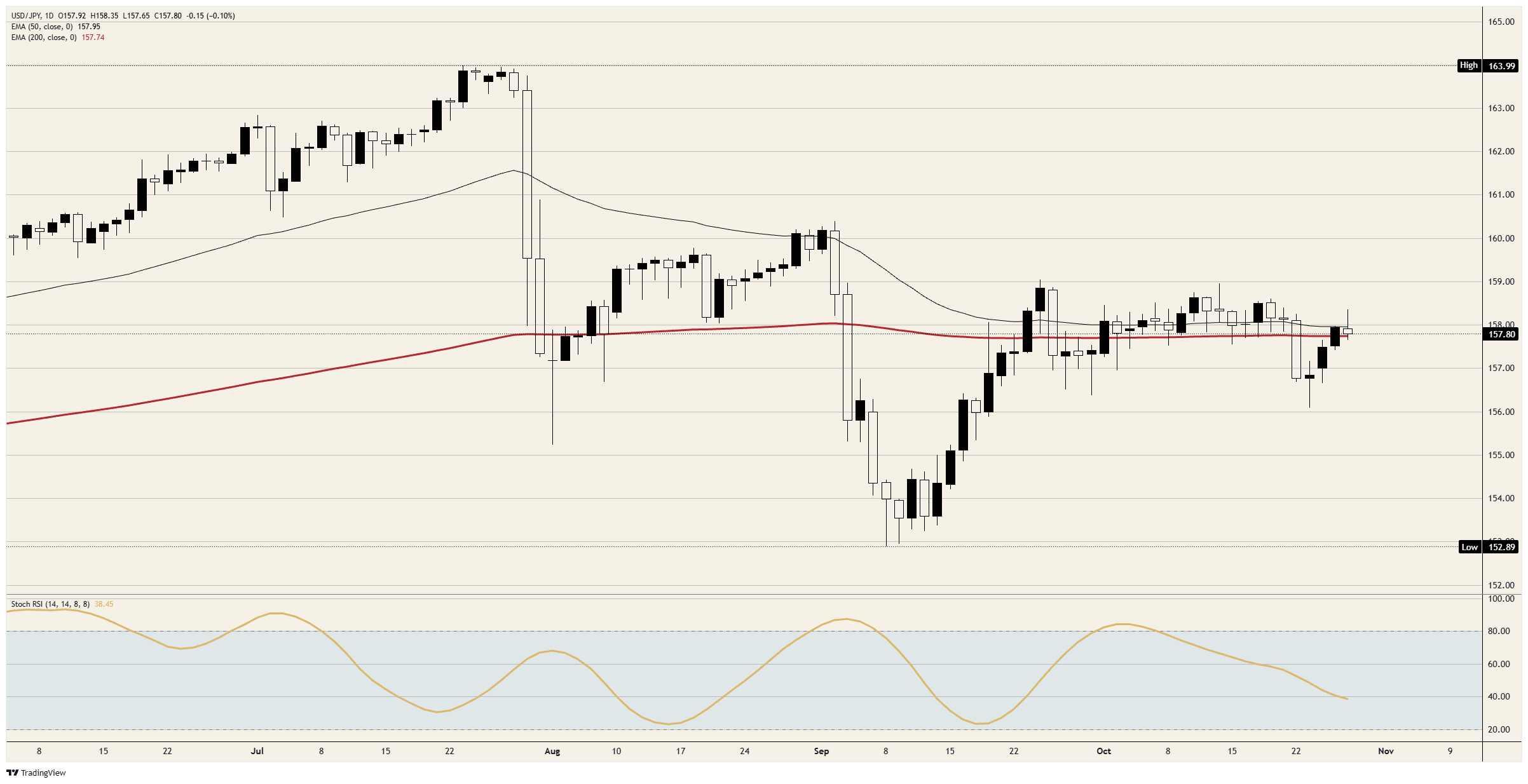
Roughly a fifth of a yen separates the 50-day and 200-day Exponential Moving Averages (EMA), with USD/JPY currently between the two. The trading range since October 1 stretches from slightly above 156.00 to slightly below 159.00. Its lower boundary is the October 23 low.
USD/JPY: daily price chart
Japanese Yen: key questions
Among the world's most actively traded currencies, the Japanese Yen (JPY) broadly reflects Japan's economic performance. More specific influences include Bank of Japan policy, the gap between Japanese and US bond yields, and traders' appetite for risk, alongside other factors.
Currency control forms part of the Bank of Japan's mandate, making its actions important for the Yen. Direct intervention in currency markets has occurred on occasion, usually to weaken the currency. Such action remains infrequent, however, because of political concerns among Japan's principal trading partners. Between 2013 and 2024, the BoJ's ultra-loose monetary policy drove Yen depreciation against its major peers as its policy increasingly diverged from that of other leading central banks. The more recent, gradual withdrawal of this ultra-loose stance has provided some support for the Yen.
By maintaining ultra-loose monetary policy over the past decade, the BoJ widened its policy divergence with other central banks, especially the US Federal Reserve. The resulting widening in the yield differential between 10-year US and Japanese bonds favoured the US Dollar over the Japanese Yen. That gap is now narrowing as other major central banks cut interest rates and the BoJ follows through on its 2024 decision to move gradually away from ultra-loose policy.
During periods of market stress, investors are more inclined to allocate funds to the Japanese Yen, reflecting its widely perceived safe-haven status and supposed reliability and stability. Turbulence is therefore likely to lift the Yen against currencies regarded as riskier investments.
POPULAR ARTICLES
1BoC rate hike lifts Canadian Dollar as attention turns to US PCE data21.3300 holds as British Pound weakens on renewed USD demand ahead of key US data36.7147: PBOC fixes USD/CNY reference rate against 6.7165 previously4Stronger US Dollar and safe-haven outflows weigh on Japanese Yen5$101.00 surpassed as Middle East supply risks lift WTI6Tokyo CPI and BoJ decision: Yen’s central bank week draws to a close7New Zealand Dollar awaits US data after both central banks hold rates8Near $4,050: Gold retreats after Fed holds rates as markets await US PCE data90.7050: Australian Dollar stays above level as hot CPI strengthens RBA rate hike bets
LIVE QUOTES


Get Started!
Sign up and access the Global Markets in less than 3 minutes

Connect With Us









Contacts
Phone: +61 2 8036 8388
Fax: +61 2 8036 8388
Email: support@tmgm.com



The information provided on this website is of a general nature only and does not constitute personal financial advice. Before acting on any information on this website, you should consider the suitability of the information in relation to your objectives, financial situation and needs. Investing in CFDs and FX Margin Contracts carries significant risks and is not suitable for all investors. You may lose more than your initial deposit. You do not own, or have, any interest in the underlying asset. We recommend that you seek independent advice and ensure you fully understand the risks involved before trading. It is important that you read and consider the disclosure document before you acquire any product listed on the website. The information and advertisements offered on this website are not intended for use by any person in any country or jurisdiction where such use would be contrary to local laws and regulations. The Products and Services offered on this website are not intended for residents of the United States, Malaysia and Thailand.
TMGM is authorized and regulated in various jurisdictions.
Trademax Australia Limited, trading as TMGM, is regulated by the Australian Securities and Investments Commission (ASIC), AFSL no. 436416 and is located at Level 28, One International Tower, 100 Barangaroo Avenue, 2000 Sydney, NSW Australia.
Email: support@tmgm.com.au
Trademax Global Limited, trading as TMGM, is authorized and regulated by the Vanuatu Financial Services Commission (VFSC), registration number 40356 and registered at 1276, Kumul Highway, Port Vila, Vanuatu, Republic of Vanuatu.
Email: support@tmgm.com
Trademax Global Markets (SE) Limited, trading as TMGM, is authorized and regulated by the Financial Services Authority (FSA) of Seychelles, with license number SD224. The company is registered at Office No 13, Providence Estate ABIS Centre, Mahe, Seychelles.
Email: support@tmgm.com
Trademax Global Markets (International) Pty Ltd, trading as TMGM, is authorized and regulated by the Financial Services Commission, Mauritius (FSC) with license no. GB22201012, and registered at 33, Edith Cavell Street C/o IQ EQ Fund Services (Mauritius) Ltd Port Louis, 11324 Mauritius.
Email: support@tmgm.com
Copyright © TMGM. All rights reserved