

Trading
Explore a wide range of markets with competitive pricing, deep liquidity, and advanced trading tools.
Learn More 
Platform
Trade seamlessly with TMGM's powerful platform, built for speed, precision, and a superior trading experience.
Learn More Trading Platform
Academy
Learn the fundamentals of trading with beginner-friendly resources, including guides, webinars, and market insights.
Learn More News & Analysis
Get real-time market updates and expert analysis to stay ahead of trading opportunities
Learn More News & Analysis
About
Learn what sets TMGM apart — our global presence, regulatory strength, and commitment to innovation in trading.
Learn More Why Choose TMGM
Sponsorship
USD/CAD Price Forecast: Pair Shows Strength Ahead of US and Canadian Jobs Data
- 1.4073 is in sight as USD/CAD surges. October employment figures from the US and Canada are next in focus.
- A worldwide sell-off in AI infrastructure shares drives US Dollar outperformance.
- October is expected to have brought an additional 13.6K workers into Canada's workforce.
USD/CAD gains 0.45% to around 1.4073. The Canadian Dollar (CAD) is under heavy selling pressure against the US Dollar (USD) during Friday's European session.
US Dollar outperformance is lifting the pair ahead of October Nonfarm Payrolls (NFP) figures from the United States (US). The release is scheduled for 13:30 GMT.

A global sell-off in Artificial Intelligence (AI) stocks is bolstering safe-haven demand for the US Dollar. At the time of writing, the US Dollar Index (DXY) stands near 101.95, up 0.35%. The index measures the Greenback against six major currencies.
US Dollar: Today's Currency Performance
The New Zealand Dollar recorded the largest loss against the US Dollar today. The table below sets out the US Dollar's (USD) percentage moves against the major currencies listed.
| USD | EUR | GBP | JPY | CAD | AUD | NZD | CHF | |
|---|---|---|---|---|---|---|---|---|
| USD | 0.38% | 0.43% | 0.24% | 0.42% | 0.78% | 0.91% | 0.18% | |
| EUR | -0.38% | 0.05% | -0.14% | 0.06% | 0.40% | 0.53% | -0.20% | |
| GBP | -0.43% | -0.05% | -0.19% | 0.00% | 0.35% | 0.48% | -0.25% | |
| JPY | -0.24% | 0.14% | 0.19% | 0.19% | 0.54% | 0.67% | -0.06% | |
| CAD | -0.42% | -0.06% | -0.00% | -0.19% | 0.35% | 0.47% | -0.25% | |
| AUD | -0.78% | -0.40% | -0.35% | -0.54% | -0.35% | 0.13% | -0.59% | |
| NZD | -0.91% | -0.53% | -0.48% | -0.67% | -0.47% | -0.13% | -0.71% | |
| CHF | -0.18% | 0.20% | 0.25% | 0.06% | 0.25% | 0.59% | 0.71% |
Percentage moves between the major currencies appear in the heat map. Select the base currency in the left-hand column and the quote currency in the top row. To read USD (base)/JPY (quote), for example, start at the US Dollar on the left and follow its row across to the Japanese Yen. The intersecting cell gives the percentage change for that pair.
40k US jobs forecast: TD highlights upside risks
Soft US nonfarm payroll growth is likely to persist in October, according to TD Securities. Its economists forecast headline gains of “40k after job gains moderated to 29k in September.” The bank adds that “despite the subdued, below-consensus print, our forecast would be within the range of breakeven job gains and result in an increase in the three-month moving average.” Nevertheless, TD cautions that “risks to our payrolls forecast are to the upside,” indicating that the result could surpass its baseline projection.
Due at the same time as US NFP, Canada's October labour market figures are also on investors' radar.
Following the dismissal of 68.3K employees in September, Canadian employers are forecast to have added 13.6K workers. The Unemployment Rate is expected to remain unchanged at 6.5%.
1.4071: USD/CAD Technical Outlook
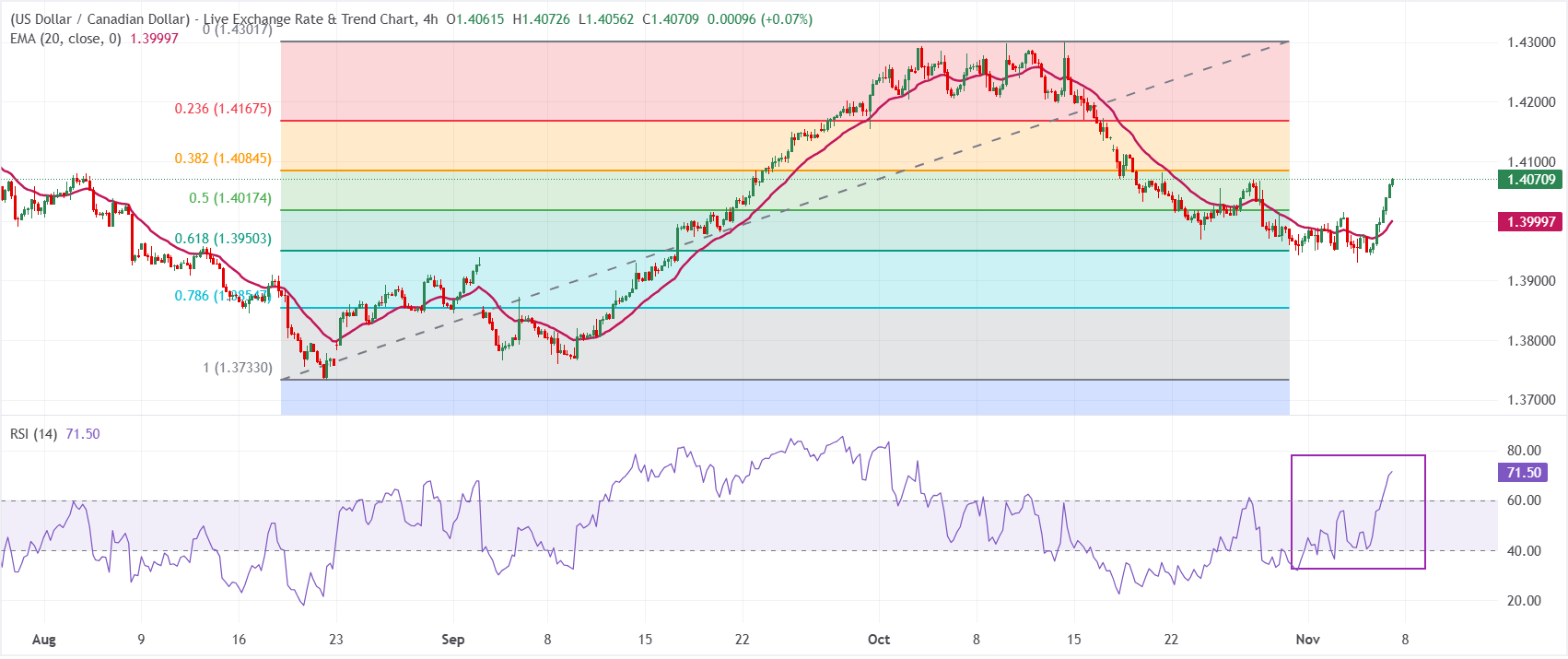
At 1.4071 on the four-hour chart, USD/CAD retains a bullish short-term outlook. Price remains above both the 20-period exponential moving average (EMA), at 1.4000, and the key Fibonacci retracement levels of 1.4017 (50.0%) and 1.3950 (61.8%). The Relative Strength Index (14), however, has entered overbought territory around 71.6. This suggests the latest rally may be overstretched, although the wider technical structure continues to favour support on pullbacks.
The first upside hurdle is 1.4084, the 38.2% Fibonacci retracement. If bullish momentum continues, the next barriers lie at the 23.6% level of 1.4167 and the recent upper Fibonacci anchor near 1.4302. Initial downside support sits at 1.4017, the 50.0% retracement, just ahead of the 20-period EMA at 1.4000. A larger retreat would bring the 61.8% retracement at 1.3950 into view. Further below, the Fibonacci base at 1.3733 provides a more distant structural floor.
(The technical analysis of this story was written with the help of an AI tool. Know more.)
Economic Data Indicator
Employment: Net Change
Statistics Canada's Net Change in Employment tracks changes in the number of people employed in Canada. An increase generally points to economic growth and is positive for consumer spending. A strong reading is therefore regarded as bullish for the Canadian Dollar (CAD), whereas a weak figure is considered bearish.
Find out more.Upcoming release: Fri 06 Nov 2026 13:30
Release frequency: Monthly
Market consensus: 13.6K
Prior reading: -68.3K
Data source: Statistics Canada
Employment Change carries the greatest weight among Canada’s labour market indicators. These statistics typically have a substantial influence on the Canadian dollar. Employment levels are closely correlated with consumption, which affects inflation and the Bank of Canada’s interest rate decisions, ultimately moving the C$. Readings above consensus generally support CAD, while currency markets usually respond to the release in a steady, consistent manner.
POPULAR ARTICLES
1Bitcoin and crypto regulation: implications of a Democratic Congress2US midterms: Why wins for Democrats in House and Senate aren’t all bad for crypto3Eurozone Retail Sales (YoY) below expectations (0.6%) in September: Actual (0.4%)4Eurozone Retail Sales (MoM) registered at -0.7%, below expectations (-0.1%) in September5ECB's Lane: Wage negotiations to reflect energy inflation6Fed's Williams: Now is an appropriate time to gather further information7Czech Koruna: CZK stays under pressure as CNB tightening remains limited - Commerzbank86.5%: Canada’s Unemployment Rate Expected to Hold as Hiring Rebounds9NFP in focus as Japanese Yen pares gains amid risk-off trading

Get Started!
Sign up and access the Global Markets in less than 3 minutes

Connect With Us









Contacts
Phone: +61 2 8036 8388
Fax: +61 2 8036 8388
Email: support@tmgm.com



The information provided on this website is of a general nature only and does not constitute personal financial advice. Before acting on any information on this website, you should consider the suitability of the information in relation to your objectives, financial situation and needs. Investing in CFDs and FX Margin Contracts carries significant risks and is not suitable for all investors. You may lose more than your initial deposit. You do not own, or have, any interest in the underlying asset. We recommend that you seek independent advice and ensure you fully understand the risks involved before trading. It is important that you read and consider the disclosure document before you acquire any product listed on the website. The information and advertisements offered on this website are not intended for use by any person in any country or jurisdiction where such use would be contrary to local laws and regulations. The Products and Services offered on this website are not intended for residents of the United States, Malaysia and Thailand.
TMGM is authorized and regulated in various jurisdictions.
Trademax Australia Limited, trading as TMGM, is regulated by the Australian Securities and Investments Commission (ASIC), AFSL no. 436416 and is located at Level 28, One International Tower, 100 Barangaroo Avenue, 2000 Sydney, NSW Australia.
Email: support@tmgm.com.au
Trademax Global Limited, trading as TMGM, is authorized and regulated by the Vanuatu Financial Services Commission (VFSC), registration number 40356 and registered at 1276, Kumul Highway, Port Vila, Vanuatu, Republic of Vanuatu.
Email: support@tmgm.com
Trademax Global Markets (SE) Limited, trading as TMGM, is authorized and regulated by the Financial Services Authority (FSA) of Seychelles, with license number SD224. The company is registered at Office No 13, Providence Estate ABIS Centre, Mahe, Seychelles.
Email: support@tmgm.com
Trademax Global Markets (International) Pty Ltd, trading as TMGM, is authorized and regulated by the Financial Services Commission, Mauritius (FSC) with license no. GB22201012, and registered at 33, Edith Cavell Street C/o IQ EQ Fund Services (Mauritius) Ltd Port Louis, 11324 Mauritius.
Email: support@tmgm.com
Copyright © TMGM. All rights reserved