

Trading
Explore a wide range of markets with competitive pricing, deep liquidity, and advanced trading tools.
Learn More 
Platform
Trade seamlessly with TMGM's powerful platform, built for speed, precision, and a superior trading experience.
Learn More Trading Platform
Academy
Learn the fundamentals of trading with beginner-friendly resources, including guides, webinars, and market insights.
Learn More News & Analysis
Get real-time market updates and expert analysis to stay ahead of trading opportunities
Learn More News & Analysis
About
Learn what sets TMGM apart — our global presence, regulatory strength, and commitment to innovation in trading.
Learn More Why Choose TMGM
Sponsorship
Seven-Week Consolidation: USD/JPY Price Forecast Looks for a Breakout
- 159.00 in focus as USD/JPY retains the previous day’s losses amid US Dollar outperformance.
- A larger December interest rate increase by the Fed is also emerging as a market expectation.
- Thursday’s release of Japan’s October PPI data is the next focus for investors.
USD/JPY hovers around 159.00 on Wednesday. The pair is near its highest level in almost seven weeks as the Japanese Yen (JPY) remains weak against the US Dollar (USD). Driving the pair’s strength is US Dollar outperformance, fuelled by concerns that the Federal Reserve (Fed) could opt for a larger interest rate increase at its December meeting.

At the time of writing, a 0.1% gain puts the US Dollar Index (DXY) near 102.32. The index measures the Greenback against six major currencies.
With United States (US) inflationary pressures accelerating in October, financial markets have begun pricing in a 50 basis points (bps) interest rate increase by the Fed at its December meeting.
US inflation overshoot complicates Fed policy outlook
A fresh setback for the disinflation narrative is evident in the latest data, according to economists at Rabobank. They note that “yesterday’s US CPI print came in hotter than expected at 0.4% m-o-m headline vs. a consensus of 0.3% and 0.3% core vs. a 0.2% market view,” highlighting the renewed challenge.
To underline that concern, Rabobank cites the “usually dovish Fed voter Goolsbee, ‘it’s another distressing report, borderline disturbing. We’ve been hoping to get progress.’” Rather than a further easing of price pressures, the bank identifies “an acceleration in grocery and food inflation, persistent housing/shelter price pressure, and a delayed pass-through from earlier energy shocks feeding into medical care, household furnishings, and other daily expenses,” reinforcing worries that underlying inflation remains firmly entrenched.
Japan’s October Producer Price Index (PPI), due on Thursday, is the focus in Tokyo. Producer prices are estimated to have risen 0.3% month-on-month (MoM), reversing a decline of the same size in September.
USD/JPY technical outlook: 158.88 near range high
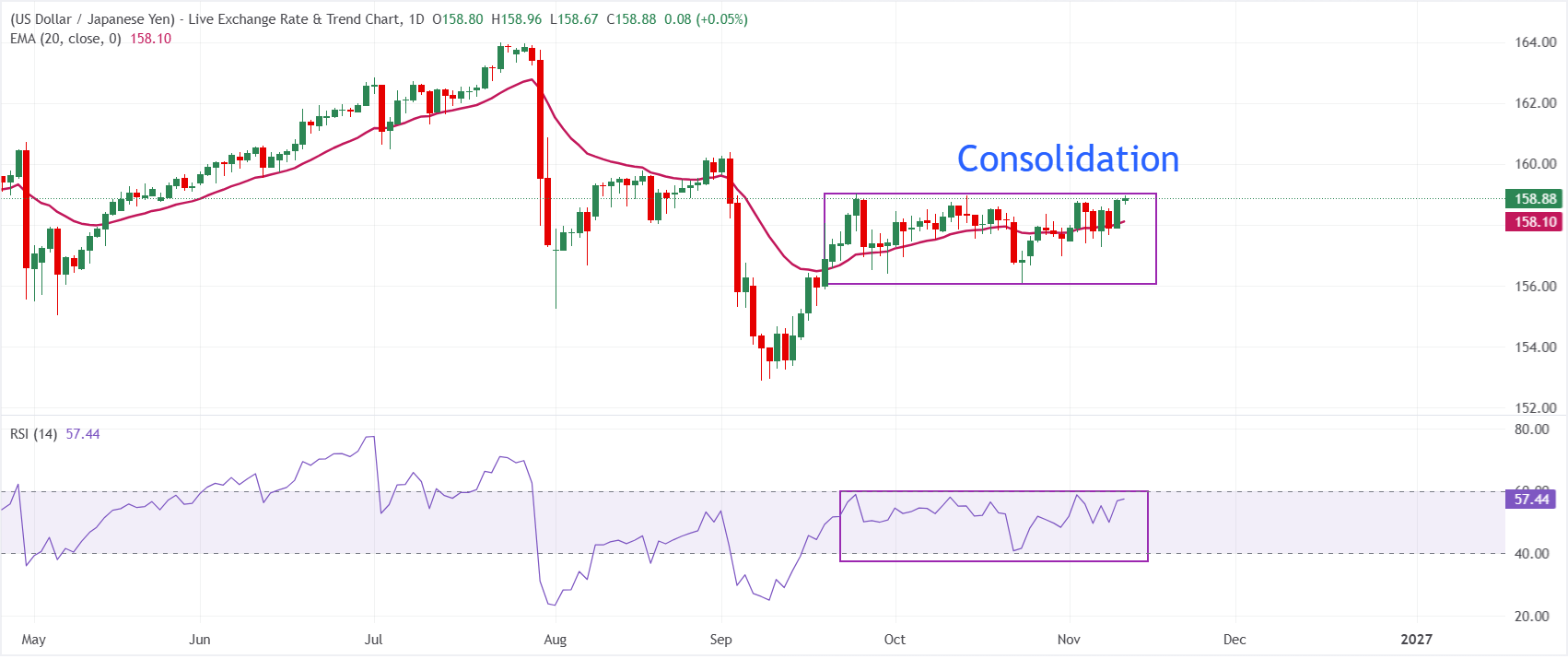
At 158.88 on the daily chart, USD/JPY sits near the top of a consolidation range that has lasted almost seven weeks. A position above the 20-day Exponential Moving Average (EMA), currently at 158.10, keeps the near-term outlook bullish. As the pair pulls further away from this dynamic support, the Relative Strength Index (RSI) is rising in positive territory at 57.38. This suggests buyers remain in control, without signs that the market is yet overstretched.
The 20-day EMA at 158.10 provides the first downside support. A daily close below it would signal fading upward pressure and the prospect of a deeper correction towards the range’s lower boundary near 156.00. Conversely, a decisive break above 159.00 would open a new upward leg, with 160.00 and September’s high of 160.39 marking key resistance.
(The technical analysis of this story was written with the help of an AI tool. Know more.)
Fed: key questions answered
Responsibility for US monetary policy rests with the Federal Reserve (Fed). Price stability and full employment form its dual mandate, with interest rate adjustments serving as the main means of pursuing those objectives. If prices climb too rapidly and inflation exceeds the Fed’s 2% target, the central bank increases rates. Higher borrowing costs across the economy make the US more attractive to international investors seeking to place funds, strengthening the US Dollar (USD). By contrast, inflation below 2% or an excessively high unemployment rate may prompt the Fed to cut rates to stimulate borrowing. This puts pressure on the Greenback.
Eight times a year, the Federal Reserve (Fed) convenes policy meetings at which the Federal Open Market Committee (FOMC) reviews economic conditions and determines monetary policy. Twelve Fed officials attend the FOMC: all seven Board of Governors members, the president of the Federal Reserve Bank of New York and four presidents drawn from the other eleven regional Reserve Banks. These four serve rotating one-year terms.
When conditions become extreme, Quantitative Easing (QE) is one policy the Federal Reserve may adopt. It substantially expands the flow of credit through a financial system that has stalled. As an unconventional policy tool, QE is deployed during crises or periods of exceptionally low inflation. During the Great Financial Crisis in 2008, it was the Fed’s preferred response. The process involves creating more Dollars and purchasing high-grade bonds from financial institutions with them. The US Dollar typically weakens under QE.
By reversing QE, quantitative tightening (QT) typically supports the US Dollar’s value. Under QT, the Federal Reserve ceases bond purchases from financial institutions. It also allows its existing bonds to mature without reinvesting the principal in new bonds.
POPULAR ARTICLES
1$4,000: Gold edges below as elevated US yields lift odds of a December Fed hike2Forex Today: UK hard data and Fedspeak take centre stage3Nearly 1% fall for Swiss Franc as US Dollar sets new yearly high4DXY sets new yearly high after bullish flag breakout: US Dollar Index price outlook5New Zealand Dollar slides as Fed hawks reassert control6PUMP Advances Despite Muted Retail Demand: Pump.fun Price Forecast7Above $52: Silver gains despite rising US yields and Fed rate-hike bets8Below 1.33: British Pound slumps after hot US CPI and hawkish Fed rhetoric9March lows in focus as Australian Dollar retreats on diverging Fed and RBA outlooks


Get Started!
Sign up and access the Global Markets in less than 3 minutes

Connect With Us









Contacts
Phone: +61 2 8036 8388
Fax: +61 2 8036 8388
Email: support@tmgm.com



The information provided on this website is of a general nature only and does not constitute personal financial advice. Before acting on any information on this website, you should consider the suitability of the information in relation to your objectives, financial situation and needs. Investing in CFDs and FX Margin Contracts carries significant risks and is not suitable for all investors. You may lose more than your initial deposit. You do not own, or have, any interest in the underlying asset. We recommend that you seek independent advice and ensure you fully understand the risks involved before trading. It is important that you read and consider the disclosure document before you acquire any product listed on the website. The information and advertisements offered on this website are not intended for use by any person in any country or jurisdiction where such use would be contrary to local laws and regulations. The Products and Services offered on this website are not intended for residents of the United States, Malaysia and Thailand.
TMGM is authorized and regulated in various jurisdictions.
Trademax Australia Limited, trading as TMGM, is regulated by the Australian Securities and Investments Commission (ASIC), AFSL no. 436416 and is located at Level 28, One International Tower, 100 Barangaroo Avenue, 2000 Sydney, NSW Australia.
Email: support@tmgm.com.au
Trademax Global Limited, trading as TMGM, is authorized and regulated by the Vanuatu Financial Services Commission (VFSC), registration number 40356 and registered at 1276, Kumul Highway, Port Vila, Vanuatu, Republic of Vanuatu.
Email: support@tmgm.com
Trademax Global Markets (SE) Limited, trading as TMGM, is authorized and regulated by the Financial Services Authority (FSA) of Seychelles, with license number SD224. The company is registered at Office No 13, Providence Estate ABIS Centre, Mahe, Seychelles.
Email: support@tmgm.com
Trademax Global Markets (International) Pty Ltd, trading as TMGM, is authorized and regulated by the Financial Services Commission, Mauritius (FSC) with license no. GB22201012, and registered at 33, Edith Cavell Street C/o IQ EQ Fund Services (Mauritius) Ltd Port Louis, 11324 Mauritius.
Email: support@tmgm.com
Copyright © TMGM. All rights reserved