

Trading
Explore a wide range of markets with competitive pricing, deep liquidity, and advanced trading tools.
Learn More 
Platform
Trade seamlessly with TMGM's powerful platform, built for speed, precision, and a superior trading experience.
Learn More Trading Platform
Academy
Learn the fundamentals of trading with beginner-friendly resources, including guides, webinars, and market insights.
Learn More News & Analysis
Get real-time market updates and expert analysis to stay ahead of trading opportunities
Learn More News & Analysis
About
Learn what sets TMGM apart — our global presence, regulatory strength, and commitment to innovation in trading.
Learn More Why Choose TMGM
Sponsorship
RBNZ monetary policy decision: What to expect
- 3% is the expected OCR level. Markets have fully priced in an RBNZ rate increase.
- 3.7% inflation in New Zealand remains high, reinforcing the case for additional tightening.
- 0.5748–0.5769 marks resistance for NZD/USD; key support stands at 0.5600.
A 25 basis points increase is expected from the Reserve Bank of New Zealand (RBNZ). Led by Governor Anna Breman, the bank is due to announce its decision on Wednesday, 28 October at 01:00 GMT. The anticipated move would lift the Overnight Cash Rate (OCR) from 2.75% to 3%, with money markets assigning it a 100% probability.

100% hike probability puts RBNZ guidance in focus
The expected increase would mark the RBNZ’s third rate rise. Markets also assign a nearly 50% probability to a further increase in December.
At its September meeting, the Committee unanimously agreed to raise the OCR and withdraw monetary stimulus. Its aim was to bring inflation towards the 2% target while supporting economic growth and the labour market. The decision sought to limit the risk of more aggressive rate changes later, without prejudging future OCR adjustments.
Another increase would move the OCR nearer to the RBNZ’s neutral range. Speaking at the press conference after the decision, Governor Breman said the committee was taking rates towards neutral while keeping policy accommodative.
Breman also indicated that a further OCR increase was likely. The impact of the rate rises already delivered would be assessed, she added.
Taken together, these signals point to a central bank inclined to raise rates further, although the timing is still unclear.
The latest figures indicate room for additional rate rises. New Zealand’s Q2 GDP growth reached 2.6% YoY, exceeding the 2.3% forecast. Q3 CPI inflation, meanwhile, eased to 3.7% YoY, below expectations of 3.8% but still above the RBNZ’s 2% inflation target.
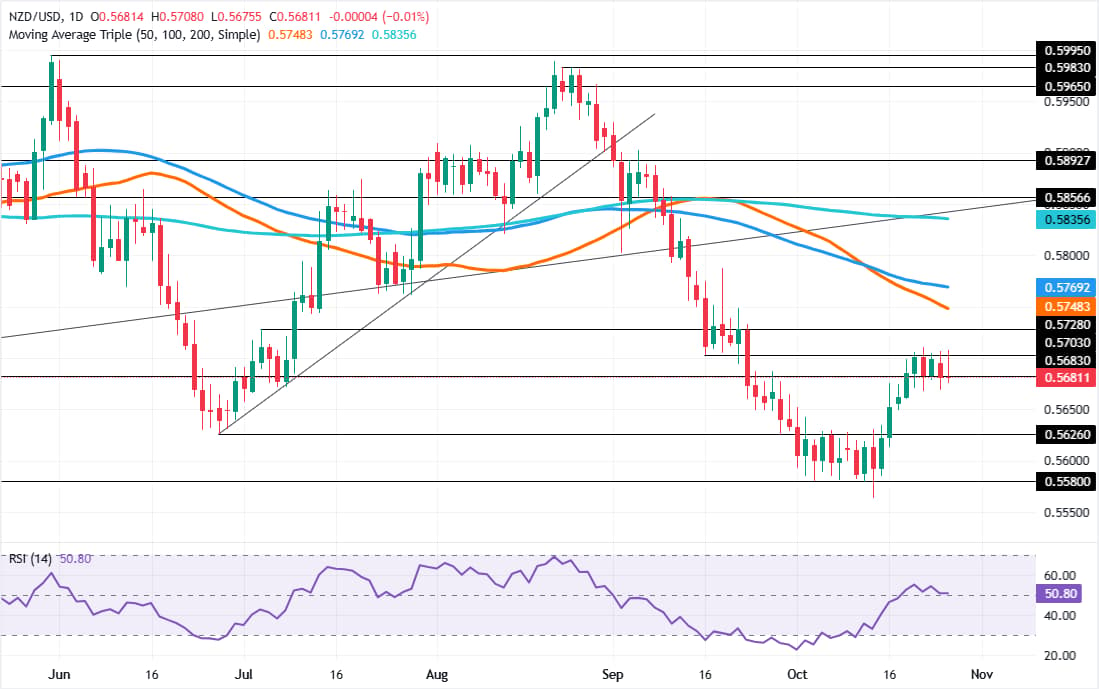
0.5748–0.5769 resistance frames the NZD/USD outlook
Near the lower end of its 0.5675-0.5708 daily range, NZD/USD is awaiting the combined impact of two policy decisions. Traders are watching the Federal Reserve’s announcement as well as the RBNZ’s.
A hawkish RBNZ stance could lift the pair towards the confluence of its 50-day and 100-day Simple Moving Averages (SMAs), at 0.5748 and 0.5769 respectively. A break above that zone would make a further advance towards 0.5800 likely.
A dovish RBNZ signal, by contrast, could bring 0.5650 and the psychologically significant 0.5600 level into view. Traders are defending 0.5600 after the pair spent at least 14 days trading on either side of it. Further losses would expose the year-to-date (YTD) low at 0.5564.
RBNZ: key questions answered
New Zealand’s central bank is the Reserve Bank of New Zealand (RBNZ). Its economic remit combines achieving and maintaining price stability with supporting maximum sustainable employment. Price stability is achieved when inflation, as measured by the Consumer Price Index (CPI), stays within a 1% to 3% range.
To meet its objectives, the Reserve Bank of New Zealand’s (RBNZ) Monetary Policy Committee (MPC) sets the appropriate Official Cash Rate (OCR). Above-target inflation prompts the bank to try to curb price pressures by increasing the OCR. This raises borrowing costs for households and businesses, slowing economic activity. Higher rates generally support the New Zealand Dollar (NZD): the resulting increase in yields makes New Zealand more attractive to investors. Rate cuts, conversely, tend to weigh on NZD.
A tight labour market can add to inflation, making employment a key consideration for the Reserve Bank of New Zealand (RBNZ). The bank defines its objective of “maximum sustainable employment” as the greatest use of labour resources that can be maintained over time without accelerating inflation. The bank explains: “When employment is at its maximum sustainable level, there will be low and stable inflation. However, if employment is above the maximum sustainable level for too long, it will eventually cause prices to rise more and more quickly, requiring the MPC to raise interest rates to keep inflation under control,”
When conditions become extreme, the Reserve Bank of New Zealand (RBNZ) can turn to Quantitative Easing as a monetary policy tool. Under QE, the bank prints local currency to purchase assets from banks and other financial institutions, typically government or corporate bonds. These purchases aim to expand the domestic money supply and stimulate economic activity. The New Zealand Dollar (NZD) usually weakens as a result. QE serves as a last resort when interest rate cuts alone are unlikely to meet the central bank’s objectives. The RBNZ deployed it during the Covid-19 pandemic.
POPULAR ARTICLES
1Thai Baht: Weakness against US dollar driven by trade deficit – MUFG2Singapore Dollar: Softer data keep range trading intact – Commerzbank3Anthropic IPO: K33 highlights Bitcoin’s exposure to AI sell-off risk4RBNZ monetary policy decision: What to expect54.2%: Australia’s CPI Expected to Rise in September6Thai Baht: BoT in focus amid double-top risk against US Dollar – OCBC718.60 reclaimed by USD/MXN as carry trade unwinding weighs on Mexican Peso8New Zealand Dollar: Long offers best risk-reward ahead of RBNZ – Societe Generale92027: Vietnam’s Growth Set to Stay Strong – Standard Chartered
LIVE QUOTES


Get Started!
Sign up and access the Global Markets in less than 3 minutes

Connect With Us









Contacts
Phone: +61 2 8036 8388
Fax: +61 2 8036 8388
Email: support@tmgm.com



The information provided on this website is of a general nature only and does not constitute personal financial advice. Before acting on any information on this website, you should consider the suitability of the information in relation to your objectives, financial situation and needs. Investing in CFDs and FX Margin Contracts carries significant risks and is not suitable for all investors. You may lose more than your initial deposit. You do not own, or have, any interest in the underlying asset. We recommend that you seek independent advice and ensure you fully understand the risks involved before trading. It is important that you read and consider the disclosure document before you acquire any product listed on the website. The information and advertisements offered on this website are not intended for use by any person in any country or jurisdiction where such use would be contrary to local laws and regulations. The Products and Services offered on this website are not intended for residents of the United States, Malaysia and Thailand.
TMGM is authorized and regulated in various jurisdictions.
Trademax Australia Limited, trading as TMGM, is regulated by the Australian Securities and Investments Commission (ASIC), AFSL no. 436416 and is located at Level 28, One International Tower, 100 Barangaroo Avenue, 2000 Sydney, NSW Australia.
Email: support@tmgm.com.au
Trademax Global Limited, trading as TMGM, is authorized and regulated by the Vanuatu Financial Services Commission (VFSC), registration number 40356 and registered at 1276, Kumul Highway, Port Vila, Vanuatu, Republic of Vanuatu.
Email: support@tmgm.com
Trademax Global Markets (SE) Limited, trading as TMGM, is authorized and regulated by the Financial Services Authority (FSA) of Seychelles, with license number SD224. The company is registered at Office No 13, Providence Estate ABIS Centre, Mahe, Seychelles.
Email: support@tmgm.com
Trademax Global Markets (International) Pty Ltd, trading as TMGM, is authorized and regulated by the Financial Services Commission, Mauritius (FSC) with license no. GB22201012, and registered at 33, Edith Cavell Street C/o IQ EQ Fund Services (Mauritius) Ltd Port Louis, 11324 Mauritius.
Email: support@tmgm.com
Copyright © TMGM. All rights reserved